just now


Liquidity Finder Ltd is incorporated in England and Wales, company number 10610740, registered address 167-169 Great Portland Street, Fifth Floor, London W1W 5PF, United Kingdom.
Published: just now

The Reserve Bank of Australia (RBA) has once again tightened monetary policy, raising the cash rate by 25 basis points to 4.35%. While the move was widely expected by markets, the tone and underlying economic signals have shifted significantly. The decision was notably more decisive than previous meetings, with eight out of nine board members voting in favor of the hike.
The cash rate is the interest rate that banks charge each other for overnight loans. It acts as the backbone of the financial system, influencing borrowing costs, mortgage rates, and overall economic activity. When the RBA raises rates, it aims to slow inflation by reducing spending and investment.
Markets had already priced in this rate hike, meaning the Australian dollar (AUD) saw little support from the announcement itself. Instead, investors shifted their focus toward future policy direction and economic forecasts—where the real story lies.
The most critical development in the RBA’s latest update is the sharp downgrade in economic growth projections. This shift is central to understanding why the AUD is weakening despite higher interest rates.
The RBA cut its GDP growth forecast for 2026 by 0.5 percentage points to just 1.3%. This is a substantial downgrade and signals that economic momentum is slowing more rapidly than previously expected.
A growth rate of 1.3% is considered below trend, indicating a sluggish economy that may struggle to generate strong employment and income growth.
Slower growth has ripple effects across the economy:
This combination creates a challenging environment where monetary tightening has a more pronounced negative effect.
While growth forecasts were significantly downgraded, inflation projections saw only minor adjustments.
The trimmed mean CPI forecast was raised by just 0.1 percentage points to 3.8% for mid-2026. This modest increase suggests that inflation pressures are not accelerating dramatically.
Key reasons include:
The RBA expects inflation to peak around mid-2026 and gradually return to target levels by mid-2028. This extended timeline reinforces the idea that inflation is sticky—but not spiraling out of control.
Another important factor influencing the bearish AUD outlook is the labor market.
The unemployment rate is now projected to rise to 4.6% by the end of 2027. While this increase may seem small, it signals a gradual cooling in labor demand.
A rising unemployment rate typically indicates:
The RBA has indicated that the current cash rate is within—but near the upper bound of—the neutral range.
A restrictive policy stance means interest rates are high enough to slow economic activity. This is a critical turning point because it suggests:
At first glance, higher interest rates should support a currency. However, the AUD is weakening—and for good reason.
Currency values are heavily influenced by interest rate differentials. If other central banks—particularly the Federal Reserve—maintain higher or more persistent rates, the AUD loses its relative appeal.
Investors seek the highest returns. If U.S. yields remain elevated:
This dynamic explains why the AUD remains under pressure despite domestic rate hikes.
Markets are increasingly interpreting the RBA’s tone as signaling a potential pause in rate hikes.
While forecasts still suggest a peak cash rate of 4.7% by the end of 2026, the central bank’s cautious language indicates flexibility.
Unless inflation surprises to the upside, the RBA is likely to:
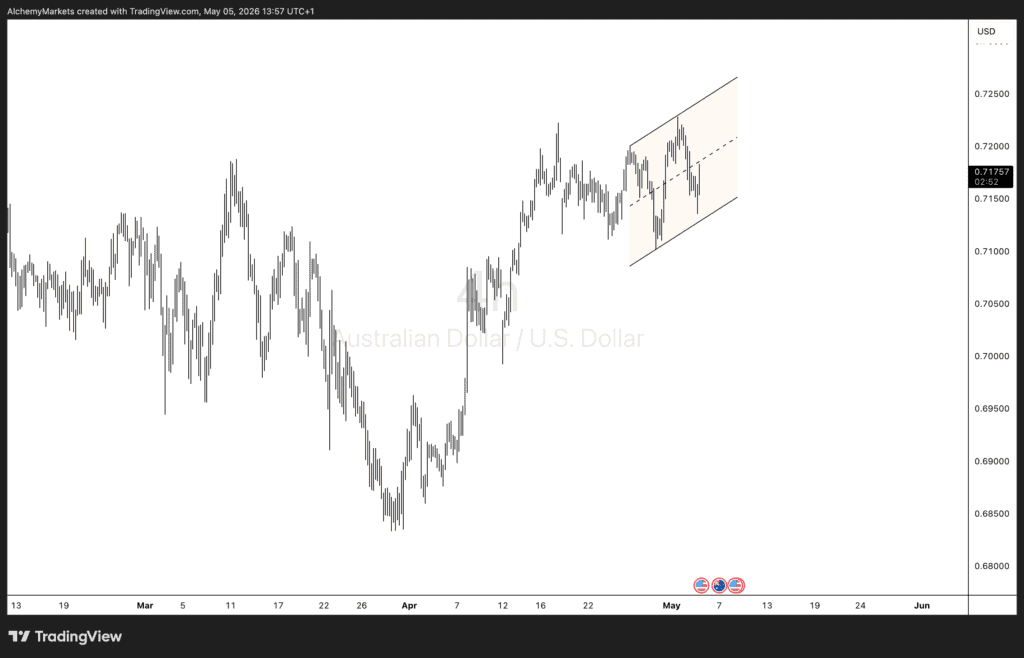
The chart shows AUD/USD trading within an upward-sloping channel but struggling to maintain momentum near resistance levels.
A break below support could accelerate downside momentum, especially if macro fundamentals continue to weaken.
If inflation rises faster than expected:
If growth deteriorates further:
Traders should consider:
Short-term rallies in AUD may present selling opportunities if fundamentals remain weak.
The combination of high rates and weak growth affects multiple sectors:
Compared to other central banks, the RBA appears more cautious. While some economies remain resilient, Australia’s growth slowdown stands out, contributing to currency weakness.
The RBA is still focused on controlling inflation, even as growth weakens. Balancing these two objectives is challenging.
Because markets focus on future expectations. Slowing growth and limited further hikes reduce currency appeal.
It’s the rate that neither stimulates nor restricts the economy. The RBA believes current rates are near the upper end of this range.
Possibly, but only if inflation rises more than expected. Otherwise, a pause is likely.
Higher U.S. rates attract capital, strengthening USD and weakening AUD.
Not guaranteed, but risks are increasing due to slowing growth and rising unemployment.
The RBA’s latest rate hike confirms its commitment to fighting inflation, but the broader economic picture tells a more complex story. Growth is slowing significantly, while inflation is only rising modestly. This imbalance is shifting market expectations and weighing heavily on the Australian dollar.
In essence, the rate hike itself is no longer the main driver of currency movement. Instead, it’s the outlook—marked by weaker growth, cautious policy signals, and global rate differentials—that is shaping the bearish trajectory of the AUD.
Alchemy Markets is a multi-asset brokerage providing retail traders with the same elite trading conditions, tools, and transparency typically reserved for institutions.

Select the categories and companies you wish to follow directly to your person rss feed.
Create Custom RSS FeedSign up and join over 5,000 professional members who receive personalized news alerts, curated professional connections, and more for free!
Multi-asset trading broker AvaTrade has agreed to acquire the majority of FXCM Group’s business and brand, in a transaction that would bring a longstanding retail FX franchise into the AvaTrade Group.
LSEG and CMC Markets have signed a multi-year strategic data agreement expanding CMC's access to LSEG's real-time and delayed pricing, reference and corporate actions data, news and analytics, plus AI-ready content, to support new products, entry into new markets and the growth of CMC's institutional and B2B partnerships.
The Tel Aviv Stock Exchange is considering a bid for the Cyprus Stock Exchange, with Israeli media citing its EU licence, trading platform and clearing house. Euronext’s Athens exchange and India’s National Stock Exchange are also seen as contenders, and Cyprus aims to sign a sale agreement by the end of this year.
CME Group will launch baseball futures on 12 October, pending regulatory review, tracking CME FutureSports Performance Indexes built on Official League Data. Standard and micro contracts will start with the 2026 Postseason and the four clubs in the League Championship Series, trading around the clock.
ESMA has published an opinion stating that MiCA-authorised crypto-asset service providers should cease services tied to non-MiCA-compliant stablecoins for EU clients across MiCA crypto-asset services. National authorities should require remediation of existing exposures within three months, by early January 2027.
Nasdaq Ventures has made a strategic investment in Amsterdam-based derivatives and crypto exchange One Trading, with both firms to explore 24/7 trading of equity futures. The undisclosed investment follows Nasdaq's US$100 million investment in Payward, the parent of Kraken, and CME Group's move to 24/7 trading.
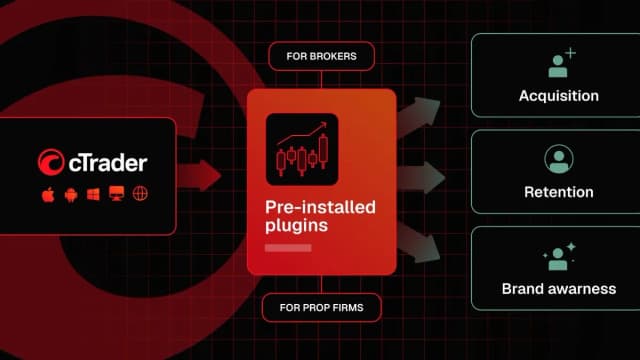
cTrader has opened multi-platform plugins to brokers and prop firms, which can pre-install their own tools for clients or list them in cTrader Store. The plugins run across Mobile, Web, Windows and Mac, and can be built and launched independently of core-platform releases, including trading journals and calculators.
Institutional brokerage and financial infrastructure provider Clear Street has joined TradingView’s broker network, allowing its clients to trade US stocks, exchange-traded funds and options directly through the charting and analysis platform.
Learn how to improve trading psychology, manage fear and greed, avoid revenge trading, and follow your trading strategy with discipline and a trading journal.
GTC Prime has announced a strategic partnership with Centroid Solutions to manage and distribute its liquidity through CS 360 Bridge, Centroid's multi-asset connectivity and execution engine, giving brokers and institutional clients access to tailor-made pricing, low-latency execution and real-time risk management.