
just now


Liquidity Finder Ltd is incorporated in England and Wales, company number 10610740, registered address 167-169 Great Portland Street, Fifth Floor, London W1W 5PF, United Kingdom.
Published: just now


The Reserve Bank of New Zealand has officially entered easing mode, cutting the Official Cash Rate (OCR) by 25 basis points to 3.25% in yesterday’s decision. Markets had fully priced in the move, but the real takeaway came from the tone of the statement, the shape of the new interest rate track, and the split vote that suggests a central bank grappling with rising inflation expectations and falling global momentum simultaneously.
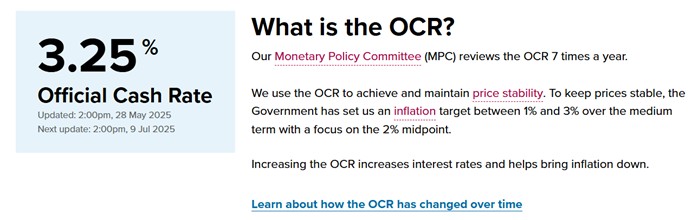
At first glance, the message looked balanced. But dig deeper and it’s clear the RBNZ is preparing for a long road ahead. The revised OCR path now dips to a low of 2.85%, softer than the previous 3.1% trough. That sends a signal: while inflation is currently sitting within the 1–3% band, the Bank is still worried about global headwinds, weak domestic demand, and the risk of a more prolonged disinflationary environment.
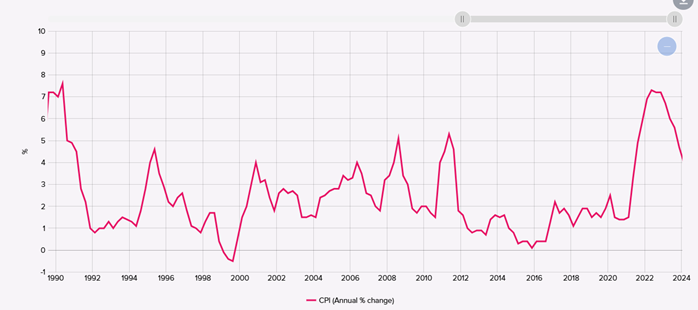
This wasn’t a unanimous decision. One committee member preferred to hold rates steady, arguing for patience in the face of recent inflation surprises. And while the market focused on the 25bp cut, what mattered more was the profile of the rate path. Rather than a fast or aggressive easing cycle, the RBNZ charted a more gradual descent more "drift" than "drop."
In other words, they want the market to know we’re easing, but we're not rushing.
This cautious tone likely stems from conflicting forces. On one hand, the domestic economy is still recovering after last year’s contraction, with spare capacity and falling wage growth pointing to softer underlying momentum. On the other hand, inflation expectations especially among households have risen. Some of that is tied to global stories: higher food prices, U.S. tariffs, and supply chain uncertainty.
It’s this global uncertainty that keeps popping up in the RBNZ's narrative. They laid out two scenarios: one where tariffs drive imported inflation higher (a supply-side shock), and another where weaker global demand hits New Zealand exports (a demand-side hit). In either case, the implications for rates could be very different. The Bank doesn’t pretend to know which scenario will win out—but they’re making sure they’re positioned to respond either way.
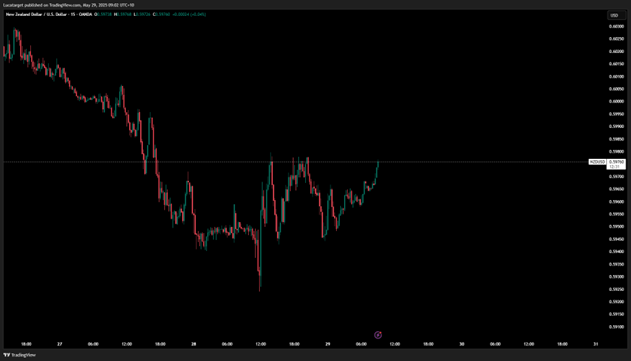
Interestingly, despite the cut, the NZD nudged higher. Part of that is technical positioning had leaned too far into dovish bets. But it also reflects how the RBNZ's easing path was gentler than some expected. The more gradual slope, plus the fact that one member voted against easing, gave markets a reason to reprice the odds of back-to-back cuts in July or August.
I’m still leaning toward further easing from here. The economic recovery is fragile, global trade uncertainty remains high, and the RBNZ’s own forecasts hint that more support may be needed to ensure inflation stays anchored. But the message is clear: they’re in no rush. Any further cuts will be conditional on the data and on whether global risks materialise or fade.
In the broader FX context, the RBNZ’s move adds to the growing divergence among major central banks. The Fed remains stuck in wait-and-see mode, with sticky inflation complicating the case for cuts. The ECB is gearing up for a likely June move, while the BoE continues to kick the can on its own tightening bias.
This divergence matters. If the RBNZ continues easing while the Fed holds firm, NZD/USD will come under fresh pressure. But if the Fed finally pivots or if global growth deteriorates rapidly those rate differentials could compress again.
The Kiwi is no longer just about dairy prices and local data. It's now sitting at the intersection of global tariffs, commodity volatility, and a central bank trying to walk a narrow path between credibility and caution.
This content may have been written by a third party. ACY makes no representation or warranty and assumes no liability as to the accuracy or completeness of the information provided, nor any loss arising from any investment based on a recommendation, forecast or other information supplies by any third-party. This content is information only, and does not constitute financial, investment or other advice on which you can rely.
ACY Securities is one of Australia's fastest growing multi-asset online trading providers, offering ultra-low-cost trading, rock-solid execution, technologically superior account management and premium market analysis.

Select the categories and companies you wish to follow directly to your person rss feed.
Create Custom RSS FeedSign up and join over 5,000 professional members who receive personalized news alerts, curated professional connections, and more for free!
Multi-asset trading broker AvaTrade has agreed to acquire the majority of FXCM Group’s business and brand, in a transaction that would bring a longstanding retail FX franchise into the AvaTrade Group.
LSEG and CMC Markets have signed a multi-year strategic data agreement expanding CMC's access to LSEG's real-time and delayed pricing, reference and corporate actions data, news and analytics, plus AI-ready content, to support new products, entry into new markets and the growth of CMC's institutional and B2B partnerships.
The Tel Aviv Stock Exchange is considering a bid for the Cyprus Stock Exchange, with Israeli media citing its EU licence, trading platform and clearing house. Euronext’s Athens exchange and India’s National Stock Exchange are also seen as contenders, and Cyprus aims to sign a sale agreement by the end of this year.
CME Group will launch baseball futures on 12 October, pending regulatory review, tracking CME FutureSports Performance Indexes built on Official League Data. Standard and micro contracts will start with the 2026 Postseason and the four clubs in the League Championship Series, trading around the clock.
ESMA has published an opinion stating that MiCA-authorised crypto-asset service providers should cease services tied to non-MiCA-compliant stablecoins for EU clients across MiCA crypto-asset services. National authorities should require remediation of existing exposures within three months, by early January 2027.
Nasdaq Ventures has made a strategic investment in Amsterdam-based derivatives and crypto exchange One Trading, with both firms to explore 24/7 trading of equity futures. The undisclosed investment follows Nasdaq's US$100 million investment in Payward, the parent of Kraken, and CME Group's move to 24/7 trading.
cTrader has opened multi-platform plugins to brokers and prop firms, which can pre-install their own tools for clients or list them in cTrader Store. The plugins run across Mobile, Web, Windows and Mac, and can be built and launched independently of core-platform releases, including trading journals and calculators.
Institutional brokerage and financial infrastructure provider Clear Street has joined TradingView’s broker network, allowing its clients to trade US stocks, exchange-traded funds and options directly through the charting and analysis platform.
Learn how to improve trading psychology, manage fear and greed, avoid revenge trading, and follow your trading strategy with discipline and a trading journal.
GTC Prime has announced a strategic partnership with Centroid Solutions to manage and distribute its liquidity through CS 360 Bridge, Centroid's multi-asset connectivity and execution engine, giving brokers and institutional clients access to tailor-made pricing, low-latency execution and real-time risk management.