just now


Liquidity Finder Ltd is incorporated in England and Wales, company number 10610740, registered address 167-169 Great Portland Street, Fifth Floor, London W1W 5PF, United Kingdom.
Published: just now

If you study the journey of every consistently profitable trader, you’ll notice something surprising. Their breakthrough rarely comes from a new indicator, a sharper entry, or an advanced model. The real shift happens internally. At some point, something clicks in the mind and everything changes.
Across your recent ACY articles, from limiting beliefs to disciplined identity, one unified message emerges:
Consistency is not built on strategy. It is built on identity.

Your beliefs, energy, structure, and emotional patterns shape your entire trading experience. This synthesis pulls together that entire series and reshapes it into one cohesive message. Less recap, more story. Less theory, more transformation.
Because in the end, you do not trade the market.
You trade your state of mind.

Picture this.
The Trader sits in front of his desk at night, screens glowing teal against the dim room. Nasdaq flickers violently. He has the model. He has the plan. He has backtested this exact scenario dozens of times.
Yet, an impulse fires inside him.
He enters early.
Price tags his stop.
It is not the loss that hits him. It is the disappointment of betraying his own plan.
That moment is the doorway into everything this series tries to teach. The moment you realize the market is neutral and you are not. The moment the message in your work on the market always being right becomes painfully clear: you cannot force price to obey your expectations, you must adapt to what the market offers.
This realization creates a fracture. And through that fracture, discipline begins to take form.

Limiting beliefs are the real enemy.
In your article on limiting beliefs as the enemy within, you showed that traders do not sabotage themselves because of weakness, but because their beliefs are in conflict.
You can say you want consistency, but another part of you might crave:
Fear narrows your awareness.
Ego distorts your expectations.
Excitement overrides your rules.
This is why traders can know exactly what to do and still do the opposite.
Discipline is not a moral issue. It is a structural and psychological issue. As many trading psychology studies highlight, emotional bias and lack of rule adherence are core reasons traders fail, even when they have a strategy that works on paper. Investopedia
Structure has to come from within, but it must also be supported by how you design your process.
One of the most important shifts in your series is the idea that discipline is not a personality type. It is a trained skill. In Self-Discipline in Trading: A Skill, Not a Personality Trait, you frame discipline as something that can be installed deliberately.
Structure is the backbone of that skill.
This includes:
Without structure, the market decides your state.
With structure, you decide how you respond to the market.
This connects to your breakdown of the three stages of becoming a consistent trader. You cannot reach that third stage of probability based, intuitive execution unless you first go through the mechanical structure phase and the pattern recognition phase.
But even the best structure collapses when your energy collapses.
Most traders think they have a discipline problem.
They actually have an energy problem.
In Mental Energy Management in Trading, you showed why traders fall into impulsive decisions on days when their cognitive load is already maxed out. Discipline requires mental bandwidth. When your energy is depleted:
Your worst trades do not come from ignorance.
They come from exhaustion.
One of the most consistent patterns across struggling traders is this: they trade tired and then blame discipline for the consequences.
The Trader in our earlier story was not simply undisciplined.
He was drained, and his brain defaulted to survival mode instead of structured execution.
This is where mental hygiene, sleep, boundaries, and screen time limits stop being lifestyle ideas and become part of your trading edge.
The deepest layer of the series sits in Creating the Disciplined Trader Identity, where you spell out a simple but confronting truth:
You cannot force yourself into discipline.
You must become a person for whom discipline is natural.
Identity precedes behavior.
Behavior precedes outcomes.
A disciplined trader:
The shift happens when you stop trying to feel disciplined and instead claim the identity:
I am a disciplined, objective, and structured trader.
Identity is the lens that turns your trading plan from rules into behavior. When identity, structure, and energy line up, what used to feel like a fight starts to feel like your default.
There is another layer worth highlighting.
Even the strongest mindset collapses if your system has no edge. A trader with an edge and no discipline struggles. A trader with discipline and no edge worships randomness.
But when you combine both, you become a different kind of operator.
When you learn structured approaches like your indices scalp strategy at the open using Smart Money Concepts, you are not just learning entries. You are giving your discipline something solid to protect.
A trader with structure and an edge does not need excitement.
They only need repetition.
Consistency is built where system and identity meet. The psychology content makes sure you can show up, and the strategy content makes sure that showing up actually pays over a large sample of trades.
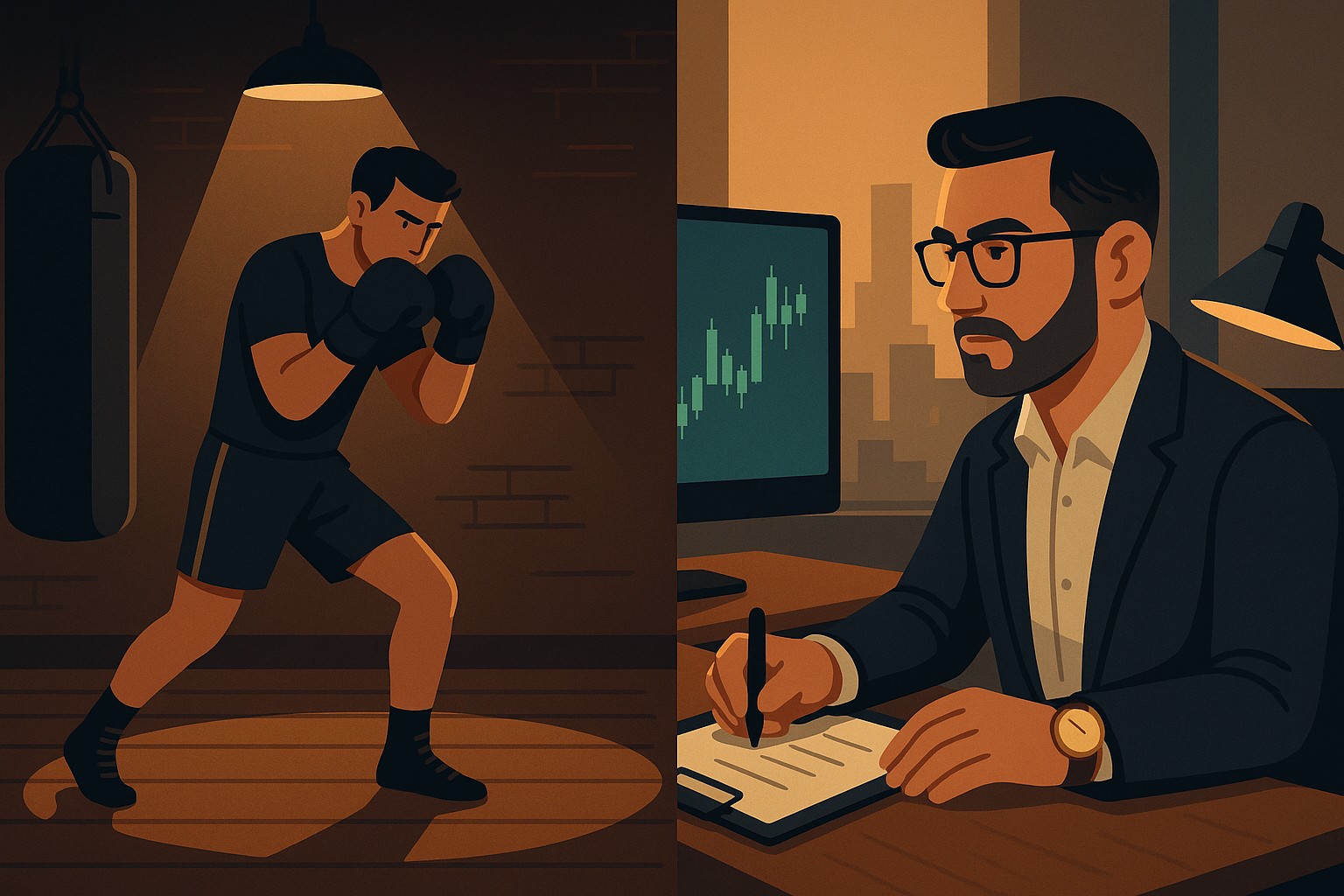
Think of a boxer.
He does not learn footwork during the fight.
He does not figure out defense while punches are flying.
Everything he needs is built long before he steps into the ring.
Trading is no different.
You do not develop discipline during the session.
You bring discipline into the session.
Your preparation determines your execution.
Your identity determines your decisions.
The market simply reveals what you built.
For the next five trading days, try this:
Write your daily identity statement before you open any chart:
“I am a disciplined, objective, and structured trader.”
Follow your trading checklist with zero negotiation, even if it means no trade for the day.
Stop trading the moment your energy dips, not when your account screams.
Journal every emotional spike: fear, FOMO, frustration, greed, boredom.
Treat this week as a live test of who you are becoming, not just what you are trading.

The messages from your entire disciplined trader series converge into one truth:
You do not achieve consistency by learning more.
You achieve consistency by becoming the trader who consistently acts on what you already know.
Identity.
Structure.
Energy.
Beliefs.
These are the real edges of a disciplined trader.
You already have the blueprint. Your job now is to live it often enough that it stops feeling like effort and starts feeling like your normal.
Because discipline depends on belief alignment, mental energy, and structural routines, not raw willpower. If any of these three areas are weak, discipline will feel unstable.
Build a strict framework around your trading: clear rules, confirmation criteria, risk limits, time filters, and journaling. Structure reduces the room for emotional decision-making.
Losses hurt because many traders attach self-worth to individual outcomes instead of seeing trades as part of a long-term probability set. Identity work and a data driven mindset help reframe that pain.
Start journaling emotional triggers, not just trade entries and exits. Awareness of how you react under pressure is the first step to reshaping those reactions.
It’s time to go from theory to execution!
Create an Account. Start Your Live Trading Now!
Looking for step-by-step approaches you can plug straight into the charts? Start here:
Sharpen your edge with proven tools and frameworks:
News moves markets fast. Learn how to keep pace with SMC-based playbooks:
From NASDAQ opens to DAX trends, here’s how to approach indices like a pro:
Gold remains one of the most traded assets - here’s how to approach it with confidence:
Candlesticks are the building blocks of price action. Master the most powerful ones:
Ready to go intraday? Here’s how to build consistency step by step:
Markets swing between calm and chaos. Learn to read risk-on vs risk-off like a pro:
Step inside the playbook of institutional traders with SMC concepts explained:
Forex pairs aren’t created equal - some are stable, some are volatile, others tied to commodities or sessions.
If you’ve ever been stopped out right before the market reverses - this is why:
Mindset is the deciding factor between growth and blowups. Explore these essentials:
The real edge in trading isn’t strategy - it’s how you protect your capital:
If you’re not sure where to start, follow this roadmap:
This way, you’ll grow from foundation → application → mastery, instead of jumping around randomly.
Follow me for more daily market insights!
Jasper Osita - LinkedIn - FXStreet - YouTube
This content may have been written by a third party. ACY makes no representation or warranty and assumes no liability as to the accuracy or completeness of the information provided, nor any loss arising from any investment based on a recommendation, forecast or other information supplies by any third-party. This content is information only, and does not constitute financial, investment or other advice on which you can rely.
ACY Securities is one of Australia's fastest growing multi-asset online trading providers, offering ultra-low-cost trading, rock-solid execution, technologically superior account management and premium market analysis.

Select the categories and companies you wish to follow directly to your person rss feed.
Create Custom RSS FeedSign up and join over 5,000 professional members who receive personalized news alerts, curated professional connections, and more for free!
Bybit has launched Perp Options, described as the first options contracts built on TradFi perpetuals, giving traders round-the-clock access to US equity options. SpaceX and Nvidia are the first underlying assets, with USDT settlement and integration into Bybit's Unified Trading Account.
Use this trading preparation checklist to plan your session, define entry rules, manage risk, and build a disciplined trading routine in seven steps.
Your Bourse expands its crypto liquidity ecosystem with Caladan, giving brokers access to broader market coverage, institutional execution capacity and streamlined settlement.
Scope Markets, the retail brokerage part of Rostro Group, has appointed Ibrahim Hossny as Head of Research and Marketing for the Middle East and North Africa.
Hantec Prime, the institutional division of Hantec Markets, has reported trading volume up more than 300% year-to-date, alongside the addition of 42 new institutional clients since December, capping one of its strongest years of growth to date.
Learn how to refine XAUUSD support and resistance on the daily chart using candle bodies, market structure and weekly gold levels for swing trading. A slug alone cannot guarantee a top Google ranking. Keep it focused rather than adding every supporting keyword.
The week in Dubai will be focused on connecting directly with the industry and discussing how technology can help modern brokerages simplify operations, automate workflows, strengthen operational control, and scale efficiently.
Devexperts has launched a turnkey solution giving brokers in South Korea access to US equity markets, combining its DXtrade trading platform, dxFeed market data, and execution services. The offering targets South Korea's growing retail demand for US stocks, worth several billion USD monthly.
Assess why WTI crude oil surged past $105 per barrel amid Saudi pipeline disruptions, record tanker charter rates, and escalating geopolitical tensions.
Bitcoin price forecast: BTC/USD retests $78,460–$80,215 resistance. Watch bearish confirmation toward $72,480 or a bullish breakout toward $86,150.