
just now


Liquidity Finder Ltd is incorporated in England and Wales, company number 10610740, registered address 167-169 Great Portland Street, Fifth Floor, London W1W 5PF, United Kingdom.
Published: just now
The AI trade has always been a supply chain story. For the past two years, the narrative has been simple: insatiable demand for compute infrastructure, constrained supply at every choke point, and the companies that own the bottlenecks collect the toll. NVIDIA on GPUs. ASML on lithography. Samsung, SK Hynix, and Micron on memory. The entire semiconductor complex has traded on scarcity, and scarcity has delivered historic margins.
CXMT's emergence as a credible fourth DRAM producer does not end the scarcity story. But it begins to unbundle it. And the implications for portfolio positioning across the AI value chain are more nuanced than a simple bull or bear call on memory stocks.
The Setup
Memory is the second largest cost line item in AI infrastructure after the GPU itself. Every training cluster and every inference deployment requires massive quantities of both conventional DRAM and High Bandwidth Memory. The shortage has been structural: three producers control over 90% of global supply, demand is growing faster than capacity can be added, and the capital expenditure required to build new fabs runs into the tens of billions. Micron's CEO has publicly stated the company has "no line of sight" on when supply will catch up with demand. Goldman Sachs expects the shortage to persist into 2028.
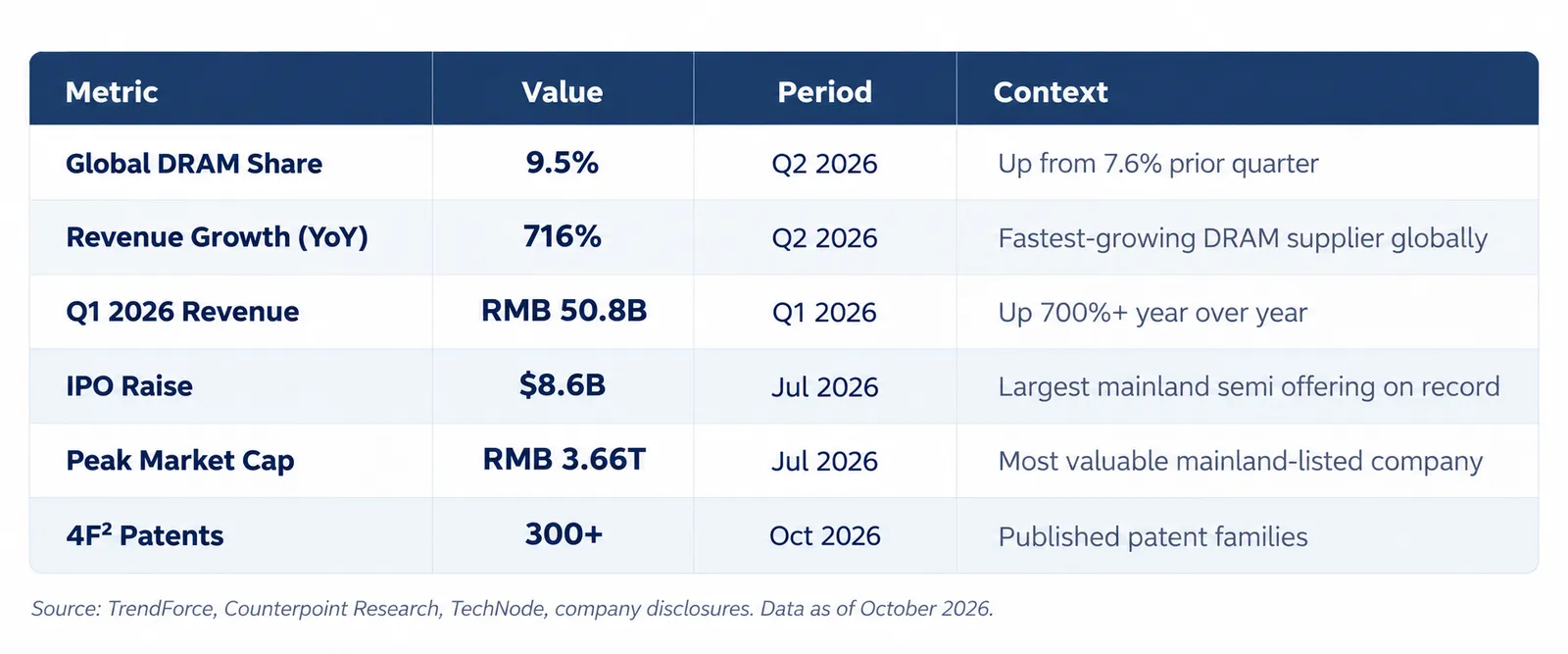
Into this environment, China's ChangXin Memory Technologies has grown from a footnote to the fourth largest DRAM producer globally. The company raised $8.6 billion in its Shanghai IPO, briefly became the most valuable company on China's mainland exchanges, and has now announced progress on a next-generation cell architecture that could increase chip density by up to 50% without requiring the advanced lithography tools that export controls deny it.
The market's initial reaction was to sell everything. But the selloff conflated two very different questions: whether CXMT can actually deliver this technology at volume, and what it means for the rest of the AI trade if the memory bottleneck loosens even partially.
The 4F² Claim: Architecture vs. Production
On October 10, CXMT president Cao Kanyu presented at the Integrated Circuits and Chiplet Conference in Shanghai and disclosed that the company has made "key progress" on a 4F² DRAM cell architecture using a Vertical Surrounded Gate transistor design. The company plans to launch a DDR5 RDIMM server memory product based on this architecture before year-end 2026. CXMT holds over 300 published patent families related to 4F².
The current industry standard is a 6F² cell. A 4F² cell reduces the footprint by roughly 33% and can fit approximately 50% more cells on the same die at the same minimum feature size. The reason it matters specifically for CXMT is that it provides a path to higher density without requiring the process node shrink that EUV lithography would enable. It is, in effect, an architectural workaround for the equipment they cannot access.
The honest assessment sits between the panic and the dismissal. CXMT operates on a roughly 16nm-class process using DUV lithography. It does not have access to EUV tools and cannot acquire them under current export controls. Samsung demonstrated a 4F² prototype at ISSCC 2026 but has not committed to mass production before 2028. SK Hynix validated the concept on its 2025 roadmap with no firm timeline. Neither has solved the yield economics, even with the full equipment stack.
CXMT faces the same yield challenges with fewer tools. A 4F² cell on a 16nm DUV process is still physically larger than a 6F² cell on a sub-10nm EUV process. The density advantage only materializes at equivalent feature sizes, and CXMT cannot shrink its feature size without equipment it is barred from purchasing. TrendForce notes that the year-end target "appears particularly ambitious" and that commercial availability "does not necessarily signal readiness for high-volume production."
What CXMT cannot do on any reasonable timeline is produce HBM. High Bandwidth Memory requires through-silicon vias, precision die stacking, hybrid bonding, advanced thermal management, and qualification with GPU vendors who have zero tolerance for reliability issues. CXMT has no commercial HBM capability and no credible path to one within the next two to three years.
The Selloff: Catalyst, Not Cause
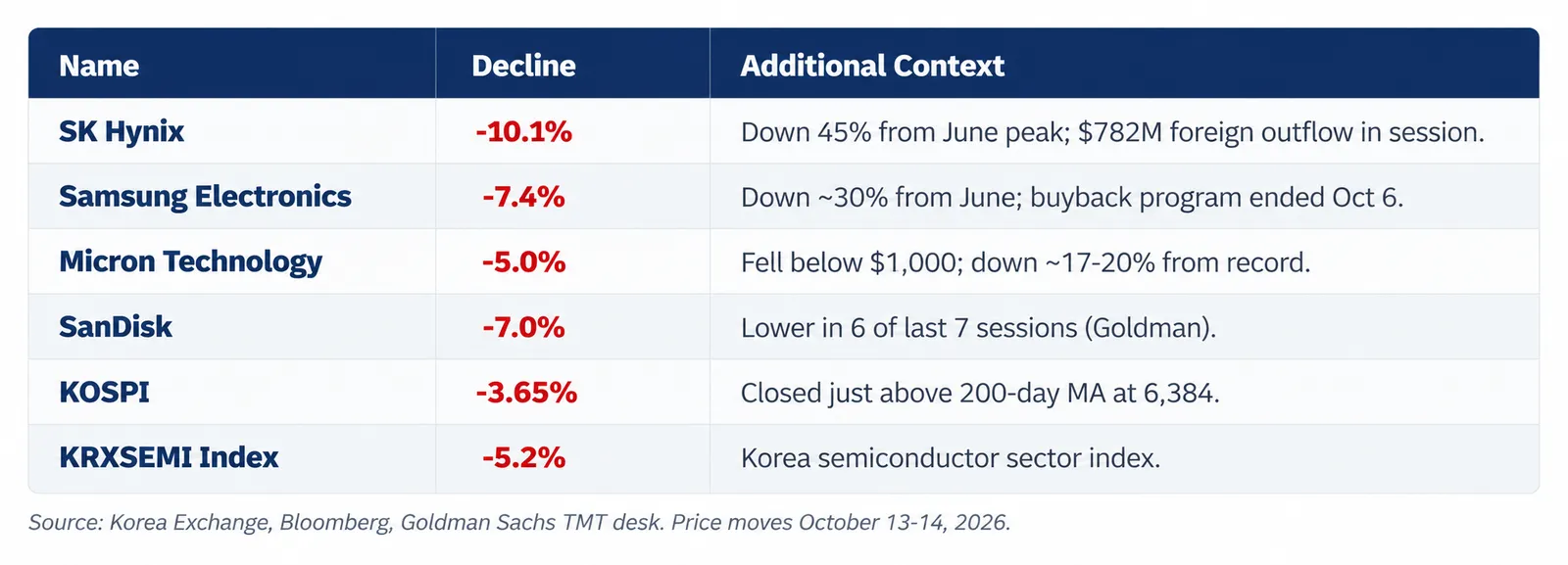
The selloff was not purely about the 4F² headline. Multiple forces converged. Samsung's buyback program ended October 6 and SK Hynix's was winding down, removing a significant source of support. Goldman's Prime Book shows US Info Tech went from the most net bought sector to the most net sold, with semis and tech hardware leading outflows. Korea, which was the poster child of the AI trade in the first half, has become the worst performer in the second half. The CXMT headline was a catalyst for a derisking move that was already in motion.
The pattern has repeated throughout 2026: CXMT's IPO in July caused a dip, the September capacity reports caused another, and now the 4F² announcement produced the sharpest move yet. Each time, the fundamental picture has not changed, but the stocks have gotten cheaper. The trade is crowded, and holders are looking for reasons to trim.
Where CXMT Actually Competes
Where CXMT is genuinely competitive is commodity DRAM: the DDR5, LPDDR5, and standard server memory that goes into PCs, smartphones, and conventional data center applications. Apple is reportedly testing CXMT chips for products sold in China and has asked the US government to allow broader use. Acer, HP, and Asus are already using CXMT chips in PCs. Citi flagged in August that CXMT entering data center markets in Europe could indirectly affect Micron even if US sales remain blocked.
The domestic absorption argument, that all CXMT supply stays in China, is directionally correct but increasingly insufficient. China does consume enormous quantities of DRAM domestically, and incremental CXMT supply flows into that demand pool first. But the boundaries are getting porous as western OEMs look for alternative sources during a shortage. Goldman expects CXMT's DRAM supply to reach 41% of Samsung's and 50% of SK Hynix's by 2028.
The real risk is not that CXMT replaces the Big Three. It is that CXMT takes enough commodity DRAM share to compress margins on the non-HBM portion of the business, forcing the incumbents to depend even more heavily on HBM premiums for their earnings growth.
The LTA Divergence
The three incumbents have structured their long-term agreements very differently, and those structures create meaningfully different risk profiles in a world where CXMT headlines periodically rattle the market.
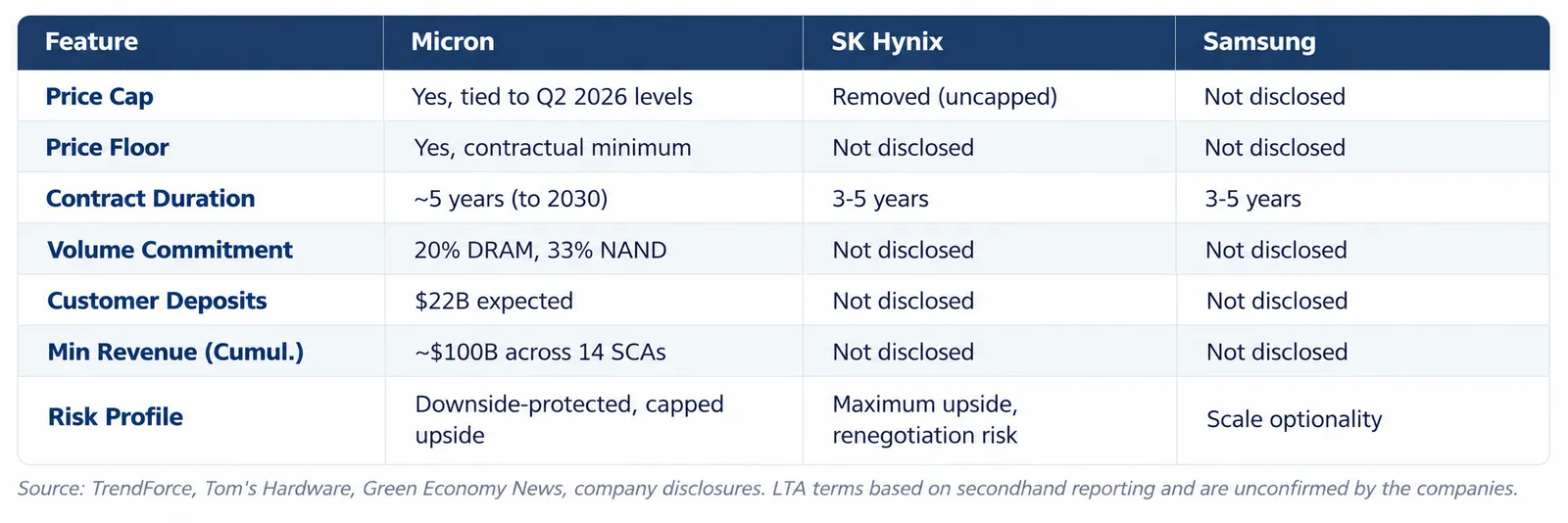
SK Hynix's uncapped structure is the most aggressive: maximum upside capture during the upcycle, but customers who feel squeezed will be the first to renegotiate or diversify supply when alternatives emerge. Counterpoint flagged that SK Hynix's early LTAs fixed prices below current levels, dragging its HBM revenue mix in Q2.
Micron has taken the opposite approach. Its 16 strategic customer agreements include both a price cap and a contractual floor, with binding volume commitments and $22 billion in customer deposits. CEO Sanjay Mehrotra has said the company has "no line of sight as to when memory supply will be able to catch up with increasing demand." The structure sacrifices upside optionality for revenue durability. In a world where CXMT creates periodic panic about the shortage ending, Micron's floor-and-ceiling approach is the most defensible.
What This Means for the AI Trade
The AI value chain is a series of interlocking cost structures. When one input gets cheaper, the economics shift for everyone downstream. Memory has been the most inflationary input in AI infrastructure outside of GPUs, and the companies building and deploying AI systems have been absorbing that cost because they had no alternative.
If the memory bottleneck loosens, even modestly, the beneficiaries are not the memory producers. They are the consumers of memory: the hyperscalers building data centers, the AI laboratories training and serving models, and the enterprise customers whose adoption timelines are partly gated by infrastructure cost.
Consider the capital expenditure math. A hyperscaler spending $50 billion annually on AI infrastructure allocates a significant portion to memory procurement. A 10 to 15% decline in memory pricing does not change the demand for compute. It reduces the cost of meeting that demand. The freed capital either drops to the bottom line or gets redeployed into more capacity, which accelerates the buildout. Either outcome is bullish for AI adoption and for the companies that monetize AI workloads.
This is the core insight the selloff missed. The market treated the CXMT headline as uniformly bearish for the semiconductor complex. But the AI trade is not synonymous with the memory trade. A world where memory supply grows faster than expected is a world where the AI infrastructure buildout gets cheaper, where the returns on AI investment improve, and where more capital flows into the buildout.
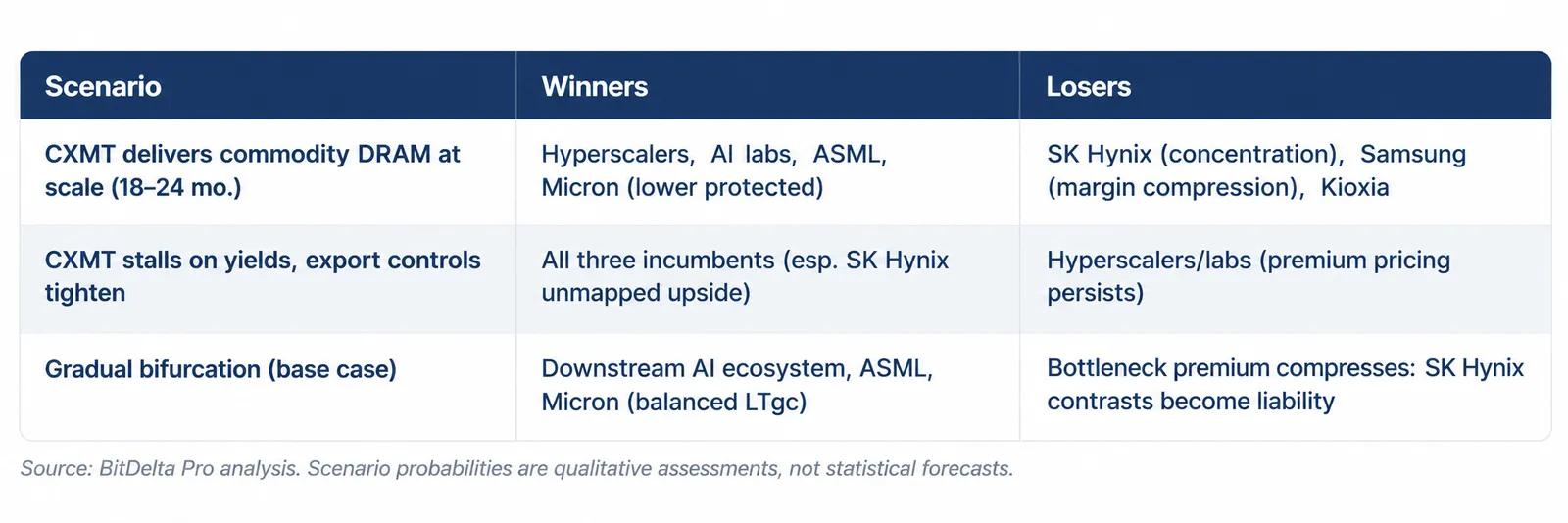
Three Scenarios
Scenario 1: CXMT Delivers Commodity DRAM at Scale
CXMT continues gaining share in commodity DRAM, reaching 12 to 15% of global revenue by late 2027. Pricing on DDR5 and LPDDR5 compresses as a genuine fourth supplier absorbs the marginal shortage. HBM remains fully controlled by the Big Three. The memory sector bifurcates: commodity margins compress while HBM margins hold or expand as the product mix shifts further toward advanced packaging.
Scenario 2: CXMT Stalls on Yields, Export Controls Tighten
The 4F² architecture fails to achieve viable yields at volume on DUV tools. Additional export restrictions further constrain CXMT's equipment access. The shortage persists as Goldman projects, and memory pricing continues to rise through 2028. The periodic CXMT selloffs prove to be buying opportunities for the incumbents.
Scenario 3: Gradual Bifurcation (Base Case)
CXMT gains share steadily in commodity DRAM but remains locked out of HBM and advanced server memory. The incumbents voluntarily retreat from the most commoditized segments to focus capacity on HBM and advanced products where margins are defensible. The overall memory market grows large enough to absorb CXMT's additions without a pricing collapse, but the shortage premium narrows on the commodity side while holding on the advanced side.
The Reframing
The market has spent two years pricing the AI trade as a supply-side story: who controls the scarce inputs and can extract the rent. CXMT's emergence, regardless of whether the 4F² claims are fully realized, begins to shift that framing. The next phase of the AI trade is a demand-side story: who builds the best products, who captures the most users, who monetizes the workloads. The supply side does not disappear, but the toll narrows as the bottleneck widens.
For portfolio positioning, this argues for rotating exposure within the AI value chain rather than reducing it. The infrastructure buildout is not slowing. The question is which part of the value chain captures the margin. As memory supply normalizes, the margin migrates downstream: from the chip producers to the system builders to the model developers to the application layer.
The memory incumbents remain fundamentally strong over the next 12 months. The shortage is real, the LTAs are locked in, HBM demand is accelerating into next-generation GPU architectures, and CXMT is years away from competing on advanced products. But the multiple these stocks trade on reflects a bottleneck premium that is beginning to erode, and each successive CXMT headline accelerates that repricing. The trade is not broken. The ceiling is lower.
Research | BitDelta Pro
Disclaimer
This document is for informational and educational purposes only and does not constitute investment advice, a solicitation, or a recommendation to buy or sell any security or financial instrument. All data sourced from public filings, government releases, and third-party providers as cited. Forward-looking statements reflect the author's analysis as of the publication date and are subject to revision. Past performance is not indicative of future results.
BitDelta Securities Financial Services LLC, regulated by the Capital Market Authority under Category 5 (Introduction Only), acts solely as an introducer and does not provide trading, execution, dealing, advisory, portfolio management, or custody services. All trading, execution, and investment-related services are provided by BitDelta Limited, Mauritius, a licensed Investment Dealer excluding underwriting. All trading and investments involve risk. The value of investments may fluctuate, and you may receive less than your initial investment.
The information contained in this article is provided for general informational purposes only and does not constitute financial, investment, legal, or professional advice, or a recommendation to buy, sell, or hold any financial product. Readers should seek independent professional advice and conduct their own due diligence before making any decisions. Neither the publisher nor the contributors accept liability for any loss arising from reliance on this content.
Appendix: Sources
Memory Industry & CXMT
TrendForce: CXMT Accelerates 4F² DRAM Push, Eyes Year-End Server DDR5 RDIMM Launch
Korea Times: CXMT's New DRAM Tech to Test Korean Memory Makers' Dominance
Digital Today: CXMT Advances Next-Generation DRAM Design
CNBC: Why This Little Known Chinese Chipmaker Has Caused a Global Stock Rout
TechNode: CXMT Becomes China's Most Valuable A-Share After $8.6B IPO
Market Data & Selloff
ZeroHedge: Micron Tumbles Below $1,000 As CXMT Shrinks The DRAM Cell
Counterpoint Research: AI Demand Reshapes DRAM Rankings in Q2 2026
Long-Term Agreements
TrendForce: SK Hynix Reportedly Removes Price Cap, Diverging from Micron
Tom's Hardware: Micron Inks Long-Term Supply Agreements Worth $100 Billion
Semiconductor Equipment & Export Controls
Analytics India Magazine: China's CXMT Claims Memory Breakthrough
Economy.ac: China's CXMT Advances Miniaturization Despite Lithography Gap
Institutional multi-asset market access across MT5 Ultency, CQG, Iress Pro and BitDelta Terminal, with transparent execution standards and global market coverage.

Select the categories and companies you wish to follow directly to your person rss feed.
Create Custom RSS Feed
just now

just now
Sign up and join over 5,000 professional members who receive personalized news alerts, curated professional connections, and more for free!
The AI trade has always been a supply chain story. For the past two years, the narrative has been simple: insatiable demand for compute infrastructure, constrained supply at every choke point, and the companies that own the bottlenecks collect the toll. NVIDIA on GPUs. ASML on lithography. Samsung, SK Hynix, and Micron on memory. The entire semiconductor complex has traded on scarcity, and scarcity has delivered historic margins.
CXM Group has agreed to acquire TD Markets (Pty) Ltd, a Johannesburg-headquartered broker authorised by South Africa’s FSCA. TD Markets keeps its brand, team and licence, and Amar Ramith stays as CEO. Financial terms were not disclosed. The deal gives CXM a regulated base in South Africa. Clients need take no action.
Global equities under pressure: Hotter than expected US inflation and rising yields weighed on stocks, particularly technology and semiconductor shares.
Understand trading psychology and learn how a clear strategy, risk management and a trading journal help build discipline and day trading consistency.
Ripple Prime has launched support for real-world asset perpetual swaps, giving institutional clients including Virtu exposure to more than 100 reference markets across equities, indices, ETFs, metals, energy and FX. The swaps reference Trade.xyz perpetual futures on Hyperliquid and trade and settle around the clock.
iSAM Securities Apex has integrated with Crossover Markets, connecting brokers to CROSSx, its institutional digital asset ECN, through Apex’s ultra-low-latency technology stack.
Your Bourse and 4XPORTAL highlight their existing partnership, combining client onboarding, CRM and payment solutions with liquidity, execution and risk-management infrastructure for brokers.
The partnership brings together 4XPORTAL’s brokerage technology capabilities with Your Bourse’s connectivity, liquidity aggregation, and risk-management infrastructure.
Clearstream has appointed Philippe Mueller as Head of Digital Products and Transformation for Clearstream Fund Services, succeeding Olivier Portenseigne. He will lead digital fund distribution, DLT-enabled fund processing and transfer agency innovation. He has over 25 years at Clearstream and Deutsche Börse Group.
Learn how to detach from trading outcomes by focusing on entry, exit, and risk. Build trading discipline with clear rules and a repeatable process.