just now


Liquidity Finder Ltd is incorporated in England and Wales, company number 10610740, registered address 167-169 Great Portland Street, Fifth Floor, London W1W 5PF, United Kingdom.
Published: just now
If trading feels emotional, chaotic, or inconsistent, it’s usually not because you lack intelligence or market knowledge. It’s because trading is being approached like a hobby instead of a performance profession. Trading for a living is not about excitement, prediction, or constant screen time. It is about execution under pressure, decision-making with uncertainty, and surviving long enough for skill to compound.
Many traders enter the markets believing effort equals results. They study charts, watch videos, add indicators, and still wonder why consistency never arrives. The uncomfortable truth is this: markets do not reward effort, passion, or opinions. They reward discipline, risk control, and behavioral stability.
This idea sits at the core of Alexander Elder’s work in Trading for a Living, where he frames trading as one of the last true performance professions - similar to surgery, aviation, or elite sports - where mistakes are punished immediately and emotionally.

In most careers, you can afford to be wrong occasionally. In trading, being wrong repeatedly - or emotionally - has immediate consequences. There is no manager to protect you, no salary to stabilize you, and no one to override your decisions.
Trading is one of the few professions where:
If you’re still early in your journey, this is why a clean foundation matters. If you want a simple starting point, use this as your baseline: Learn Trading From Scratch: Clean, Simple, Zero-Noise. It’s the “strip it down and build it right” approach.

A hobby trader approaches the market for stimulation. A professional trader approaches the market for execution.
Here’s the difference most traders never formally define:
Hobby mindset
Professional mindset
This is why a structured base like Daily Trading Routine: Build Consistency and Discipline Fast changes everything - it makes “showing up” mechanical instead of emotional.
Professionals also don’t need 12 strategies. They commit to one. If you’ve been hopping setups, anchor your execution around this idea: Beginner Trading Strategy: How to Choose One Setup and Commit.
One of the most important insights from Trading for a Living is that most losses do not come from bad analysis. They come from self-destructive behavior - overtrading, revenge trading, oversized risk, and emotional decision-making.
Early traders often:
This creates a loop where emotional decisions reinforce bad habits. Without structure, trading becomes reactive instead of deliberate.
If you want a clean mental framework for this, it connects well with Trading Psychology: How to Control Yourself in the Markets because the real enemy is rarely the market - it’s impulse.

Imagine someone training for a marathon but sprinting every mile.
They feel strong at the start, exhausted halfway through, and injured before the finish. That is exactly how most traders approach the markets.
They trade aggressively early, chase wins, ignore recovery, and burn out emotionally. Professional traders pace themselves. They conserve energy, avoid unnecessary trades, and understand that longevity - not intensity - is the advantage.
If you’ve never done scenario thinking (and you keep getting surprised by the other side), this is the simplest fix: Scenario Planning: Expect Both Sides. It forces you to trade conditions instead of emotions.
One of the most damaging beliefs new traders carry is the need to be right. Markets do not reward correctness - they reward risk-adjusted decision-making.
Professional traders:
When trading becomes about being right, ego enters the decision process. When trading becomes about execution, ego fades.
If you want a deeper “why” on this (especially the emotional spiral that follows being stopped out), the psychology angle is covered well in the Stop Hunting framework - start with Stop Hunting 101: How Swing Highs and Lows Become Liquidity Traps and notice how often “being right” becomes the trap.
Trading for a living does not mean trading every day. It does not mean staring at charts all day. And it definitely does not mean forcing trades to make money.
It means:
This is why risk management becomes the backbone, not an optional module. If you want the clearest expression of that truth, read: Trading Risk Management: The Real Edge Behind Consistency. That one piece alone will save more accounts than any indicator.
And if you’re still building your foundation step-by-step, the full roadmap is here: Beginner Trading Master Guide 2025: The Complete Roadmap to Consistency.

Trading does not demand brilliance. It demands restraint. The traders who survive are not the most aggressive - they are the most consistent. Once you stop treating trading like entertainment, it starts behaving like a profession.
It means approaching trading as a professional business focused on execution, risk management, and long-term consistency rather than daily income or excitement.
Yes - but only if they adopt process-based goals instead of profit-based expectations. A structured foundation like the Introduction to Trading: What Beginners Must Understand helps you start with the right mental model.
Because fewer trades reduce emotional errors and allow capital to be deployed only when conditions are favorable.
Often, yes. Boredom usually means you are no longer reacting emotionally to the market.
It’s time to go from theory to execution!
Create an Account. Start Your Live Trading Now!
Looking for step-by-step approaches you can plug straight into the charts? Start here:
Sharpen your edge with proven tools and frameworks:
News moves markets fast. Learn how to keep pace with SMC-based playbooks:
From NASDAQ opens to DAX trends, here’s how to approach indices like a pro:
Gold remains one of the most traded assets - here’s how to approach it with confidence:
Candlesticks are the building blocks of price action. Master the most powerful ones:
Ready to go intraday? Here’s how to build consistency step by step:
Markets swing between calm and chaos. Learn to read risk-on vs risk-off like a pro:
Step inside the playbook of institutional traders with SMC concepts explained:
Forex pairs aren’t created equal - some are stable, some are volatile, others tied to commodities or sessions.
If you’ve ever been stopped out right before the market reverses - this is why:
Mindset is the deciding factor between growth and blowups. Explore these essentials:
The real edge in trading isn’t strategy - it’s how you protect your capital:
If you’re not sure where to start, follow this roadmap:
This way, you’ll grow from foundation → application → mastery, instead of jumping around randomly.
Follow me for more daily market insights!
Jasper Osita - LinkedIn - FXStreet - YouTube
This content may have been written by a third party. ACY makes no representation or warranty and assumes no liability as to the accuracy or completeness of the information provided, nor any loss arising from any investment based on a recommendation, forecast or other information supplies by any third-party. This content is information only, and does not constitute financial, investment or other advice on which you can rely.
ACY Securities is one of Australia's fastest growing multi-asset online trading providers, offering ultra-low-cost trading, rock-solid execution, technologically superior account management and premium market analysis.

Select the categories and companies you wish to follow directly to your person rss feed.
Create Custom RSS FeedSign up and join over 5,000 professional members who receive personalized news alerts, curated professional connections, and more for free!
Businesses eventually reach a point where basic tools are not enough basic tools.
Multi-asset trading broker AvaTrade has agreed to acquire the majority of FXCM Group’s business and brand, in a transaction that would bring a longstanding retail FX franchise into the AvaTrade Group.
LSEG and CMC Markets have signed a multi-year strategic data agreement expanding CMC's access to LSEG's real-time and delayed pricing, reference and corporate actions data, news and analytics, plus AI-ready content, to support new products, entry into new markets and the growth of CMC's institutional and B2B partnerships.
The Tel Aviv Stock Exchange is considering a bid for the Cyprus Stock Exchange, with Israeli media citing its EU licence, trading platform and clearing house. Euronext’s Athens exchange and India’s National Stock Exchange are also seen as contenders, and Cyprus aims to sign a sale agreement by the end of this year.
CME Group will launch baseball futures on 12 October, pending regulatory review, tracking CME FutureSports Performance Indexes built on Official League Data. Standard and micro contracts will start with the 2026 Postseason and the four clubs in the League Championship Series, trading around the clock.
ESMA has published an opinion stating that MiCA-authorised crypto-asset service providers should cease services tied to non-MiCA-compliant stablecoins for EU clients across MiCA crypto-asset services. National authorities should require remediation of existing exposures within three months, by early January 2027.
Nasdaq Ventures has made a strategic investment in Amsterdam-based derivatives and crypto exchange One Trading, with both firms to explore 24/7 trading of equity futures. The undisclosed investment follows Nasdaq's US$100 million investment in Payward, the parent of Kraken, and CME Group's move to 24/7 trading.
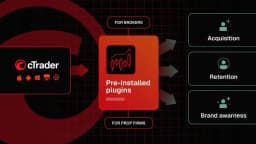
cTrader has opened multi-platform plugins to brokers and prop firms, which can pre-install their own tools for clients or list them in cTrader Store. The plugins run across Mobile, Web, Windows and Mac, and can be built and launched independently of core-platform releases, including trading journals and calculators.
Institutional brokerage and financial infrastructure provider Clear Street has joined TradingView’s broker network, allowing its clients to trade US stocks, exchange-traded funds and options directly through the charting and analysis platform.
Learn how to improve trading psychology, manage fear and greed, avoid revenge trading, and follow your trading strategy with discipline and a trading journal.