just now


Liquidity Finder Ltd is incorporated in England and Wales, company number 10610740, registered address 167-169 Great Portland Street, Fifth Floor, London W1W 5PF, United Kingdom.
Published: just now

A weekly review shows you what happened.
A daily review shows you how you behaved.
But a monthly review reveals something deeper - the true direction your trading is heading.
Most traders never zoom out far enough to see the bigger picture, which is why their performance feels random. A monthly review organizes your journaled data, emotional notes, screenshots, and trade logs into a performance narrative - similar to what you build through structured backtesting and forward testing.
This is how professional traders find real edge, refine their strategy, and strengthen the psychological foundations taught in guides like Trading Psychology: Controlling Yourself and Identity-Based Trading.
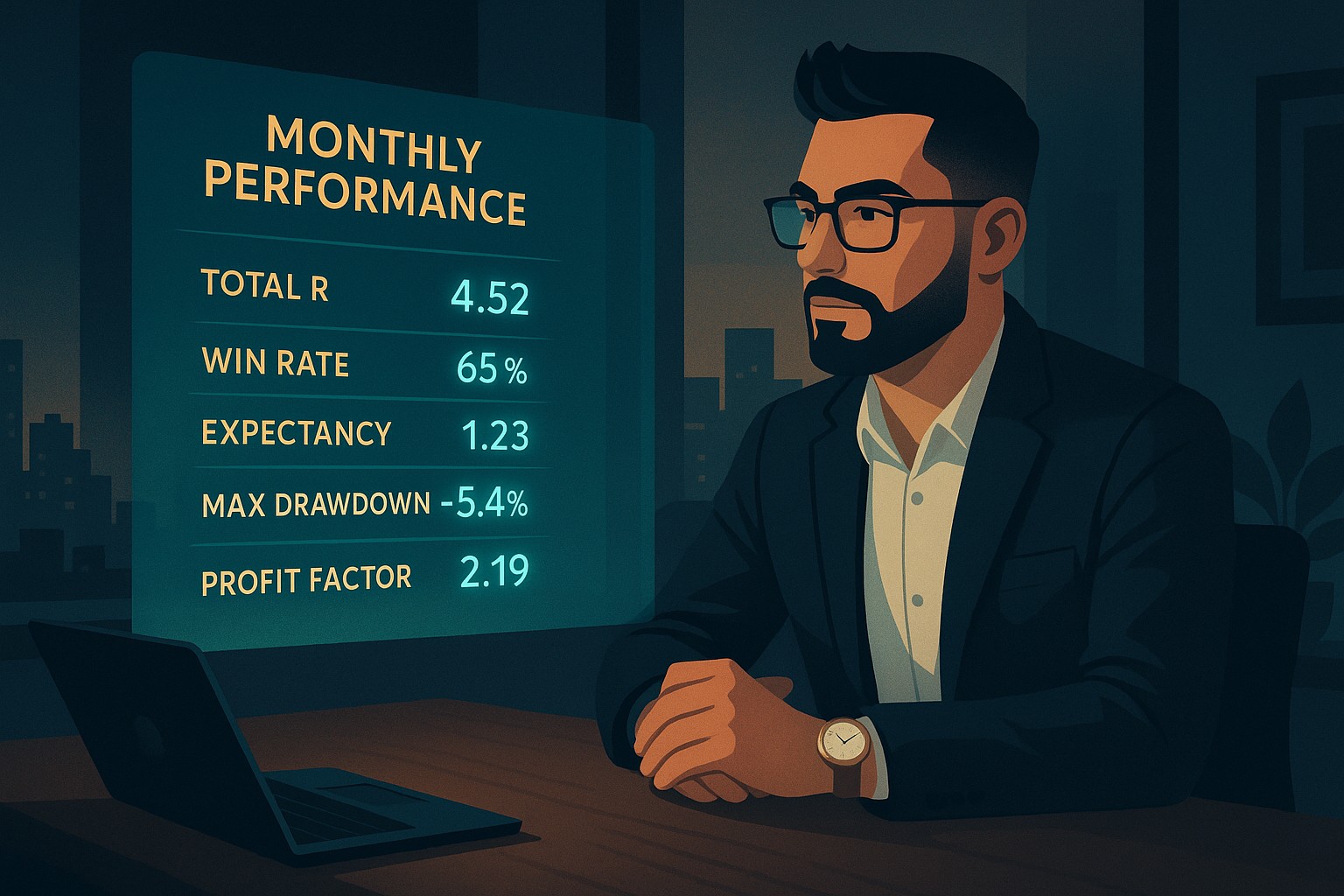
Collect your core metrics:
These metrics only start making sense when you compare them to last month - just like how markets only make sense when viewed through proper trend identification and macro structure rather than one candle at a time.
Your monthly summary reveals whether:
This is your trading “health report.”

Your strategy is not one system - it is a collection of setups, each with its own performance profile.
For each setup, measure:
This helps you refine your system the same way you refine execution using frameworks like the Confirmation Model (OB + FVG + Liquidity Sweep).
You will often discover:
By focusing on high-expectancy setups and filtering out weak ones, you increase consistency - a principle reinforced in The Disciplined Trader Blueprint.
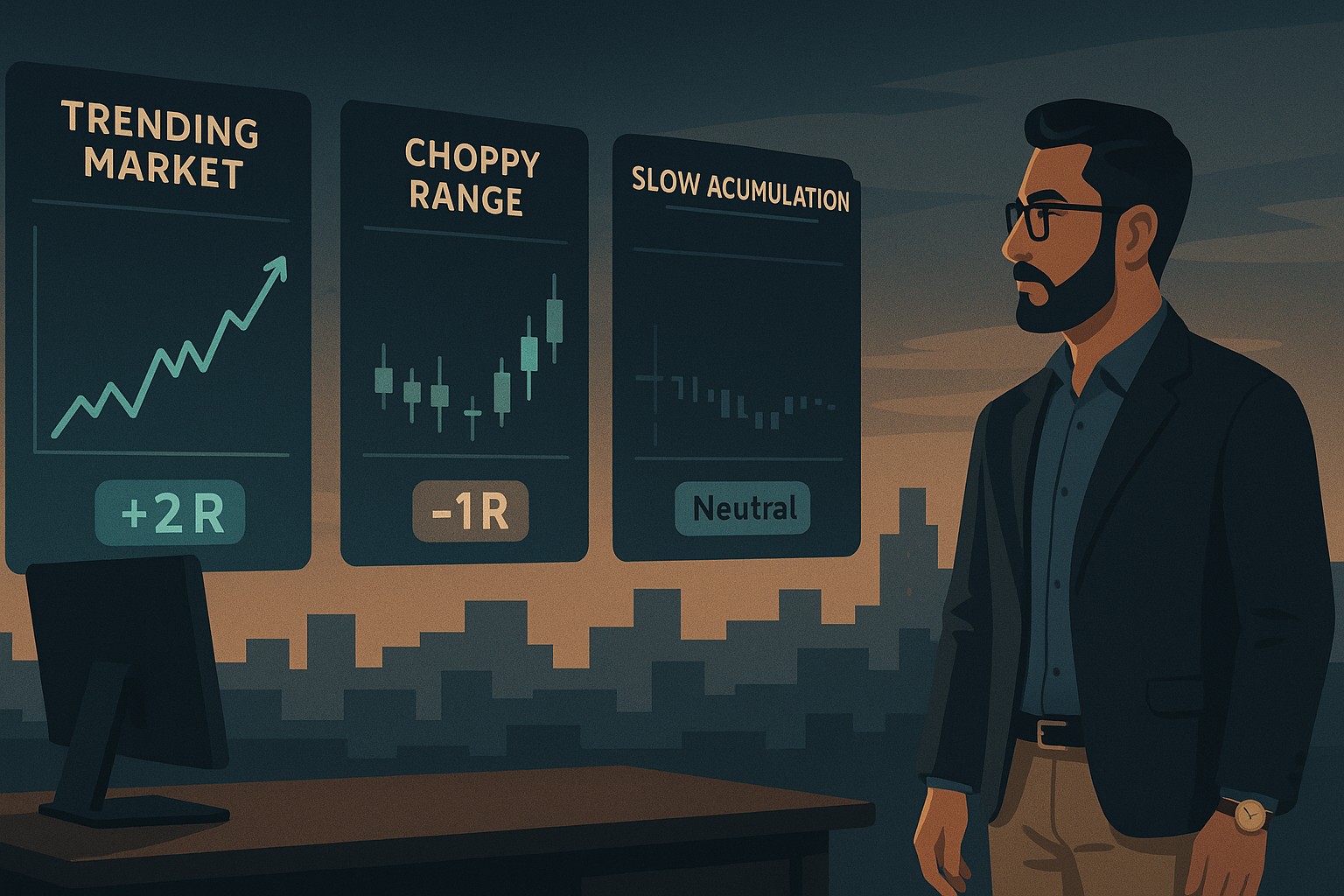
Your performance changes with the environment.
Review how you traded in:
These insights echo the importance of adapting to sentiment taught in How to Trade Risk-On and Risk-Off Sentiment and recognizing how liquidity shifts across sessions the way London Session Trading explains.
This section tells you:
It’s not about trading everywhere - it’s about trading where you are strongest.
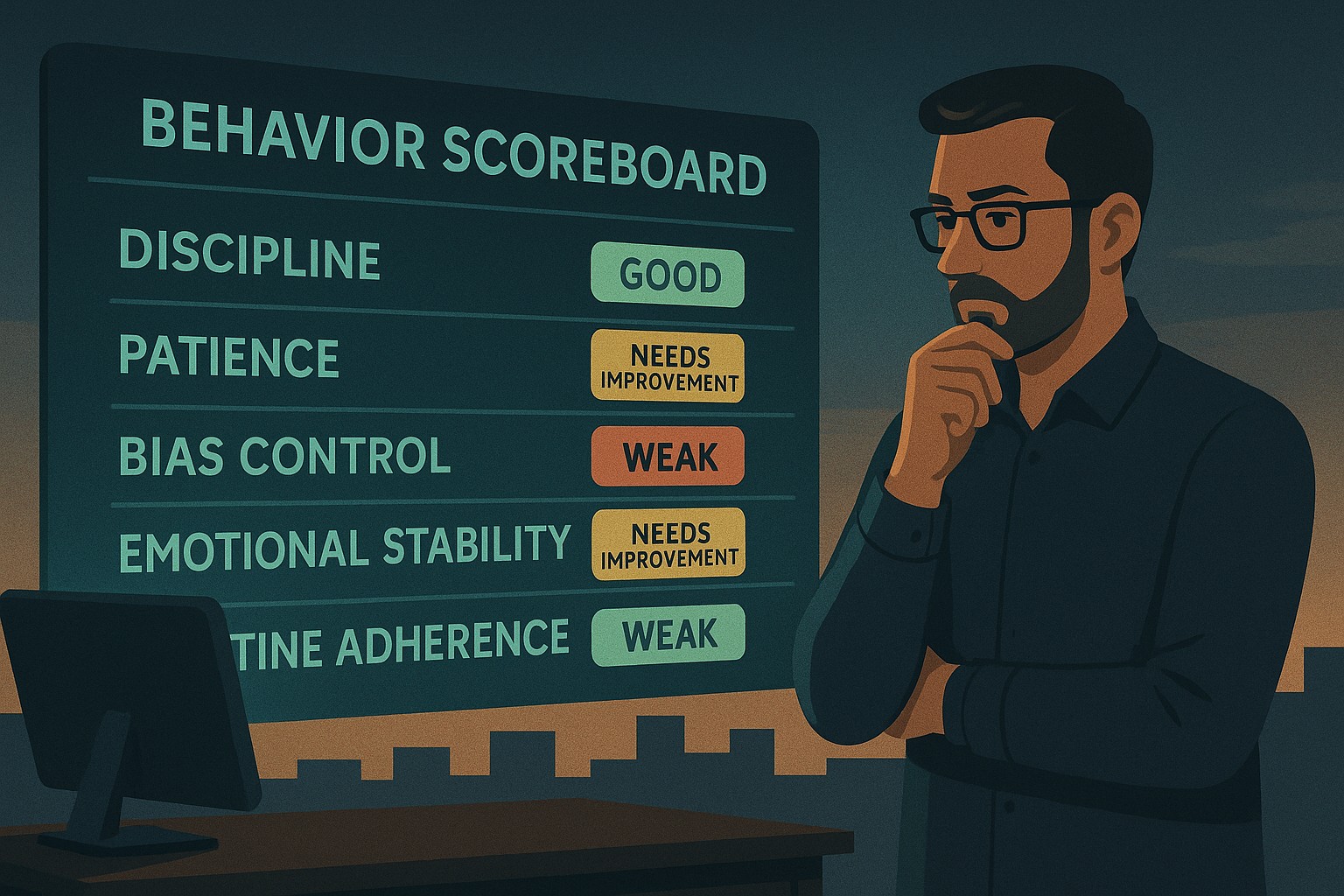
This is where breakthroughs happen.
Your monthly behavior review should track:
Did you improve your emotional stability, something emphasized in Managing Trading Losses and Execution Psychology?
Did recency bias spike after a losing streak?
Did overconfidence appear after a big win?
Did certain environments, dates, or mistakes lead to rule-breaking?
Your behavior dictates your R-distribution more than your strategy does.

Rate yourself monthly on:
Identity-based improvements are the core of consistency - a principle detailed in Identity-Based Trading and The Zen of Trading.
Your system won’t change until you change.

Your system must evolve slowly, guided by data, not emotion.
Each month, document:
Rules or setups that performed well.
Weak rules that need refinements - the same refinement mindset used in Refining Your Trading Edge.
Setups, tools, or habits that repeatedly lose.
Small, validated improvements - never overfitting.
Behaviors and habits that worked exceptionally well.
This keeps your system alive and improving, just like institutional systems evolve through iterative feedback.

Plot your full month of trades in R-multiples:
This reveals whether you’re applying the reward-to-risk principles taught in Mastering Risk Management and whether your edge is truly scalable.
If your R-distribution is healthy, your strategy is healthy.
If it is chaotic, your psychology is chaotic.
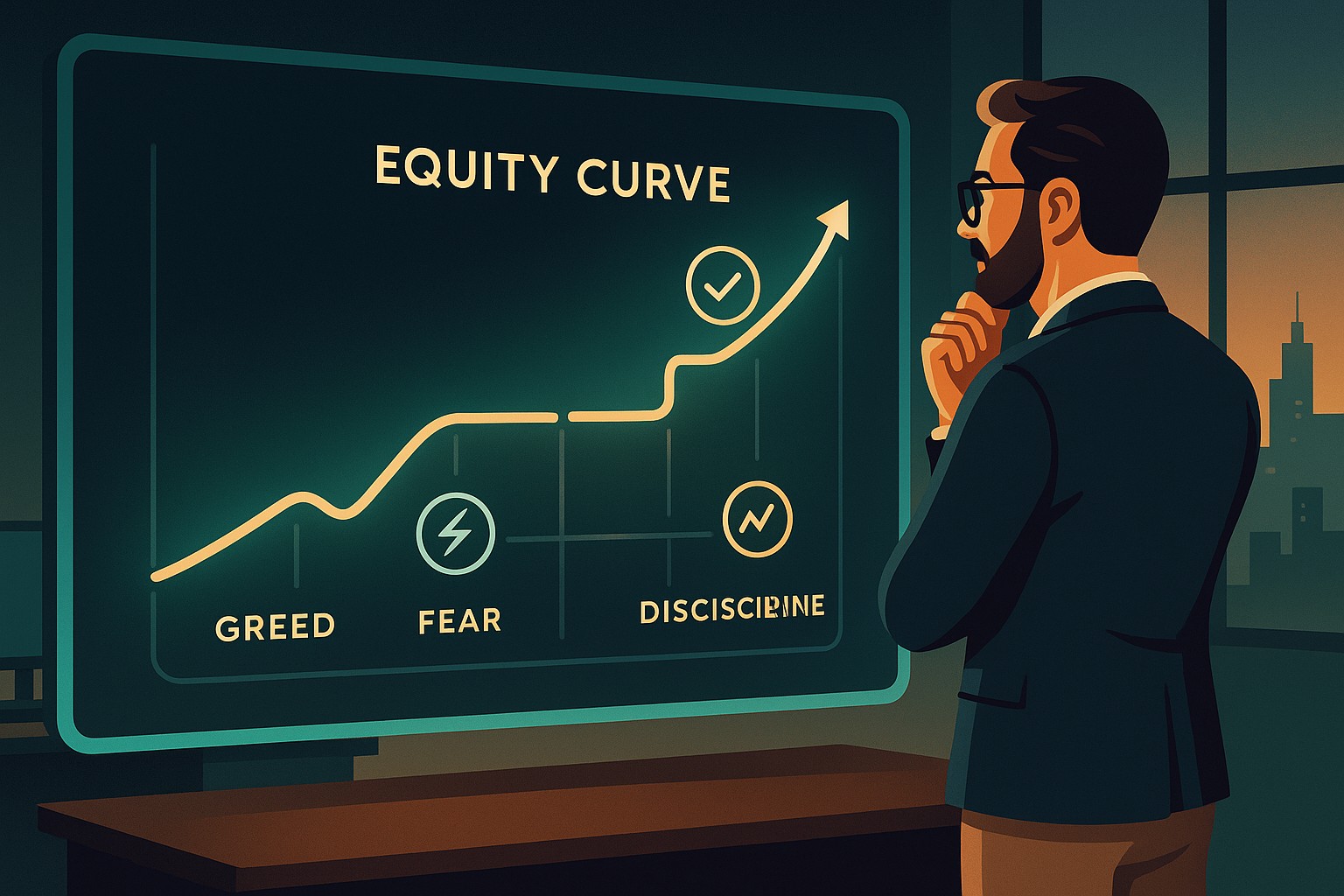
Your equity curve exposes:
This truth is similar to what traders learn in Why Most Traders Fail - they don’t lose because of strategy, but because of unmanaged internal conflict.
A monthly equity curve is the cleanest mirror of your internal state.
Just as lifters don’t measure strength rep-by-rep but month-to-month, traders should evaluate performance across cycles:
Your monthly review shows whether you’re trending toward the trader you aim to become - or drifting.
A month of data is not just information - it is a story of your evolution.
When applied consistently, this framework transforms:
This is how traders go from inconsistent to professional -
not through more trades, but through higher-quality reflection.
A monthly review should be done once every 30 calendar days, ideally on a weekend when markets are closed. This gives you emotional distance and enough historical data to spot patterns in setups, behavior, and performance. Weekly reviews show micro trends; monthly reviews show the real direction of your trading system.
While traders obsess over win rate, the most important metric is expectancy because it reveals whether your overall system is profitable over time. A trader with a low win rate but high average R-multiple can outperform someone with 70% win rate but poor risk-to-reward. Expectancy tells the truth win rate cannot.
Look at three things:
Your R-distribution (Are winners getting larger? Losers staying controlled?)
Your equity curve (Is it smoother than last month?)
Your behavior score (Are emotional mistakes decreasing?)
If these three improve, your system is strengthening - regardless of whether you had a winning or losing month.
Absolutely. A losing month may reveal major breakthroughs: cleaner execution, better discipline, stronger routines, fewer emotional trades, or improvements in setup selectivity. Profit isn’t the only KPI; your behavior and decision quality matter more for long-term growth. Many traders become profitable after a losing but highly educational month.
Not necessarily. Monthly reviews help you observe, not overhaul. Professionals evolve their system slowly, based on recurring data - not emotional reactions to one bad week. Only change a rule if you have multiple months of evidence, similar to how you validate strategies via structured backtesting and forward testing.
It’s time to go from theory to execution!
Create an Account. Start Your Live Trading Now!
Looking for step-by-step approaches you can plug straight into the charts? Start here:
Sharpen your edge with proven tools and frameworks:
News moves markets fast. Learn how to keep pace with SMC-based playbooks:
From NASDAQ opens to DAX trends, here’s how to approach indices like a pro:
Gold remains one of the most traded assets - here’s how to approach it with confidence:
Candlesticks are the building blocks of price action. Master the most powerful ones:
Ready to go intraday? Here’s how to build consistency step by step:
Markets swing between calm and chaos. Learn to read risk-on vs risk-off like a pro:
Step inside the playbook of institutional traders with SMC concepts explained:
Forex pairs aren’t created equal - some are stable, some are volatile, others tied to commodities or sessions.
If you’ve ever been stopped out right before the market reverses - this is why:
Mindset is the deciding factor between growth and blowups. Explore these essentials:
The real edge in trading isn’t strategy - it’s how you protect your capital:
If you’re not sure where to start, follow this roadmap:
This way, you’ll grow from foundation → application → mastery, instead of jumping around randomly.
Follow me for more daily market insights!
Jasper Osita - LinkedIn - FXStreet - YouTube
This content may have been written by a third party. ACY makes no representation or warranty and assumes no liability as to the accuracy or completeness of the information provided, nor any loss arising from any investment based on a recommendation, forecast or other information supplies by any third-party. This content is information only, and does not constitute financial, investment or other advice on which you can rely.
ACY Securities is one of Australia's fastest growing multi-asset online trading providers, offering ultra-low-cost trading, rock-solid execution, technologically superior account management and premium market analysis.

Select the categories and companies you wish to follow directly to your person rss feed.
Create Custom RSS FeedSign up and join over 5,000 professional members who receive personalized news alerts, curated professional connections, and more for free!
Visa has received approval of its Application to Prepare from the People's Bank of China, allowing it to begin formal preparations to establish a domestic bankcard clearing institution in China. The company will now work to complete the process under PBOC regulations before starting domestic clearing operations in the country.
Plus500 has conditionally agreed to acquire Hedge Capital Markets, an SEC-registered US broker-dealer, marking its entry into US securities. The cash-funded deal supports a planned US super-app in Q1 2027 combining futures, prediction markets, stocks, options and ETFs, plus a new hub in New York.
MAS Markets has appointed Simon Naish as Head of APAC to lead its plans across the Asia-Pacific region. Naish brings over 30 years of experience in institutional banking and FX, most recently as Country Head at ATFX Global and previously 33 years at National Australia Bank (NAB) across Asia-Pacific and global markets.
BTCUSD rejects $78,400–$82,175 support. Watch bullish follow-through toward $86,550 and a daily close below $80,268.75 for weakness.
Gold price forecast: Watch $4,175–$4,190 support for bullish confirmation toward $4,265, or a weekly support breakdown toward $3,935.
WTI crude oil price forecast: A confirmed breakout above $94.765 could open the way toward $100.305, while weekly support remains at $87.360–$90.830.
NAS100 price forecast recap: Explore the Nasdaq 100 rally to 31,401.3, with technical analysis of the breakout and key support and resistance levels.
Learn how to identify, draw and trade XAUUSD supply and demand zones using Gold market structure, price action confirmation and clear risk management.
cTrader has been named Best Trading Platform at UF Awards APAC 2026 during iFX EXPO Asia in Hong Kong.
AUD/CHF reached last week’s 0.57732 bearish target. Learn how resistance, market structure and a neckline retest shaped the original price action forecast.