just now


Liquidity Finder Ltd is incorporated in England and Wales, company number 10610740, registered address 167-169 Great Portland Street, Fifth Floor, London W1W 5PF, United Kingdom.
Published: just now


Markets are still digesting the latest White House flip-flop on tariffs, with President Trump announcing a temporary reprieve on a wide range of Chinese tech imports late Friday. While this rollback offers short-term relief to consumer electronics giants like Apple, it’s hardly the confidence booster the market needs. The policy shift isn’t a signal of clarity or strategy quite the opposite. It’s a spotlight on the growing dysfunction in U.S. trade policy, and investors are responding accordingly.
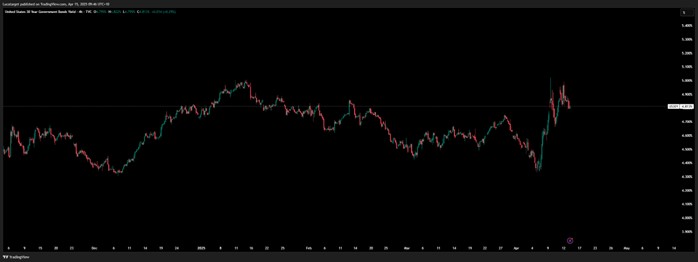
U.S. Treasury yields have surged the 30-year is brushing up against January highs but instead of reinforcing the dollar, the rally in yields is being interpreted as a red flag for fiscal credibility. Meanwhile, the DXY index has slipped to levels not seen since 2022, and EUR/USD broke out above both 2023 and 2024 highs last week. The loss of confidence in the U.S. bond market and by extension, the dollar is palpable.
Let’s be clear: this isn’t a pivot. Trump made it clear this weekend that “nobody is getting off the hook,” framing the tariff rollback as a prelude to a more targeted set of sector-specific tariffs especially on semiconductors and broader electronics supply chains. Commerce Secretary Lutnick echoed this view, suggesting new tariffs could be rolled out within the next couple of months. This is consistent with Washington’s increasing rhetoric about reshoring critical supply chains and reducing dependence on China.
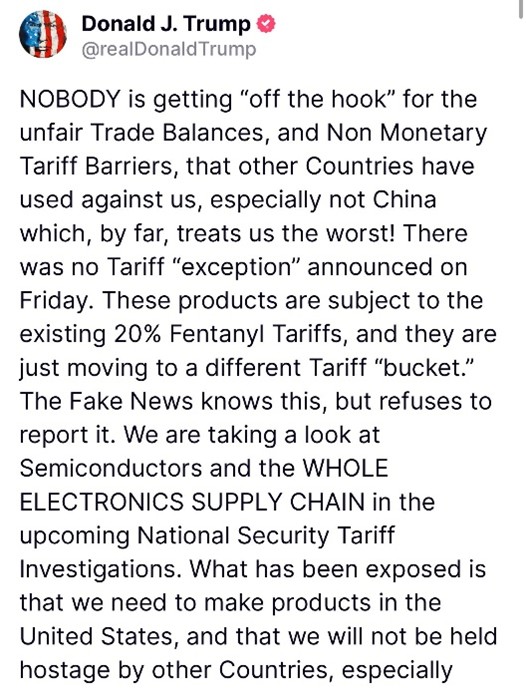
Yet this piecemeal approach adds layers of uncertainty. The reprieve covers nearly $400 billion in imports a quarter of which are Chinese but if the new tariffs that replace them land between 10% and 125%, that spells volatility, not stability.
Markets are looking past the near-term headlines and focusing on the broader message: U.S. economic policy lacks a coherent long-term strategy. The latest tax cut proposals, currently being debated between House and Senate Republicans, only deepen the disconnect. The market smells another debt-funded giveaway, and bond investors are hitting the exits accordingly.
China’s own reaction may be reinforcing this trend. While there’s no sudden drop in Fed custody data, the reality is that Beijing has been reducing its holdings of U.S. Treasuries for years. Whether this is a strategic divestment or defensive positioning, it undercuts the safety net the U.S. has traditionally relied on.
At this point, we’re seeing a decoupling between rates and FX something that would’ve been unthinkable just a year ago. Despite rising yields, the dollar is falling, because the core issue isn’t interest rate differentials anymore it’s trust.
This week’s central bank meetings Bank of Canada on Wednesday, ECB on Thursday are set against a backdrop of tariff uncertainty and fragile sentiment. The ECB is widely expected to cut rates by 25bps, with markets now pricing in an additional cut down to 1.75% before year-end. The euro’s real effective exchange rate (EER-41) has surged 5.5% since March, which alone could shave 0.1–0.2ppt off inflation forecasts, pushing them further below the 2% target.
Canada is in a trickier spot. While inflation expectations are edging up — partly due to a more aggressive retaliatory stance against U.S. tariffs the BoC is likely to hold for now, especially with a federal election looming on April 28.
Still, FX market reaction to these decisions may be muted. The usual playbook rate divergence driving currency strength is falling apart as macro risk and political noise override traditional fundamentals. Current EU-US and Canada-US 2-year swap spreads suggest EUR/USD should be closer to 1.06 and USD/CAD near 1.43, yet reality paints a very different picture.
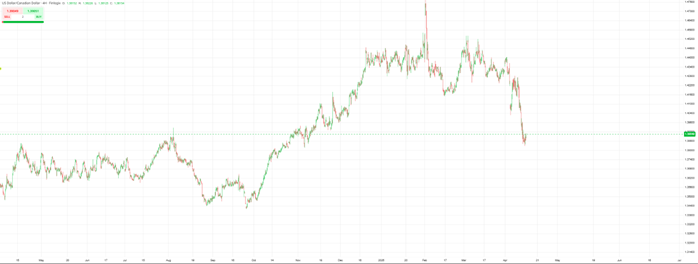
As of today, equity markets across Asia are green and U.S. futures are up, but beneath the surface lies a fragile narrative: the dollar’s credibility is in question. No amount of temporary tariff relief can fix that.
Markets are now operating in an environment where policy whiplash is the norm and confidence in the U.S. fiscal trajectory is fraying. Unless there’s a meaningful shift either in fiscal responsibility or strategic clarity the risk is that the dollar’s decline becomes less of a correction and more of a trend.
This content may have been written by a third party. ACY makes no representation or warranty and assumes no liability as to the accuracy or completeness of the information provided, nor any loss arising from any investment based on a recommendation, forecast or other information supplies by any third-party. This content is information only, and does not constitute financial, investment or other advice on which you can rely.
ACY Securities is one of Australia's fastest growing multi-asset online trading providers, offering ultra-low-cost trading, rock-solid execution, technologically superior account management and premium market analysis.

Select the categories and companies you wish to follow directly to your person rss feed.
Create Custom RSS FeedSign up and join over 5,000 professional members who receive personalized news alerts, curated professional connections, and more for free!
The AI trade has always been a supply chain story. For the past two years, the narrative has been simple: insatiable demand for compute infrastructure, constrained supply at every choke point, and the companies that own the bottlenecks collect the toll. NVIDIA on GPUs. ASML on lithography. Samsung, SK Hynix, and Micron on memory. The entire semiconductor complex has traded on scarcity, and scarcity has delivered historic margins.
Interactive Brokers reported customer equity of USD 964.7 billion at the end of the third quarter, up 27% year on year, as customer accounts increased 35% to 5.58 million.
Crypto exchange BingX has secured a Markets in Crypto-Assets Regulation (MiCA) licence for its European arm from Austria's Financial Market Authority (FMA).
CXM Group has agreed to acquire TD Markets (Pty) Ltd, a Johannesburg-headquartered broker authorised by South Africa’s FSCA. TD Markets keeps its brand, team and licence, and Amar Ramith stays as CEO. Financial terms were not disclosed. The deal gives CXM a regulated base in South Africa. Clients need take no action.
Global equities under pressure: Hotter than expected US inflation and rising yields weighed on stocks, particularly technology and semiconductor shares.
Understand trading psychology and learn how a clear strategy, risk management and a trading journal help build discipline and day trading consistency.
Ripple Prime has launched support for real-world asset perpetual swaps, giving institutional clients including Virtu exposure to more than 100 reference markets across equities, indices, ETFs, metals, energy and FX. The swaps reference Trade.xyz perpetual futures on Hyperliquid and trade and settle around the clock.
iSAM Securities Apex has integrated with Crossover Markets, connecting brokers to CROSSx, its institutional digital asset ECN, through Apex’s ultra-low-latency technology stack.
Your Bourse and 4XPORTAL highlight their existing partnership, combining client onboarding, CRM and payment solutions with liquidity, execution and risk-management infrastructure for brokers.
The partnership brings together 4XPORTAL’s brokerage technology capabilities with Your Bourse’s connectivity, liquidity aggregation, and risk-management infrastructure.