just now


Liquidity Finder Ltd is incorporated in England and Wales, company number 10610740, registered address 167-169 Great Portland Street, Fifth Floor, London W1W 5PF, United Kingdom.
Published: just now


The Big Picture
Welcome to the era of increased economic tensions, rising inflation, heightened sovereign debt, and elevated interest rates—where peace takes a back seat to financial challenges. This is the new normal we find ourselves in.
The momentum toward de-globalization, set in motion immediately after the pandemic, has been confirmed in 2023. Geopolitical tensions ensure that this trend will persist for the foreseeable future. The conclusion of the 'risk-free' world and the disappearance of the 'peace dividend' signify a heightened weaponization of the global economy. Economic policies are now employed defensively, aiming to bolster self-sufficiency in crucial sectors (such as Europe's focus on energy and the relocation of computer microchip manufacturing away from Taiwan). Simultaneously, these policies are used offensively to diminish competitors' economic influence, as seen in China's approach to electric vehicles (EVs).
The surge in protectionism is driven by a significant increase in public debt. In response to this, the US government has taken a proactive stance through the Inflation Reduction Act (IRA), which entails USD 394 billion in tax incentives. This move is a deliberate effort to propel its economy forward, particularly in the green sector. Japan, with its Green Transformation Act amounting to USD 1 trillion, and Canada, with an USD 80 billion plan embedded in the 2023 budget, have both mirrored the IRA's approach. France and Australia have also adopted similar measures.
The ongoing restructuring of the global economy is poised to result in widening disparities between nations, notably in their capacity to transition towards greener energy sources. This transformation may lead to economic inefficiencies and a temporary alleviation of higher prices due to escalating government deficits and debt. However, this very factor may subsequently diminish the preparedness of developed and emerging markets to effectively respond to any future financial or economic shocks.
Main Conflicts in 2023
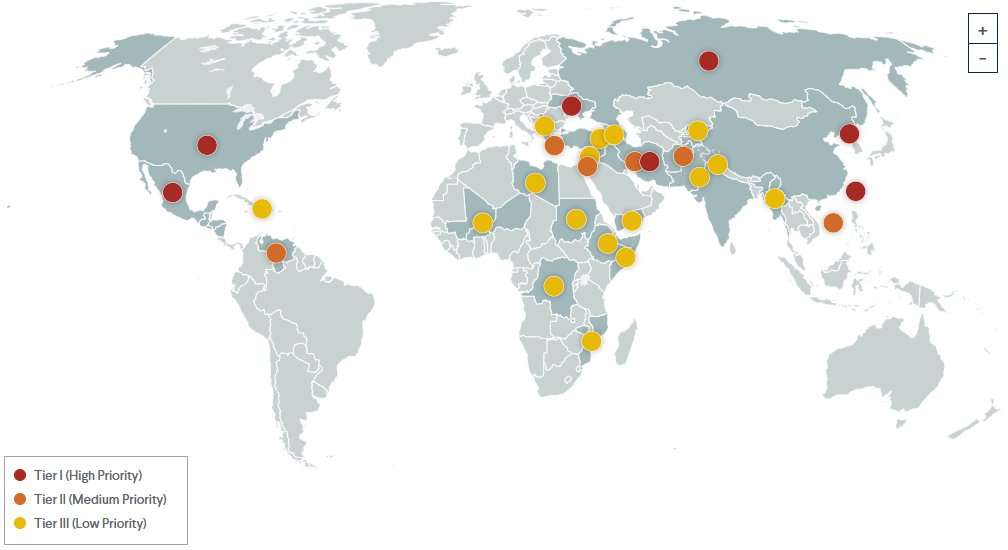
Source: Council on Foreign Relations (cfr.org)
In 2024, there is a discernible trend indicating that financial assets are poised to progressively incorporate an elevated level of risk within the environment.
My overarching global scenario is built upon three central concepts:
These three key ideas collectively shape the global landscape, indicating the need for a recalibration in financial markets to accommodate the heightened multi-risk environment, sustained inflation, and the prolonged absence of fiscal measures targeting debt reduction.
In summary, my perspective is that financial assets will progressively adapt to the heightened risk environment. This adaptation is influenced not only by the increased risks across various factors but also by the availability of a greater number of investment alternatives offering higher yields.
Inflation: Targets Remain Elusive
United Stated Inflation
Following a surge in December driven by base effects, I anticipate a gradual decrease in headline CPI throughout the first half of 2024, returning to approximately 2.5%. Concurrently, core CPI is expected to exhibit a more stable, albeit gradual, decline towards 2.7% over the same period. Once reaching these levels, achieving further disinflation becomes challenging, and I anticipate it will persist within this range through 2025, remaining above 2%.
Several factors contribute to this outlook:
Eurozone Inflation
Despite the recent moderation in Eurozone inflation, I anticipate a resurgence, driven by the shift from negative to positive base effects, particularly for energy. In 2024, I project Eurozone inflation to hover around the 3% mark. Several factors contribute to my expectation that inflation will not converge towards the 2% target in the coming year:
These four factors collectively contribute to my outlook of Eurozone inflation remaining near the 3% threshold in the coming year, diverging from a convergence towards the 2% target.
BoJ: Persistent Commitment to Easing Policies
Amidst the prospect of a potential global economic slowdown and persistent structural deflationary pressures, coupled with the government's unwavering commitment to Abenomics, the Bank of Japan (BoJ) is expected to maintain its current stance in 2024. As the global economy experiences deceleration, the peak in upward pressure on global bond yields is anticipated to alleviate some of the YCC (Yield Curve Control) framework's challenges, providing leeway for the BoJ to sustain its existing policies.
The BoJ appears strategically inclined to lag other major central banks by one cycle when it comes to initiating the normalization process. The prevailing viewpoint suggests that the BoJ may exit from YCC in 2025, foreseeing inflation reaching or exceeding 2% in FY26 and FY27. Following this, a shift away from the negative interest rate policy is projected for 2026, contingent upon confirmation that inflation is consistently at or above 2%, and as corporate savings return to negative territory.
However, if the BoJ cannot anticipate achieving the 2% inflation target in 2025, there might be a revision of the YCC framework. In a scenario where the U.S. economy surpasses expectations and the market ceases to anticipate Fed rate cuts, the BoJ could potentially exit from YCC before the projected timeline of 2025, introducing an element of risk to the forecast.
ECB: Anticipated Delay in Rate Cuts and Full Quantitative Tightening (QT) in 2024
I anticipate that the European Central Bank (ECB) will initiate rate cuts in September 2024. In this scenario, I envision the ECB having inflation projections reaching 2% within the subsequent 18 months, specifically reaching this target in March 2026 by September 2024. This milestone is considered a prerequisite for the ECB to commence its path towards its neutral rate.
Once the initial rate cut is implemented, my expectation is that the ECB will proceed to cut rates by 25 basis points at each meeting until reaching its estimated neutral rate of 2.5% in Q2 2025. While not included in my central scenario, the possibility of another rate hike at the beginning of 2024 is not ruled out. This could occur if inflation exhibits more persistence than anticipated, and economic growth experiences improvement, prompting the ECB to consider further monetary policy tightening.
Regarding quantitative tightening, I anticipate the ECB to persist with its full Quantitative Tightening (QT) on the Asset Purchase Program (APP), which commenced in July 2023. I expect an acceleration of the reduction of its balance sheet by initiating the reduction of holdings in the Pandemic Emergency Purchase Program (PEPP) in Q1 2024, contrary to the current communication indicating QT on the PEPP in 2025 at the earliest.
It's noteworthy that a significant portion of the balance sheet reduction will likely occur through Targeted Longer-Term Refinancing Operations (TLTRO) repayments, with banks expected to repay around EUR 500 billion between December 2023 and December 2024.
Fed: Prolonged Commitment to Higher Rates Implies a Gradual Initiation of Easing Cycle
This content may have been written by a third party. ACY makes no representation or warranty and assumes no liability as to the accuracy or completeness of the information provided, nor any loss arising from any investment based on a recommendation, forecast or other information supplied by any third-party. This content is information only, and does not constitute financial, investment or other advice on which you can rely.
ACY Securities is one of Australia's fastest growing multi-asset online trading providers, offering ultra-low-cost trading, rock-solid execution, technologically superior account management and premium market analysis.

Select the categories and companies you wish to follow directly to your person rss feed.
Create Custom RSS FeedSign up and join over 5,000 professional members who receive personalized news alerts, curated professional connections, and more for free!
Multi-asset trading broker AvaTrade has agreed to acquire the majority of FXCM Group’s business and brand, in a transaction that would bring a longstanding retail FX franchise into the AvaTrade Group.
LSEG and CMC Markets have signed a multi-year strategic data agreement expanding CMC's access to LSEG's real-time and delayed pricing, reference and corporate actions data, news and analytics, plus AI-ready content, to support new products, entry into new markets and the growth of CMC's institutional and B2B partnerships.
The Tel Aviv Stock Exchange is considering a bid for the Cyprus Stock Exchange, with Israeli media citing its EU licence, trading platform and clearing house. Euronext’s Athens exchange and India’s National Stock Exchange are also seen as contenders, and Cyprus aims to sign a sale agreement by the end of this year.
CME Group will launch baseball futures on 12 October, pending regulatory review, tracking CME FutureSports Performance Indexes built on Official League Data. Standard and micro contracts will start with the 2026 Postseason and the four clubs in the League Championship Series, trading around the clock.
ESMA has published an opinion stating that MiCA-authorised crypto-asset service providers should cease services tied to non-MiCA-compliant stablecoins for EU clients across MiCA crypto-asset services. National authorities should require remediation of existing exposures within three months, by early January 2027.
Nasdaq Ventures has made a strategic investment in Amsterdam-based derivatives and crypto exchange One Trading, with both firms to explore 24/7 trading of equity futures. The undisclosed investment follows Nasdaq's US$100 million investment in Payward, the parent of Kraken, and CME Group's move to 24/7 trading.
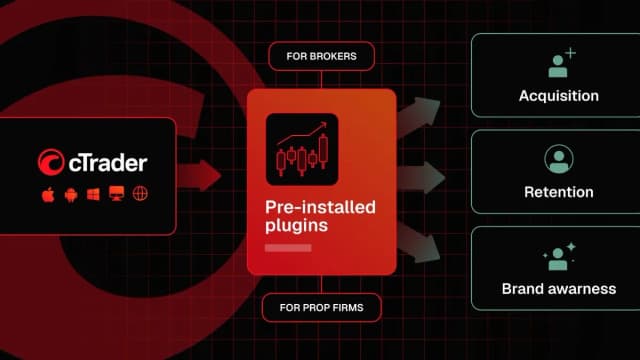
cTrader has opened multi-platform plugins to brokers and prop firms, which can pre-install their own tools for clients or list them in cTrader Store. The plugins run across Mobile, Web, Windows and Mac, and can be built and launched independently of core-platform releases, including trading journals and calculators.
Institutional brokerage and financial infrastructure provider Clear Street has joined TradingView’s broker network, allowing its clients to trade US stocks, exchange-traded funds and options directly through the charting and analysis platform.
Learn how to improve trading psychology, manage fear and greed, avoid revenge trading, and follow your trading strategy with discipline and a trading journal.
GTC Prime has announced a strategic partnership with Centroid Solutions to manage and distribute its liquidity through CS 360 Bridge, Centroid's multi-asset connectivity and execution engine, giving brokers and institutional clients access to tailor-made pricing, low-latency execution and real-time risk management.