
just now


Liquidity Finder Ltd is incorporated in England and Wales, company number 10610740, registered address 167-169 Great Portland Street, Fifth Floor, London W1W 5PF, United Kingdom.
Published: just now
Most brokerage professionals already know where the friction is. The CRM that needs manual updates from the trading system. The IB commission run that takes the finance team two days every month.
The bonus campaign had to be reviewed because the cost came in higher than projected. The dealing desk workaround during a volatile session because the margin logic was not pre-configured for it.
These are not signs that something is fundamentally broken. They are signs that the systems running the business were each built for their own purpose and were never designed to share information automatically. That is a very common position to be in, and it has a very practical solution.
The brokers who are gaining the most operational ground in 2026 are not necessarily running more sophisticated strategies or operating in easier markets. They are running connected infrastructure. One environment where the functions that drive the business share a common data layer and act on each other’s outputs without requiring someone to move information between them manually. That is the shift this article is about.
What a Connected Operational Environment Actually Looks Like
Connected does not mean a single dashboard that pulls reports from separate systems. It means the systems themselves are integrated at the data level, so that an action or event in one function can automatically trigger a response in another without human initiation.
A few practical examples of what this looks like when it is working. When a client’s trading behaviour crosses a risk threshold your dealing desk has defined, the CRM flags that account automatically. When an IB’s referred client quality drops based on actual trading data, the commission logic reflects it without a manual review. When a bonus campaign starts generating the pattern of minimum-volume withdrawal activity, the automation layer identifies and acts on it before the cost builds further.
None of these require someone to notice the signal, make a decision, and then execute it manually across two or three separate systems. They happen because the infrastructure is configured to make them happen. The team focuses on the decisions that genuinely require judgment. The operational layer handles the rest.
The Six Functions That Benefit Most From Being Connected
For a forex or CFD broker, there are six operational functions where the benefit of connection is most direct and most measurable.
Risk Management
Dealing desks operate best when they are monitoring and confirming rather than implementing changes manually under pressure. Pre-configured rules that execute when defined thresholds are crossed give the desk that position.
Without the connection between live trading data and the margin configuration layer, the desk is always responding to conditions that are already further along than the available data shows.
Client Relationship Management
A CRM is only as useful as the data it has access to. The signals that indicate a client is about to disengage, is ready to increase activity, or needs a specific intervention live in the trading infrastructure. A CRM connected to that data makes retention and reactivation work more precise and more timely. One that is not is working with a partial picture.
Copy Trading
Copy trading environments generate risk in ways that are not always visible in the individual account view. Follower concentration across a single strategy, execution quality under heavy simultaneous order flow, cross-server replication consistency. These are operational considerations that require visibility at the ecosystem level, not just the account level. Real-time monitoring at that level is what allows proactive management.
IB and Affiliate Management
Partner networks scale cleanly when commission logic is automated and performance data is connected to actual client trading behaviour. Without that connection, the administrative overhead of managing the network grows with it. With it, the network can grow without the back office growing proportionally.
Bonus and Campaign Management
Campaign performance is visible in real time or it is visible after the fact. When the campaign management layer is connected to live trading data, eligibility rules and abuse detection run continuously. When it is not, the review happens after the campaign has run and the cost has been incurred. The difference in commercial outcome between those two positions is significant across a full year of campaign activity.
MAM and PAMM
Managed account structures require automated allocation, transparent fee calculation, and a complete audit trail to operate professionally at scale. These are not optional features for a serious managed account offering. They are the operational foundation that makes the product credible to investors and manageable for the ops team.
The YOONIT Trading Solution
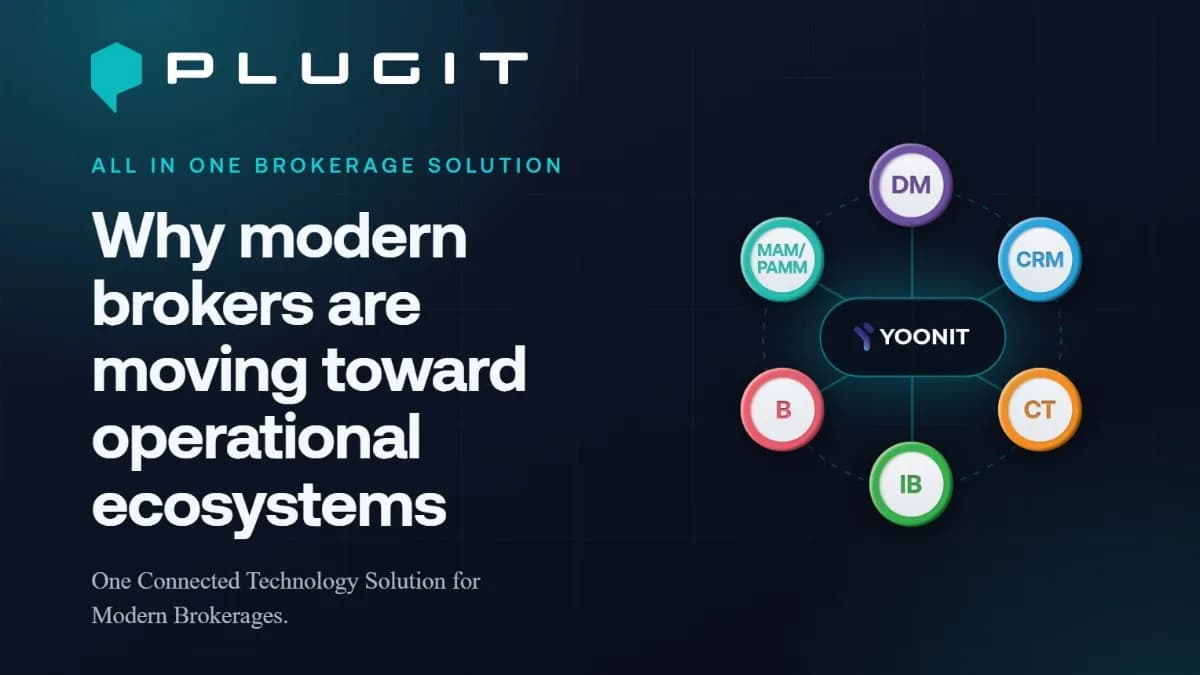
YOONIT is the connected operational ecosystem PLUGIT has built for forex and CFD brokers on MT4 and MT5. Six integrated modules covering each of the functions above: Dynamic Margin, CRM, Copy Trade, IB and Affiliate Management, Bonus Automation, and MAM/PAMM.
Each module works independently for brokers who want to address one specific function. Together they form a unified operational layer where data moves automatically between functions and configured rules execute without manual initiation. YOONIT does not replace existing trading infrastructure. It connects to it, running natively on the platforms already in use.
What Brokers Are Seeing When the Infrastructure Is Connected
The practical improvements that follow from moving to a connected operational environment are consistent across brokers of different sizes and different product focuses.
The dealing desk operates against pre configured rules rather than implementing changes manually under pressure. Operations teams spend less time on reconciliation and more time on decisions that require judgment. Partner commissions are accurate and paid on schedule without a monthly manual process. Campaign costs are visible in real time rather than surfacing in the month-end review.
Over time these improvements compound. Stronger margins on the same revenue. The ability to grow partner networks and client volumes without growing the back office at the same rate.
A client management function that is working from complete data rather than a partial picture. These are measurable operational improvements, not aspirational ones. They are what brokers who have made this shift are already experiencing.
The PLUGIT team works with brokers at every stage of this process. Whether the starting point is one specific module or a full operational review, the right approach depends on the brokerage model and the specific functions where the friction is most visible. That is a conversation worth having directly.
What Changes When the Shift Is Made
The brokers who have moved from a fragmented stack to a connected operational environment describe consistent and immediate improvements. The dealing desk stops reacting to risk events and starts operating against rules that have already accounted for the most common ones.
The ops team stops spending its capacity on manual reconciliation and starts spending it on the decisions that actually require judgment and experience. Partner relationships improve because commissions are accurate, transparent, and no longer require monthly reconciliation meetings. Campaign costs become predictable because the monitoring is continuous rather than retrospective.
These are not dramatic changes in isolation. Over twelve months they compound into a measurably more efficient operation: stronger margins on the same revenue, the ability to grow the partner network without growing the ops team proportionally, and a client management function that is informed by complete data rather than the subset of it that happens to live in the CRM.
The shift toward operational ecosystems is happening across the industry in 2026. The brokers making it earliest are building the operational foundation that will determine their competitive position for the next several years.
The PLUGIT team works with brokers at every stage of this process, from initial assessment through to full YOONIT deployment, and would be glad to show you what the connected alternative looks like for your specific MT4, MT5 and cTrader platform setup.
 Speak with a PLUGIT specialist.
 +35725025026
Select the categories and companies you wish to follow directly to your person rss feed.
Create Custom RSS FeedSign up and join over 5,000 professional members who receive personalized news alerts, curated professional connections, and more for free!
AUDCAD price forecast tracks a bullish retest of 0.99265–0.99450 toward 0.99940, with a weekly support breakdown putting 0.98740 in focus.
Visa has received approval of its Application to Prepare from the People's Bank of China, allowing it to begin formal preparations to establish a domestic bankcard clearing institution in China. The company will now work to complete the process under PBOC regulations before starting domestic clearing operations in the country.
Plus500 has conditionally agreed to acquire Hedge Capital Markets, an SEC-registered US broker-dealer, marking its entry into US securities. The cash-funded deal supports a planned US super-app in Q1 2027 combining futures, prediction markets, stocks, options and ETFs, plus a new hub in New York.
MAS Markets has appointed Simon Naish as Head of APAC to lead its plans across the Asia-Pacific region. Naish brings over 30 years of experience in institutional banking and FX, most recently as Country Head at ATFX Global and previously 33 years at National Australia Bank (NAB) across Asia-Pacific and global markets.
BTCUSD rejects $78,400–$82,175 support. Watch bullish follow-through toward $86,550 and a daily close below $80,268.75 for weakness.
Gold price forecast: Watch $4,175–$4,190 support for bullish confirmation toward $4,265, or a weekly support breakdown toward $3,935.
WTI crude oil price forecast: A confirmed breakout above $94.765 could open the way toward $100.305, while weekly support remains at $87.360–$90.830.
NAS100 price forecast recap: Explore the Nasdaq 100 rally to 31,401.3, with technical analysis of the breakout and key support and resistance levels.
Learn how to identify, draw and trade XAUUSD supply and demand zones using Gold market structure, price action confirmation and clear risk management.
cTrader has been named Best Trading Platform at UF Awards APAC 2026 during iFX EXPO Asia in Hong Kong.