
Search Companies, News, Members & more
Terms of ServicePrivacy PolicySecurity PolicyLegal InformationCommunity GuidelinesSitemapsCookie Settings
2026 Copyright © Liquidity Finder Ltd. All rights reserved.
Liquidity Finder Ltd is incorporated in England and Wales, company number 10610740, registered address 167-169 Great Portland Street, Fifth Floor, London W1W 5PF, United Kingdom.
Why Brokers Should Be Adding Prediction Markets

Published on Oct 27, 2026
Updated on Oct 27, 2026
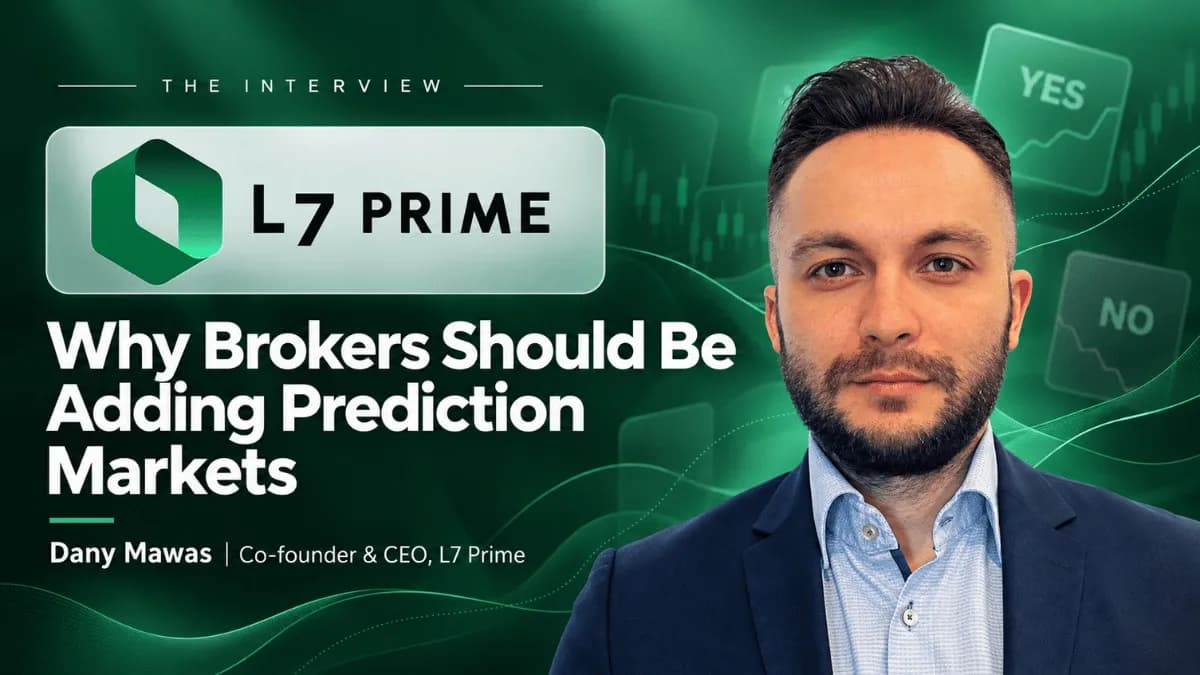
Dany Mawas, co-founder and CEO of L7 Prime, thinks prediction markets are where brokers should be looking now, both to win back clients and to reach new ones. I asked him why, how a broker plugs them into its business, and where that leaves prop firms and 24/7 gold.
L7 Prime is a brokerage technology and infrastructure provider. It pulls together the technology, liquidity, payments and operating services that brokerages, prop firms, asset managers and, increasingly, prediction market platforms need to launch and grow. It started life as Fortress Core, holds a Category I licence from South Africa's Financial Sector Conduct Authority (FSCA), and works with trading platforms including MetaTrader, cTrader, DXtrade and TradeLocker.
L7 Prime is part of the ATFX group, and its clients get institutional liquidity through ATFX Connect (@ATFXConnect), the group's institutional arm. Dany was keen to make clear that they are two separate businesses with different models: L7 Prime is the tech provider and ATFX Connect is the liquidity provider. Dany is co-founder and CEO of L7 Prime, and earlier this year ATFX also appointed him its CEO for Africa.
L7 Prime has spent a lot of time building a white-label prediction market product for brokers, so Dany has had a number of these conversations with brokers. We started with prop firms, because that is where his argument begins.
Is The Prop Firm Model Dying?
Sam Low: When we spoke in Dubai, you hinted that you have new things coming down the pipe. Before we get to those, I know you have strong views on prop firms.
Dany Mawas: My personal opinion is that prop firms are pretty much dying now. I mean the prop firm model. You will always find very successful prop firms. Generally, they either have access to a very niche market they can monetise, or they have been around for ten years, like FTMO, and they will always make money simply because of their name. But starting a prop firm in 2026 and hoping to make money out of it? I would tell you no way.
Sam Low: Why is that? Is the market saturated?
Dany Mawas: Yes, the market is saturated. Over the past two or three years, most prop firms dropped the price of their challenges, so they drastically cut their margins. Then, because the one-step and two-step model was saturated, they came up with instant funding. Now you see prop firms offering a USD 10,000 account for USD 8.99 with instant funding.
With instant funding, you as the prop firm are exposed from the start, and to manage that risk you need a decent balance sheet. If you are not well capitalised, either you do a deal with another provider to run the risk for you, and very likely give away something like 50% of your profits, or you go bust.
Because there are so many prop firm tech providers now, it's very easy to open a prop firm, but not so easy to manage the risk. So, for me, prop is very good for well-established brokerages as a lead magnet, a client acquisition tool. If you can make a little bit of money out of it, great. But that's where it will stay.
Sam's note: Instant funding skips the evaluation, so the firm is paying out on the trader's results from the very first trade. That pulls the risk onto the firm's balance sheet much earlier.
Where Is The Opportunity Now?
Sam Low: So if prop is running out of road, where is the opportunity?
Dany Mawas: Prediction markets. It's not the next thing; it's already here. But not many people have managed to get into it yet, because there aren't many tech providers. That's why we have spent quite a bit of time developing a white-label prediction market solution, and why we went quite deep into the rabbit hole.
I can see more and more brokerages offering prediction markets as their next client acquisition tool. But not only that: you can actually make a lot of money out of it, so it becomes another revenue driver for the brokerage.
Sam Low: Where does the liquidity come from? Are we talking about Kalshi and Polymarket?
Dany Mawas: Kalshi, Polymarket, and also Crypto.com, which has quite a good offering. Those three can give you the liquidity access to get going. Eventually, with any of these business models, you will want to make markets yourself, but that's a completely different kind of business. These venues let you get started. You find a tech provider, you push the flow back to them, you mark up your contracts and you make money out of it.
Sam Low: Are we talking about financial and economic events only, or football and baseball too?
Dany Mawas: It's a very good question, and it comes down to which region you are targeting. If you are a well-established broker, multi-regulated all over the world, I don't think you want to push your luck with sports contracts. In most regions, the regulators looking into it see sport as more of a betting or gambling product than a financial product, so steer clear.
Anything event-related, crypto or politics, why not? You can offer it and see how it goes. But be careful about the regions you go into, and clear your way with a law firm and a legal opinion first.
Sam Low: Which territories are open, and which are difficult?
Dany Mawas: Generally speaking, Africa and Latin America are quite open. Europe is becoming a no-no. In Asia, a few countries are open, but others are completely closed, where the authorities have said you need a licence or it's prohibited. But the world is big. It comes down to picking the right markets.
Sam Low: When I interviewed Andy Ross, head of institutional at Kalshi, he convinced me this is a valid financial product. Event contracts can be used to hedge, in the same way CFDs can. I think regulators who lump them in with binary options are missing that.
Dany Mawas: You're right, it's a legit product. We just need some sort of framework in place. We will know in the next few months how the regulators are looking at it. Some regulators are known for banning anything they don't understand, and hopefully we won't get into that conversation again with prediction markets.
How Do Brokers Plug Prediction Markets Into Their Business?
Sam Low: So what's the missing piece that lets a CFD broker bring Kalshi or Polymarket into its stack?
Dany Mawas: It's the tech behind it, and being able to spin it up quickly. Within about a month, we can deliver a fully branded solution from A to Z, integrated with the broker's own infrastructure: payments, KYC, email, messaging like WhatsApp and Telegram.
Well-established brokers are multi-regulated, with hundreds of thousands of traders, so it will be very easy for them to monetise it. By the end of 2026, I think most CFD traders will be aware of prediction markets.
Sam Low: Where does the money come from for the broker?
Dany Mawas: Think of all the cross-selling between CFDs and prediction markets, in both directions.
First, your existing clients. From your client portal, you introduce a prediction market account. The broker already has all of the client's information, so the client is already pretty much onboarded, or you reuse their KYC if the prediction market offering sits in a different entity. The client clicks, and they can start trading. You can even link the balance on their trading account so they can cross-margin and don't have to deposit again. That's a great way to generate revenue from inactive clients who no longer trade CFDs but want to try prediction markets, or to boost revenue from active ones.
Second, you promote your prediction market offering to your existing database, which everyone will be doing for sure.
Third, you pick up new clients. No one had heard of your CFD brand, but now they want to try your prediction markets.
Fourth, partners. If you want to be partner-led, you onboard affiliates to push your prediction market offering, and they bring you traffic you couldn't get before. That traffic is closer to iGaming than CFDs, so it's a completely different client profile. And then you can cross-sell them back into CFDs.
Sam Low: When I look at what Plus500 is doing, or IG buying Underdog, part of it feels defensive. Everyone is trying to offer everything, and brokers need to offer prediction markets to stay in competition.
Dany Mawas: Across a lot of conversations over the past few months, you get the feeling they all have the same ultimate plan: an all-in-one app where users can trade everything, including online banking. The well-established crypto exchanges and brokerages want prop, prediction markets, online banking and cash equities, so they can cater to every kind of client profile, get them in and keep them there.
Look at IG buying Underdog for more than a billion dollars. Of course, the new management comes from gaming, but still, it tells you something. A well-established CFD shop is diversifying away from CFDs only, because it understands it needs to attract new types of clients.
[Sam's note: IG Group agreed in July to buy Underdog, a US daily fantasy sports and prediction markets operator, for up to USD 1.3 billion. Underdog is the third-largest US prediction markets venue, behind Kalshi and Robinhood, and brings its own futures commission merchant, exchange and clearing licences. IG's chief executive, Breon Corcoran, previously ran Paddy Power Betfair, which is the gaming background Dany is referring to.]
Sam Low: Does this mean getting prediction market prices into MT5 or cTrader, or is it a standalone product?
Dany Mawas: It's more about integrating the front end into the brokerage's client portal, not the trading platform itself. We are quite far from integrating with the likes of MT5, and even if you managed it, which at the end of the day is just a FIX API of some sort, I don't think clients want to trade prediction markets on MT5 or cTrader. They want an easy-to-understand front end, integrated directly into the broker's, prop firm's or crypto exchange's client portal. For anything more advanced, you need a dedicated front end.
The missing piece is doing all of that integration. Even well-established shops know their product and their audience very well, but when it comes to introducing a new product, most of them don't know where to start. They know a few names for tech, but they don't know where to get the liquidity, how to do payments or how to integrate it with their client portal.
Big brands have devs and project managers, but those people are focused on the core business. That's why you see big brands moving into prop five or six years late: they had to find a tech provider that could connect all the dots for them. A tech provider usually gives you the front end, not the liquidity, not the payments, not the compliance.
Is Anyone Trading 24/7 Gold?
Sam Low: While I have you can I ask about 24/7 Gold trading - something I am very interested in at the moment. Quite a few brokers are announcing 24/7 gold, some 24/7 oil and at least one 24/7 silver. Are you seeing much demand?
Dany Mawas: It's a hot topic. We had demand maybe six weeks to two months ago, but it has cooled down. It isn't being traded, and I can guarantee you that, because the trading conditions are terrible. The leverage is terrible and the spreads are terrible.
Retail gold traders are used to trading on super-tight spreads. Over the weekend, you have no choice but to offer gold on much wider spreads, because there is no liquidity.
Sam Low: Will that change? Could weekend liquidity eventually look like midweek?
Dany Mawas: It's like everything. Think of FX trading in 2008. What was your spread on euro-dollar? Two and a half, three pips. Then non-bank liquidity providers came through, brokerages started distributing their own liquidity and taking some risk, and that improved the trading conditions: better leverage, lower margin requirements, more affordable and easier to trade. So yes, for sure. But it's going to take time.
Do we see a need for 24/7 trading generally? Definitely. That's also why prediction markets are big. People want to take sides on events at any time of the day. They don't want to stick to trading hours anymore. And you see it from the exchanges themselves, which are extending their trading hours.
Want To Talk To Dany?
I'm with Dany on 24/7 gold, at least for now. On prediction markets, I think he's right: they are going to be a big part of this market next year, and the brokers who work out the integration early will have a head start.
Dany now has his own AI assistant, making him accessible 24/7 to discuss your ideas, explore opportunities, and help bring your next project to life.
Whether you’re looking to launch a brokerage, introduce prediction markets, or build a new fintech venture, Dany is always open to a conversation.
Try it out: Dany.L7prime.com
And don’t forget to mention that you discovered him on LIQUIDITYFINDER!
Found this interesting? Become a member of LIQUIDITYFINDER, join the community and join the discussion - join here.
Share this article

Comments
Most Recent
Find The Right Partners for
Your Trading Business
Sign up and join over 5,000 professional members who receive personalized news alerts, curated professional connections, and more for free!

Some thoughts from Forex Expo Dubai 2026 about forex brokers: what was going on in the competition for attention, offshore unregulated entities on the same playing field as multi regulated brokers, in-house AI builds and the rise of prediction markets.
The Lowdown - newsletter. Something significant is happening in financial markets right now. Prediction markets are the new shiny object, and they are definitely now an institutional asset class. In the same way that brokers scrambled to add crypto to their offering a few years ago, the smartest operators in our space are already asking how they access prediction markets.

Kalshi is the largest CFTC-regulated prediction markets and event contracts exchange. In this exclusive interview, LiquidityFinder's Sam Low speaks with Andy Ross, Head of Institutional Business, about institutional access, block trading, market making, capital efficiency and the landmark launch of the first regulated perpetual futures on a US exchange, and what it all means for liquidity providers, brokers and institutional FX professionals.

Inside ATFX's global marketing engine with Weems Chan – how a 130-strong team scales retail and institutional growth through localisation, technology and AI.
Create Your FREE Account
Get access to latest news, updates, real-time data, brokerage and trading firm insights and customized information feeds.


Charles Schwab has launched a Model Context Protocol (MCP) server that lets clients connect their own AI platforms to their Schwab accounts.


Gold remains under significant selling pressure. with price now around $3,840. The 1-hour chart confirms the bearish momentum, with price recently breaking below the $3,870 area.

US stock futures are pointing lower at the start of the week, as investors remain cautious following a volatile week on Wall Street, with all eyes now on Nvidia’s highly anticipated earnings report and the latest developments in the AI sector.
CMC Markets has become the first UK-regulated broker to offer options on pre-IPO grey markets, launching with Anthropic. Clients can buy European-style, cash-settled call and put options, with the premium capping losses. The product is live for UK clients from today, with a wider global rollout planned.

Thunes has expanded its Direct Global Network into Bhutan, enabling digital banks, MTOs and remittance providers to send real-time C2C payouts to all licensed bank accounts in the country, so Bhutanese living abroad can send funds home in Ngultrum in seconds. Personal remittances to Bhutan grew 69% from 2024 to 2025.

IG Securities will offer Anthropic (ANT) share CFDs from the first day of the AI company’s Nasdaq listing, expected 19 November 2026. The instrument will be a 24-hour tradable contract with short selling available and up to 5x leverage for individual accounts. IG Securities does not offer physical share dealing.

DBS and Kinexys by J.P. Morgan have launched a solution letting institutions move USD instantly, 24/7, between blockchain-based accounts in the US and Singapore. It links DBS Token Services with Kinexys' deposit network, uses Partior for settlement orchestration, and Ant International is the first client to use it.


AI can write a dealing report in seconds. It cannot take responsibility for one. We look at how many dealing desks now quietly run on AI-generated answers, the risks that creates for brokers, where AI genuinely adds value, and the questions to ask before you trust anyone with your book.

Sky Links Capital has appointed Adel Abi Hanna as Institutional Manager. He brings more than 15 years across banking, financial services and client relationship management, joining from ATFX MENA where he was Senior Manager. Earlier roles include Markets Act, AvaTrade, SquaredFinancial, ATFX Arabic, HSBC and Citi.


Integral's weekly newsletter covering industry insights in the traditional and deFi trading space
Feed