just now

Liquidity Finder Ltd is incorporated in England and Wales, company number 10610740, registered address 167-169 Great Portland Street, Fifth Floor, London W1W 5PF, United Kingdom.
Published: just now

For a year now, the AI build-out has been the cleanest bull case in the market. This week it sent a bill to one of the companies that was supposed to be a winner.
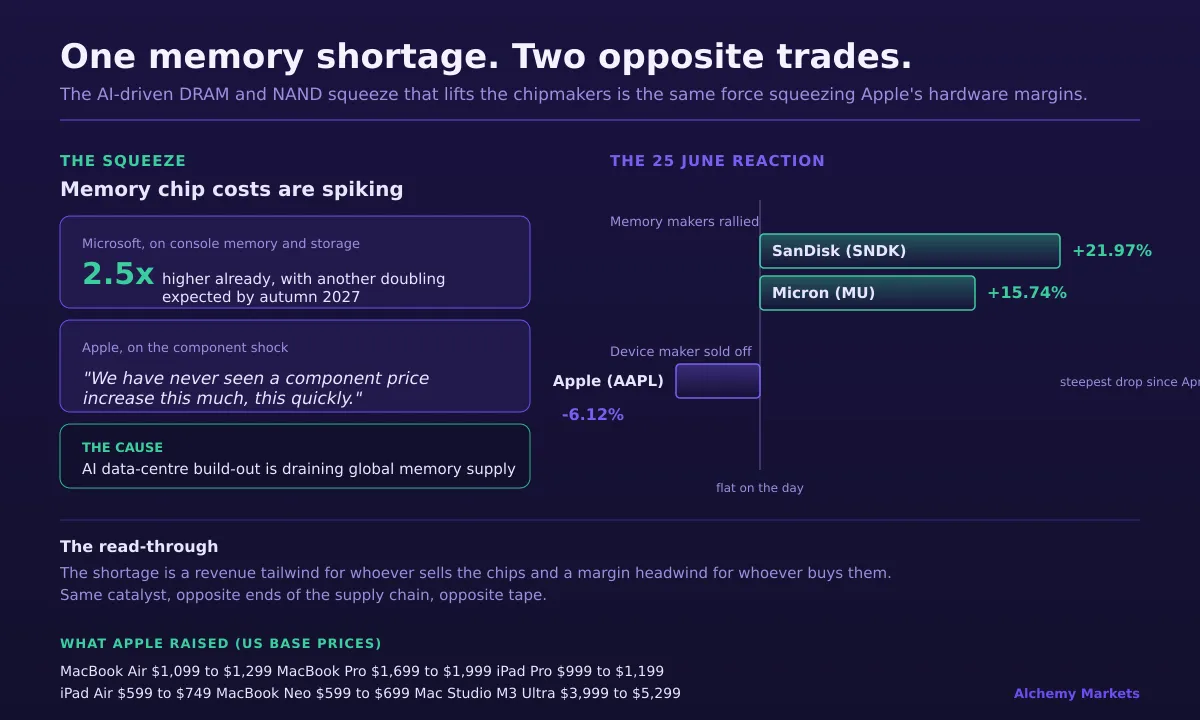
On Thursday, Apple raised prices across its Mac and iPad ranges, with many of the most popular models going up by 20 percent or more. The base MacBook Air moved from $1,099 to $1,299, the cheapest MacBook Pro from $1,699 to $1,999, and the iPad Pro from $999 to $1,199. The entry-level MacBook Neo, a machine that sold partly because it was cheap, went from $599 to $699. The Mac Studio M3 Ultra took the biggest jump of the lot, from $3,999 to $5,299.
The reason was not tariffs, and it was not weak demand. It was memory. Apple told customers it had shielded them from rising component costs until now but had reached the point where it had to start raising prices, blaming an extraordinary surge in demand for memory and storage from AI data centres. The line that stuck was the admission that it had never seen a component price increase this much, this quickly. Microsoft said almost exactly the same thing on the same day, lifting Xbox storage prices and warning that console memory costs had already risen more than 2.5 times with another doubling expected by late 2027.
The market's response told the real story. Apple fell 6.12 percent, its steepest single-day drop since the tariff shock of April 2025. On the same screen, the companies that make the chips Apple now has to pay up for were the best performers in the market. Micron rose almost 16 percent and SanDisk jumped close to 22 percent. One shortage, and the tape split straight down the supply chain. The firms selling memory got a revenue tailwind, and the firm buying it got a margin headwind.
This is worth sitting with, because it reframes how the AI trade filters through the rest of the market. The build-out is no longer a story that lifts everything with a silicon angle. It is starting to pick winners and losers based on which side of the component bill a company sits on. Apple is not facing a demand problem here. Services are still growing, the installed base is intact, and iPhone revenue has been running in double digits. What it is facing is a cost problem that lands directly on hardware gross margins at the worst possible moment, with the next iPhone pricing decision sitting just over the horizon in the autumn. That is the tension the chart has to weigh, and it is the difference between a sharp repricing inside a healthy trend and the start of something heavier.
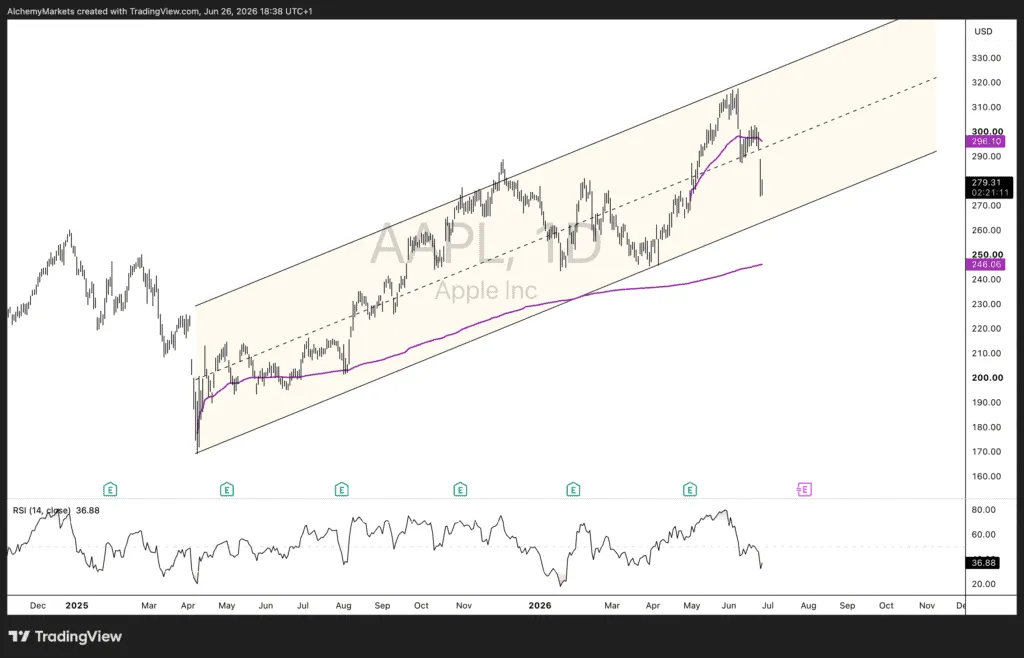
Pull up the Apple daily and the structure is still constructive, which is exactly why Thursday matters. The stock has spent the entire move since the April 2025 lows climbing inside a clean rising channel, and the selloff has knocked it back through the middle of that channel rather than out the bottom of it. RSI has rolled over from the overbought readings it carried into the June highs and now sits in the mid-30s, soft but not yet at the levels that have marked exhaustion lows in this name before.
That leaves two pieces of support doing the work below the current price, and they are where the question gets answered. The first is the lower boundary of the rising channel, which has guided every meaningful pullback for more than a year and continues to climb. The second sits underneath it, the anchored VWAP measured from the April 2025 lows, the average price every buyer in this advance has paid. Those two levels are the line between a margin scare that gets bought and a trend that has genuinely changed character. The fundamentals lean toward the former, since nothing about Thursday touched the demand side of the business, but the honest risk is that the memory squeeze is not a one-quarter event. If component costs are still elevated when Apple has to price the next iPhone, the margin hit repeats, and that is the scenario those supports exist to test.
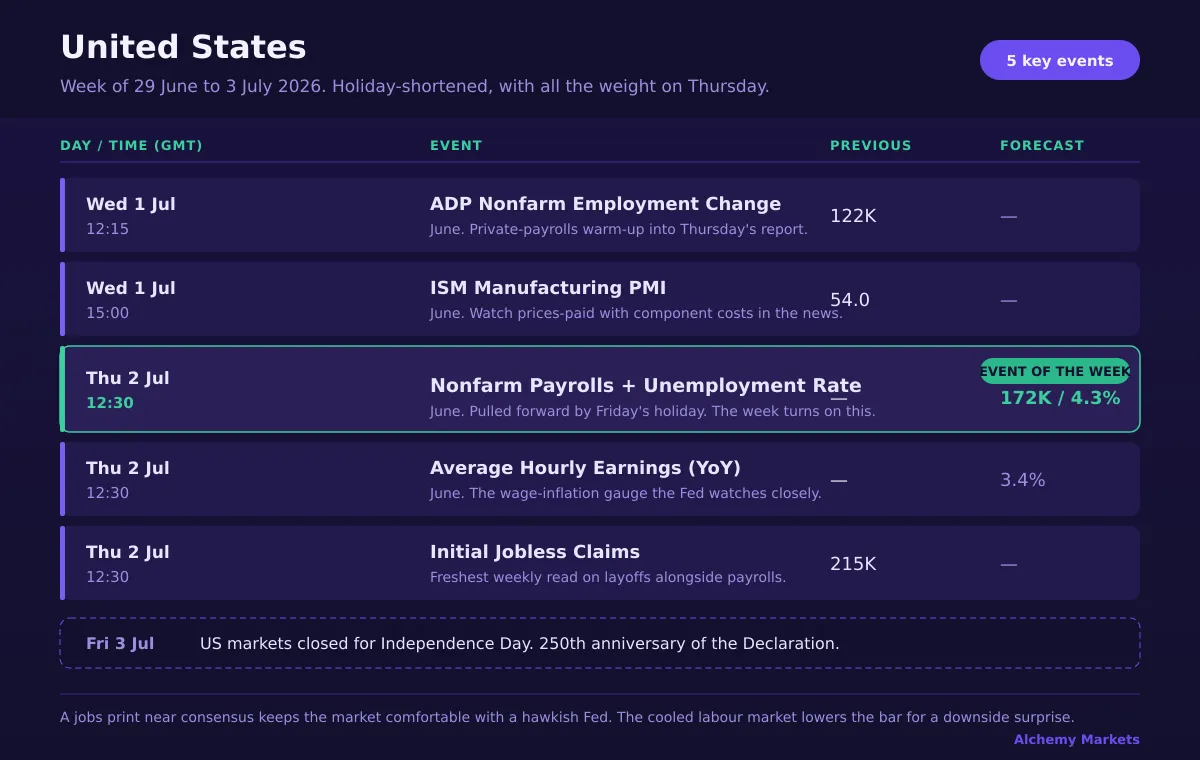
Next week is light on sessions and heavy on consequence. The United States closes on Friday 3 July for Independence Day, which pulls the most important release of the week forward into Thursday and compresses a lot of risk into a short window.
Thursday's June jobs report is the event everything turns on, and the holiday has crammed it together with ISM manufacturing and the ADP read in the front half of the week. A print near consensus keeps the market comfortable with a Fed that has turned hawkish, while a cooled labour market means the bar for a downside surprise is lower than the headline number suggests. On ISM, the prices-paid component is the one to watch, since input-cost pressure feeds straight back into the inflation debate the Fed is leaning on.
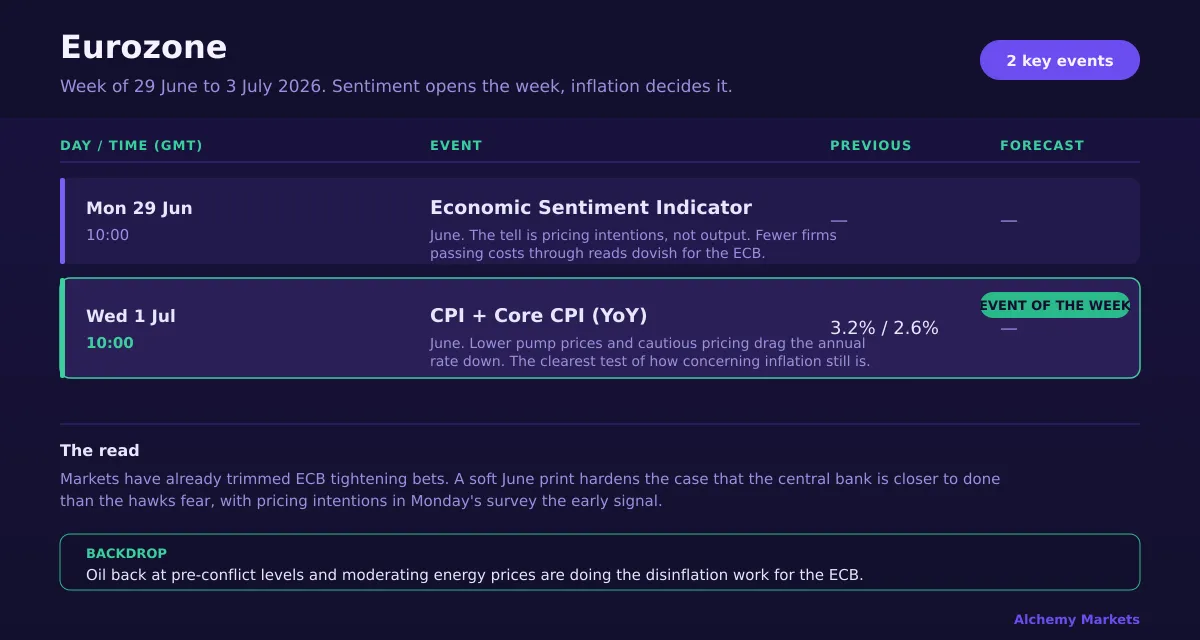
Monday's sentiment survey opens the week, but Wednesday's June inflation print is the one that matters. The tell in both is pricing: fewer firms passing costs through, and a lower annual CPI rate as energy moderates, would harden the case that the ECB is closer to done than the hawks fear.
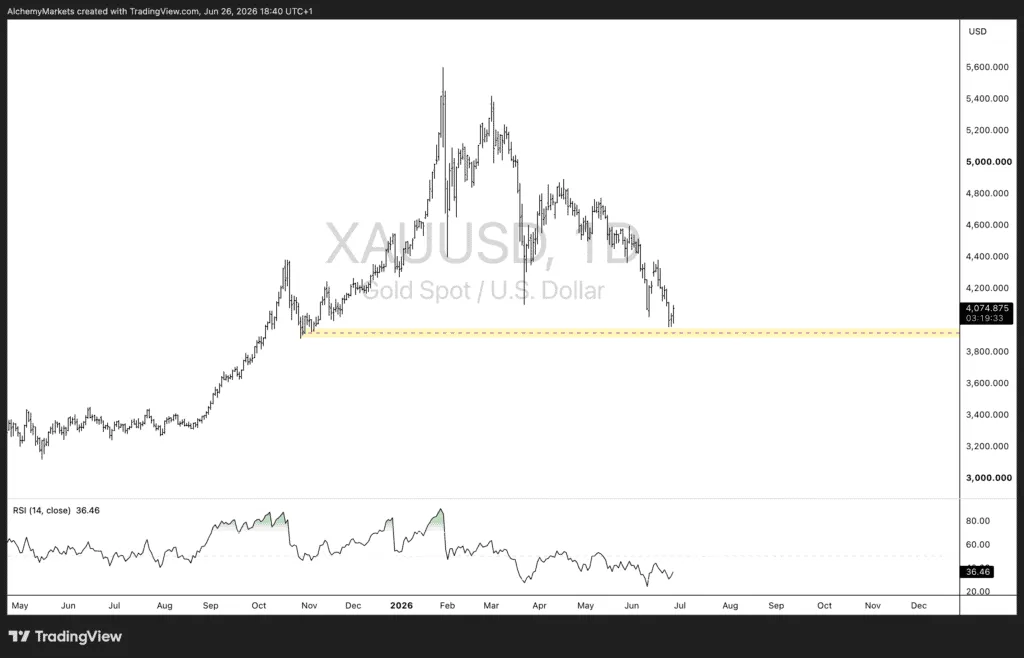
Here is the part of the market that has quietly turned its story inside out. For most of 2025, gold was the everything-hedge, the trade you bought for inflation, for geopolitics, for debasement, and it ran all the way to an all-time high near $5,600 in late January. In 2026 the same asset is being punished by the same macro engine that lifted it, and that reversal is the more interesting chart on the desk right now.
Gold is down to around $4,000, roughly a fifth below that January peak, and it shed close to 5 percent on the week into Friday. The driver is the Fed. With the central bank signalling it will hike to bring inflation to heel, real yields have been grinding higher, and gold pays no yield, so a rising real return on cash and bonds is a direct headwind. The dollar at a one-year high and oil falling back to pre-conflict levels as Middle East tensions ease have stripped out the inflation-hedge bid on top. The real-yield framework that has always governed this market has not stopped working. It has simply flipped to the wrong side for the bulls.
On the chart, the descending structure off the January high is textbook, a clean run of lower highs and lower lows. Price is now leaning on the $4,000 round number, with the shelf of support from the November consolidation sitting just beneath around $3,900. That zone is the battle line, and it does not exist in a vacuum. Thursday's jobs report is the swing factor that decides which way it breaks. A soft payrolls print pulls real yields down and hands gold the one lifeline that could rescue it before it reaches that support, while a firm print presses it straight into the level. RSI in the high-30s says there is room in either direction, which is the honest read into an event-driven week.
It is a short week with a long shadow. Apple has shown that the AI build-out now cuts both ways, rewarding the companies that sell memory and taxing the ones that buy it, and the Apple chart is sitting on the supports that decide whether Thursday was a scare or a turn. The jobs report on Thursday then sets the tone for everything priced off the Fed, gold included. Two charts, one macro engine, and a holiday on Friday to think about it.
Alchemy Markets is a multi-asset brokerage providing retail traders with the same elite trading conditions, tools, and transparency typically reserved for institutions.
Select the categories and companies you wish to follow directly to your person rss feed.
Create Custom RSS FeedSign up and join over 5,000 professional members who receive personalized news alerts, curated professional connections, and more for free!
CME Group will launch Bitcoin Cash and Uniswap futures on 19 October, pending regulatory review, expanding its crypto derivatives suite with standard and micro contracts. Executives from CME Group, Volatility Shares and Ripple Prime say the products give institutions broader, regulated tools for managing digital asset risk.
ATARIA CRM helps brokers manage a growing client base by bringing client information into one organized platform. It highlights key client statuses such as total, active, inactive, and blocked clients, making it easier for teams to track records, manage communication, automate follow-ups, personalize engagement, and use data insights to strengthen relationships, improve collaboration, save time, and support business growth.
The biggest macro events of Q3 may be behind us. Now comes the next question: what happens when the market starts separating companies rather than trading the macro narrative? Following the Fed’s 25-basis-point hike, a flattening yield curve and sharply elevated tanker rates, the investment landscape is shifting. The same forces can create very different pressures across technology, energy, financials, industrials and consumer sectors. In this week’s BitDelta Pro Weekly Outlook, we look beyond the headlines to examine where those differences may start to matter most. Read the full article for our breakdown of the rate path, the inflation signal hiding in shipping costs, and the sector dynamics taking shape. BitDelta Securities Financial Services LLC, regulated by the Capital Market Authority under Category 5 (Introduction Only), acts solely as an introducer and does not provide trading, execution, dealing, advisory, portfolio management, or custody services. All trading, execution, and investment-related services are provided by BitDelta Limited, Mauritius, a licensed Investment Dealer. All trading and investments involve risk. The value of investments may fluctuate, and you may receive less than your initial investment.
An analysis of how Federal Reserve policy, geopolitical risks in the Persian Gulf, and shifting global yields drive the US Dollar (DXY) near the 100.3 level, alongside market scenarios and technical outlooks.
audcad-price-forecast-support-retest-bullish-breakout
Gold holds weekly support as XAUUSD breaks above its daily EMA. Explore key support and resistance levels and the next bullish confirmation.
Detailed market analysis and technical outlook for WTI Crude Oil prices near $100 per barrel for the week of September 21 to 25, 2026, combining macroeconomic drivers, EIA inventory data, and key chart indicators.
Learn how to convert custom Gold (XAUUSD) price action tutorials into MetaTrader 5 AI prompts using external AI, analyze live charts, audit risk, and auto-generate MQL5 code.
MarketsVox has introduced 24/7 trading on Gold, Silver, WTI and Brent crude CFDs, giving clients round-the-clock access to key commodity markets. The launch is part of the broker's 2026 roadmap, alongside Client Area and Partner Area updates. CEO Joe Roeder says clients "should not have to wait for a trading session to open."
DXtrade, Devexperts' flagship multi-asset trading platform, has become one of only two platforms approved by Indonesia's Bappebti. The approval authorises DXtrade for licensing by commodity futures and derivatives brokers in Indonesia, and is expected to support future applications to OJK, including for digital asset services.