just now

Liquidity Finder Ltd is incorporated in England and Wales, company number 10610740, registered address 167-169 Great Portland Street, Fifth Floor, London W1W 5PF, United Kingdom.
Published: just now
The US launch combines equities and options trading with Clear Street’s clearing and risk systems, an in-house AI research engine and API access. The initial rollout is open to 10,000 traders.
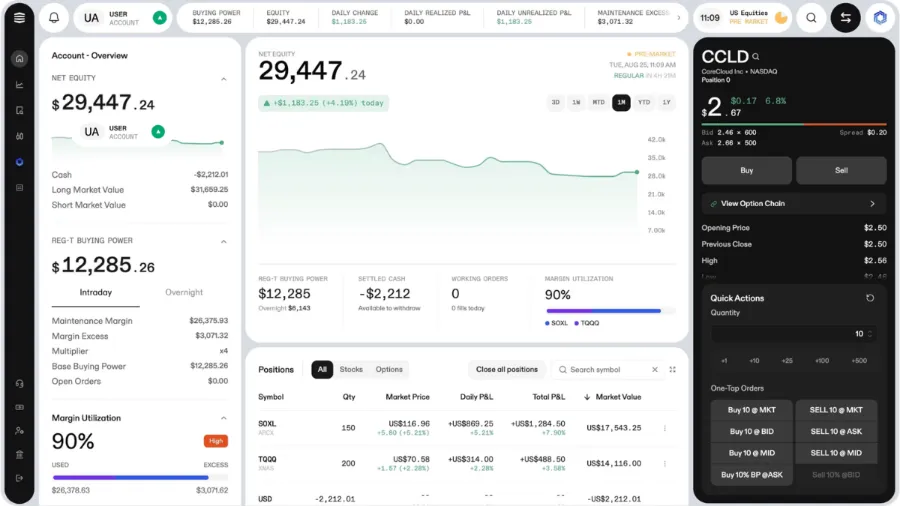
Clear Street's Desktop
Financial infrastructure and brokerage provider Clear Street has launched a trading platform for US-based individual investors, extending access to the technology it developed for hedge funds, asset managers and other institutional clients.
Available on iOS, Android and web, the platform initially supports equities and options trading. Clear Street plans to add futures, fixed income, prediction markets, digital assets and other asset classes during the remainder of 2026.
The launch gives sophisticated individual traders access to the same execution, clearing, settlement, custody, risk management and reporting infrastructure used by the company’s institutional customers, according to Clear Street. Its initial rollout is open to the first 10,000 traders.

Uri Cohen, Co-Founder and Executive Chairman of Clear Street
Uri Cohen, Co-Founder and Executive Chairman of Clear Street, said:
“Our mission to give sophisticated investors access to every asset in every market has been our North Star since we founded the business eight years ago. We built the world-class single ledger platform that enables more than 900 institutional clients, including some of the world’s most premier hedge funds, globally. Proven with institutions, today we are bringing Clear Street to individual investors who have never had access to technology like this before. This is the vision we have been building toward, and a most exciting new chapter in Clear Street's evolution.”
Founded in 2018, Clear Street serves more than 900 clients across hedge funds, asset managers and broker-dealers. The company reports approximately $19.4 billion in average interest-bearing client balances and $33.6 billion in average daily US equities trading volume, equivalent to roughly 3.4% of the US equity market.
Clear Street also holds 57 exchange and clearing memberships globally and says it reaches more than 40 million end users through its institutional clients.
The new individual-investor platform uses a single real-time ledger, with trades supported by the same clearing, settlement and risk systems. Clear Street says direct order routing to exchanges, real-time Level 2 depth-of-book data and execution-quality reporting on each trade operate within the same system.
The platform includes Omni AI, a research engine developed in-house by Clear Street. It combines earnings data, company filings, analyst consensus and news into a structured investment thesis.
According to the company, Omni can model position sizes and portfolio impact in real time, identify concentrated exposures and highlight tax implications before an order is placed. It can also assemble proposed positions, including options overlays and hedging strategies, for the investor to approve or reject.

Raja Bhatia, Chief Technology Officer, Trading and Risk, Clear Street,
Raja Bhatia, Chief Technology Officer, Trading and Risk, at Clear Street, said:
“For years, we've built the infrastructure that some of the largest institutions in the world trade on. Clear Street takes that same foundation and rebuilds it around the sophisticated individual trader. That means the fastest execution ever made available to retail, AI and proprietary quantitative models drawn from the same systems our institutional clients use, and the real-time risk and data depth that serious decisions demand. Every capability was designed with that trader in mind.”
Developers and systematic traders can access the platform’s execution, risk and data capabilities through a REST API and software development kits supporting multiple programming languages.
Execution options include time-weighted average price (TWAP) and volume-weighted average price (VWAP) algorithms, alongside direct market access (DMA), with pre-trade risk controls built in.
Clear Street also provides a Model Context Protocol (MCP) server, which allows AI assistants including Claude and Gemini to connect to the underlying platform. This enables users to connect their own AI tools alongside Clear Street’s Omni engine.
Bhatia continued:
“Think of this new platform as an AI-powered ‘broker on your shoulder,’ guiding you toward the better trade. What we're launching today is just the starting point. Over the next twelve months, our roadmap will push this experience meaningfully further, and we're inviting our first 10,000 users to help us shape what it becomes.”
The offering also includes yield on idle cash, reporting, tax documentation, onboarding and customer support.
Found this interesting? Become a member of LIQUIDITYFINDER and get daily industry news direct to your inbox — join here.
We're the largest marketplace to connect with brokers, Fintech companies & digital asset firms. Want to partner? Let's get in touch.

Select the categories and companies you wish to follow directly to your person rss feed.
Create Custom RSS FeedSign up and join over 5,000 professional members who receive personalized news alerts, curated professional connections, and more for free!
Why did gold keep falling after reaching $3,880? See how a failed 4-hour retest confirmed weakness in XAUUSD and why $3,400 is the next weekly support to watch.
Reality television personality Aaron Chalmers and finfluencer Jason Agbodza have been fined after pleading guilty to illegally promoting an unauthorised foreign exchange trading scheme on social media.
UK retail sales rose a stronger-than-expected 0.7% in October, giving sterling some support, while a deepening tech sell-off pushed the dollar lower overnight against all major currencies. Thanim Islam, Head of FX Analysis at Equals, says the dollar remains in charge as the week ends, with the Fed expected to raise rates more than both the Bank of England and the ECB.
Nvidia beats expectations, reporting $115.8bn in revenue and raising its long-term growth outlook, but the stock still struggled to sustain its gains. AI remains fundamentally strong, but investor expectations are becoming more demanding, particularly around capex and profitability. Wall Street suffered a major sell-off, with the S&P 500 entering a six-session losing streak as rate concerns intensified.
iSAM Securities reviews the ris of weekend gold trading
Webull Corporation reported record third quarter 2026 revenue of $218.7 million, up 39% year-on-year, with customer assets reaching $32.4 billion and options contracts volume up 79%. Net income attributable to the company was $31.2 million, while margin debit balances passed $1 billion for the first time.
Anthropic, the company behind the Claude family of AI models, begins trading on the Nasdaq today under the ticker ANT. It priced its shares at $83 last night, above its marketed range of $70 to $78, and raised about $81.3 billion. That makes it the largest initial public offering on record, ahead of the roughly $75 billion SpaceX raised in June. This note covers what investors need to know: the terms, the business, how the company is governed, and what to watch.
Nvidia's first results without Jensen Huang answered the question that has hung over the AI trade since October. Revenue of $115.8 billion beat consensus by about $7 billion, fourth-quarter guidance of $130 billion came in roughly $5 billion above expectations, and the company raised its outlook for next fiscal year to around 75% growth. All of this assumes no data-centre sales to China.
Marex has entered the football financing market through a partnership with specialist sports investment and advisory firm Pinto Capital, targeting clubs in the Premier League and EFL Championship.
Around 110,000 UK retail investors have secured $300 million worth of Anthropic shares in its record-breaking $81 billion IPO. The heavily oversubscribed offer, coordinated by RetailBook, saw smaller investors prioritised, with 63% of applicants receiving their full allocation.