just now


Liquidity Finder Ltd is incorporated in England and Wales, company number 10610740, registered address 167-169 Great Portland Street, Fifth Floor, London W1W 5PF, United Kingdom.
Published: just now

The Consumer Price Index (CPI) is the benchmark inflationary gauge that dictates the trajectory of global financial markets. This is like a monthly price tag for the overall cost of living.
To determine the CPI data, government agencies such as the Bureau of Labor Statistics (BLS) monitor a massive market basket containing thousands of goods and services. This basket is divided into several key sectors:

This is differentiated between two primary versions of the index:
Why the CPI data Dictates Market Policy
Traders wait for news. Once the data comes out, the market reaction begins immediately. This response is the real trigger. The numbers just sit on a page until buyers make their move. Ultimately, human behavior is what truly shifts prices today. Crowds buy and sell. Prices move, in fact, on the basis of how these traders react to the information.
An increase or surge in price which means if the inflation (measured by CPI) gets out of hand, central banks will raise interest rates to try to reduce spending and slow the economy.
A declining in price levels which means that if the CPI data is too low, the banks may possibly lower the interest rates to make borrowing cheaper and boost economic activity.
In a typical Consumer Price Index report, two comparative numbers that are emphasized:
• The Year-over-Year data or YoY. Compares price changes today to the same period 12 months ago, example if prices are up 3.5% from last year.
• The Month-over-Month data or MoM. How much did something change from the previous month, example if prices rose 0.3% from last month.
An increasing CPI indicates that your currency's purchasing power is eroding. Conversely, a stable or declining CPI suggests that your money maintains its value over time.
Trading CPI data is ultimately about timing the Expectation Mismatch. Markets don't just react to the statistics; they react to how much the reality differs from what everyone thought would happen.
Before the news drops, check an economic calendar for these key figures:
Example below how the DJ30 reacted from the Inflation data.
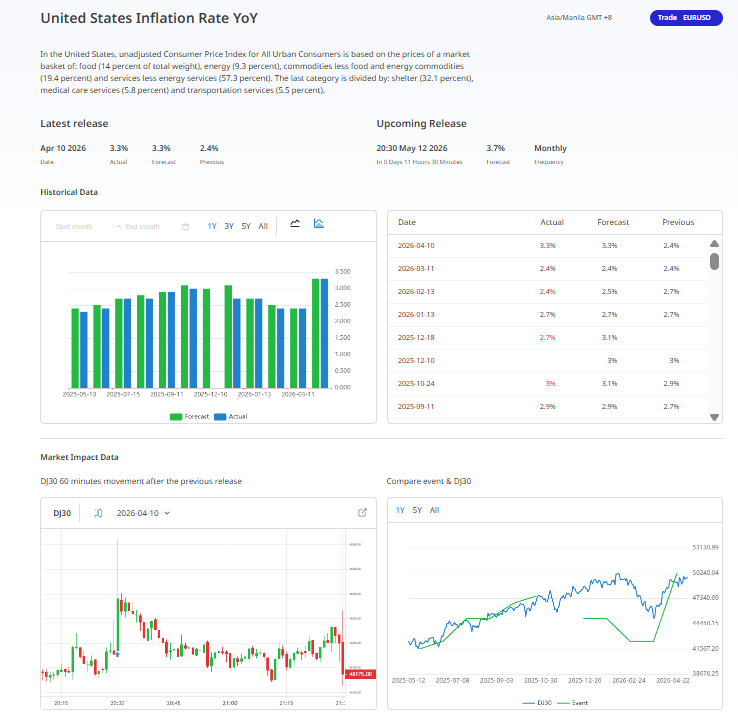
The Breakout: Setting orders slightly above and below the price just before the announcement to catch a fast move in either direction.
The Second Chance (Recommended): Wait 10 minutes for the high market movements or volatility to end. Enter your trade only after the price settles and starts moving steadily in one direction.
The Core Filter: If the main number looks good but the Core CPI (which ignores food/gas) looks bad, trust the Core. Big banks and central banks pay more attention to the Core.
Selecting the ideal timeframe is a direct result of your chosen strategy. Because a CPI release triggers such rapid, high-intensity price action, standard slow charts like the Daily (D1) or 4-Hour (H4) will fail to show the immediate volatility you need to execute a trade.
•M1 For the Breakout, you may need the 1-Minute or M1 chart so you can see the exact second that the price explodes out of its pre-news range.
• Second chance the initial spike, take either the 5 minute or M5 or 15 minute or M15 chart. They are detailed to identify a pullback or retest, but without the noise of the 1-minute chart.
• M15 for retests. Core filter, priority on 15 Minute (M15) to 1 Hour (H1) charts.
To sum up, while the 4-hour chart conveys you the story of the week, The lower timeframes, like M1 through M15 are, like your binoculars. They help you see the moment when the data hits the market.
Explore my portfolio for further insights:
DAX(GER30): How the index will weather the twin shocks of wholesale inflation and shrinking output?
EURUSD: Trading EUR/USD Through High Oil an Rate Volatility
EURUSD Outlook: Interest Rate Pair to Energy Security Pair
GBPUSD: Inflation vs. Geopolitics: What Will Break the GBPUSD Consolidation?
USDJPY: Key Breakout or Imminent Bull Trap After Japan’s CPI?
NASDAQ100: Breakout or Breakdown for the Nasdaq?
Disclaimer: This content may have been written by a third party. ACY makes no representation or warranty and assumes no liability as to the accuracy or completeness of the information provided, nor any loss arising from any investment based on a recommendation, forecast or other information supplies by any third-party. This content is information only, and does not constitute financial, investment or other advice on which you can rely.
ACY Securities is one of Australia's fastest growing multi-asset online trading providers, offering ultra-low-cost trading, rock-solid execution, technologically superior account management and premium market analysis.

Select the categories and companies you wish to follow directly to your person rss feed.
Create Custom RSS FeedSign up and join over 5,000 professional members who receive personalized news alerts, curated professional connections, and more for free!
Multi-asset trading broker AvaTrade has agreed to acquire the majority of FXCM Group’s business and brand, in a transaction that would bring a longstanding retail FX franchise into the AvaTrade Group.
LSEG and CMC Markets have signed a multi-year strategic data agreement expanding CMC's access to LSEG's real-time and delayed pricing, reference and corporate actions data, news and analytics, plus AI-ready content, to support new products, entry into new markets and the growth of CMC's institutional and B2B partnerships.
The Tel Aviv Stock Exchange is considering a bid for the Cyprus Stock Exchange, with Israeli media citing its EU licence, trading platform and clearing house. Euronext’s Athens exchange and India’s National Stock Exchange are also seen as contenders, and Cyprus aims to sign a sale agreement by the end of this year.
CME Group will launch baseball futures on 12 October, pending regulatory review, tracking CME FutureSports Performance Indexes built on Official League Data. Standard and micro contracts will start with the 2026 Postseason and the four clubs in the League Championship Series, trading around the clock.
ESMA has published an opinion stating that MiCA-authorised crypto-asset service providers should cease services tied to non-MiCA-compliant stablecoins for EU clients across MiCA crypto-asset services. National authorities should require remediation of existing exposures within three months, by early January 2027.
Nasdaq Ventures has made a strategic investment in Amsterdam-based derivatives and crypto exchange One Trading, with both firms to explore 24/7 trading of equity futures. The undisclosed investment follows Nasdaq's US$100 million investment in Payward, the parent of Kraken, and CME Group's move to 24/7 trading.
cTrader has opened multi-platform plugins to brokers and prop firms, which can pre-install their own tools for clients or list them in cTrader Store. The plugins run across Mobile, Web, Windows and Mac, and can be built and launched independently of core-platform releases, including trading journals and calculators.
Institutional brokerage and financial infrastructure provider Clear Street has joined TradingView’s broker network, allowing its clients to trade US stocks, exchange-traded funds and options directly through the charting and analysis platform.
Learn how to improve trading psychology, manage fear and greed, avoid revenge trading, and follow your trading strategy with discipline and a trading journal.
GTC Prime has announced a strategic partnership with Centroid Solutions to manage and distribute its liquidity through CS 360 Bridge, Centroid's multi-asset connectivity and execution engine, giving brokers and institutional clients access to tailor-made pricing, low-latency execution and real-time risk management.