just now


Liquidity Finder Ltd is incorporated in England and Wales, company number 10610740, registered address 167-169 Great Portland Street, Fifth Floor, London W1W 5PF, United Kingdom.
Published: just now

The Federal Reserve kept interest rates unchanged at 3.50%–3.75% on Wednesday, but the real market signal was not the hold itself. It was what Chair Kevin Warsh didn’t say about September.
Three FOMC members dissented in favour of an immediate 25bp hike, while the statement maintained a relatively hawkish tone around inflation. Economic activity was described as expanding at a “solid pace”, the labour market remains broadly stable, and inflation is still running above the Fed’s 2% objective.
On the surface, that sounds like a central bank preparing to tighten.
But Warsh stopped short of guiding markets towards a September hike. Instead, the message remained data-dependent, leaving the Fed with optionality rather than committing to another move.
That distinction matters.
Before the meeting, investors were increasingly treating September as the natural destination for a hike if the Fed stayed on hold in July. Following Warsh’s comments, those expectations were scaled back materially, leaving September much closer to a genuine coin toss.
This creates an interesting contradiction.
The Fed’s language remains hawkish: inflation is too high, economic growth remains solid enough to tolerate tighter policy, and three policymakers already believe rates should be higher.
Yet the market heard something slightly more dovish: the Fed is not in a rush.
That was reflected in the initial reaction. Interest-rate-sensitive two-year Treasury yields fell and the dollar weakened after the decision, suggesting traders reduced expectations for near-term tightening.
My bias here is that the dollar could remain vulnerable unless upcoming inflation data forces the market to rebuild expectations for a September hike.
The Fed has effectively handed the decision back to the data.
If inflation remains sticky, September pricing can quickly turn hawkish again. But if the next few inflation and labour-market releases soften, the market may increasingly conclude that July was not simply a delayed hike — it was the beginning of a longer pause.
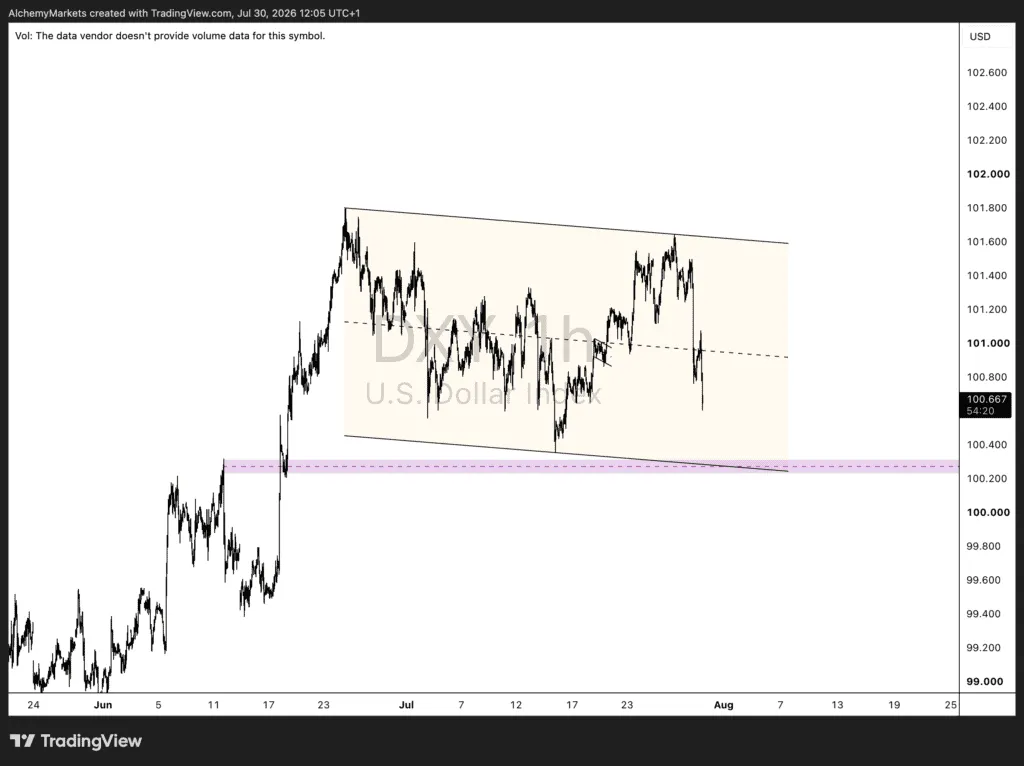
Technically, the Dollar Index now has the potential to extend its move lower following the post-Fed rejection.
The key downside area to watch is 100.300, which provides the next meaningful support zone.
As long as DXY fails to regain its recent highs and expectations for September tightening remain contained, the path of least resistance could remain lower towards this level.
A clean break below 100.300 would strengthen the bearish dollar narrative, while a recovery driven by stronger inflation data and renewed Fed hike expectations would challenge it.
For now, the interesting takeaway from the Fed is simple: the rhetoric was hawkish, but the market was expecting something even more hawkish.
And in markets, the difference between what happens and what was already expected is often what matters most.
Alchemy Markets is a multi-asset brokerage providing retail traders with the same elite trading conditions, tools, and transparency typically reserved for institutions.
Select the categories and companies you wish to follow directly to your person rss feed.
Create Custom RSS FeedSign up and join over 5,000 professional members who receive personalized news alerts, curated professional connections, and more for free!
Multi-asset trading broker AvaTrade has agreed to acquire the majority of FXCM Group’s business and brand, in a transaction that would bring a longstanding retail FX franchise into the AvaTrade Group.
LSEG and CMC Markets have signed a multi-year strategic data agreement expanding CMC's access to LSEG's real-time and delayed pricing, reference and corporate actions data, news and analytics, plus AI-ready content, to support new products, entry into new markets and the growth of CMC's institutional and B2B partnerships.
The Tel Aviv Stock Exchange is considering a bid for the Cyprus Stock Exchange, with Israeli media citing its EU licence, trading platform and clearing house. Euronext’s Athens exchange and India’s National Stock Exchange are also seen as contenders, and Cyprus aims to sign a sale agreement by the end of this year.
CME Group will launch baseball futures on 12 October, pending regulatory review, tracking CME FutureSports Performance Indexes built on Official League Data. Standard and micro contracts will start with the 2026 Postseason and the four clubs in the League Championship Series, trading around the clock.
ESMA has published an opinion stating that MiCA-authorised crypto-asset service providers should cease services tied to non-MiCA-compliant stablecoins for EU clients across MiCA crypto-asset services. National authorities should require remediation of existing exposures within three months, by early January 2027.
Nasdaq Ventures has made a strategic investment in Amsterdam-based derivatives and crypto exchange One Trading, with both firms to explore 24/7 trading of equity futures. The undisclosed investment follows Nasdaq's US$100 million investment in Payward, the parent of Kraken, and CME Group's move to 24/7 trading.
cTrader has opened multi-platform plugins to brokers and prop firms, which can pre-install their own tools for clients or list them in cTrader Store. The plugins run across Mobile, Web, Windows and Mac, and can be built and launched independently of core-platform releases, including trading journals and calculators.
Institutional brokerage and financial infrastructure provider Clear Street has joined TradingView’s broker network, allowing its clients to trade US stocks, exchange-traded funds and options directly through the charting and analysis platform.
Learn how to improve trading psychology, manage fear and greed, avoid revenge trading, and follow your trading strategy with discipline and a trading journal.
GTC Prime has announced a strategic partnership with Centroid Solutions to manage and distribute its liquidity through CS 360 Bridge, Centroid's multi-asset connectivity and execution engine, giving brokers and institutional clients access to tailor-made pricing, low-latency execution and real-time risk management.