
just now


Liquidity Finder Ltd is incorporated in England and Wales, company number 10610740, registered address 167-169 Great Portland Street, Fifth Floor, London W1W 5PF, United Kingdom.
Published: just now


FOMC (Federal Open Market Committee) decisions set the U.S. central bank's interest rates to help balance the inflation (increase in prices) and national employment.
Increasing the rates also help to increase borrowing costs, which in turn boosting the U.S. dollar but also put a pressure on equity or stock prices.
Cutting rates makes money lowers its value, which often boosts or support the stocks (equities) and weakens the US dollar.
Steady rates signal a wait and see approach, requiring investors to focus on incoming economic data and inflationary trends rather than assuming an immediate policy pivot toward growth.
The Federal Reserve has a special group of officials who meet regularly to set the financial rules. FOMC decisions serve as the primary lever used to set U.S. interest rates, which helps balance national employment levels and keep inflation perfectly in check.
These choices instantly change what it costs to get a loan. Because of this massive influence, their actions drive global financial market sentiment, causing giant waves across all major economies around the world. Markets watch these movements.
Who Makes Them?
Source: Federal Reserve
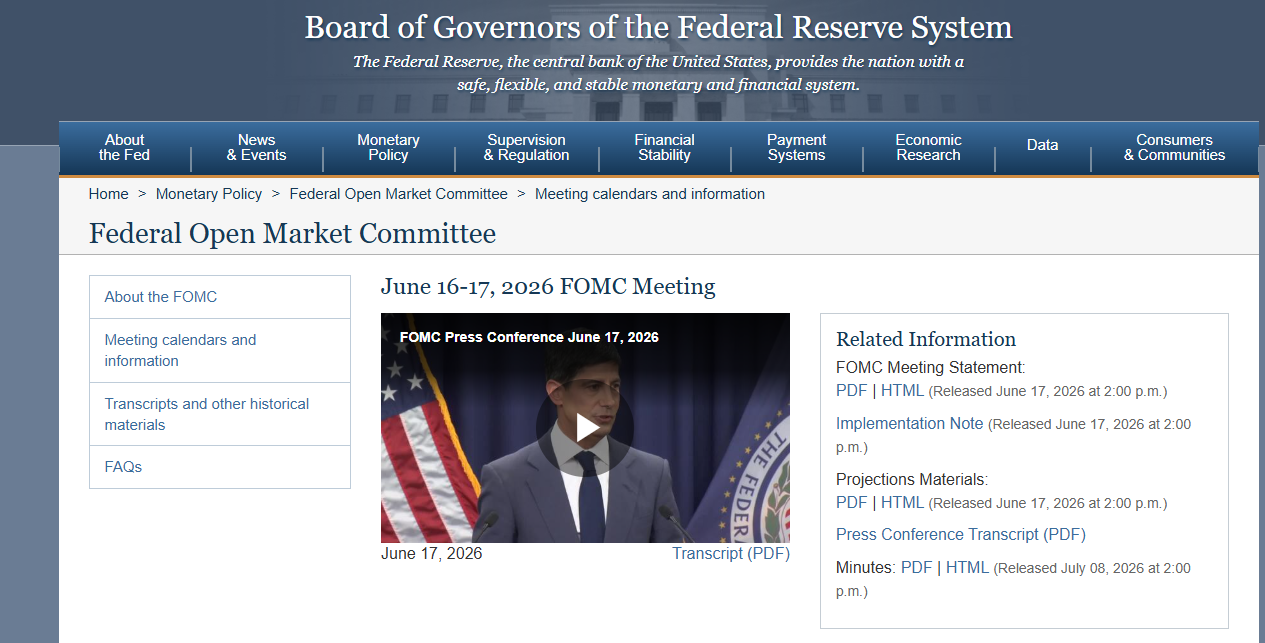
Official FOMC decisions are done by Federal Reserve leaders. These experts act as the central bank's policy committee, using interest rate adjustments to guide the entire country's financial health. They hold the keys.
Their main job is to use interest rates to carefully balance inflation and national employment. It takes careful planning.
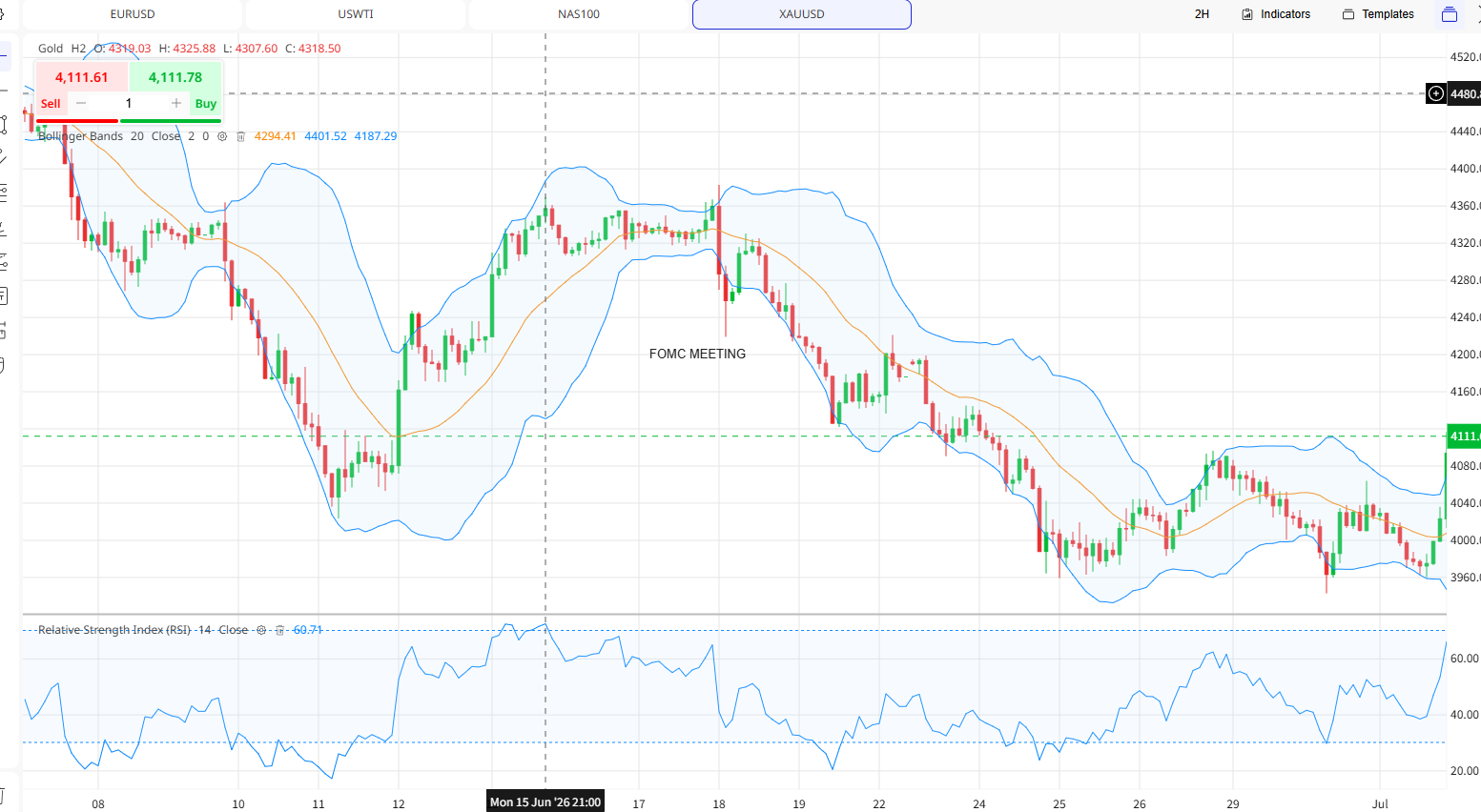
Example of XAU/USD movement during FOMC Decisions
Source: ACY
Since Gold is priced in USD, it reacted towards downward momentum as the Federal Reserve to maintain its target range at 3.50% to 3.75% which this in turn boosts the US Dollar.
How Do FOMC Decisions Impact Markets and Borrowing Costs?
Since the decisions shifts the cost of borrowing costs, they instigate immediate changes in how investors or markets value various assets. Stock prices or bonds and the U.S. dollar all respond right away to these major announcements. The impact is really sudden.
Example on June 2026 FOMC Decision
The Federal Reserve held rates target range steady but signaled an aggressive change that surprised markets with this unexpected stance on higher-for-longer rates triggered a sell-off in major equity indices.
Federal Reserve Monetary Policy and How It Works
With Dual Mandate legally requires the bank to maximize employment and stabilize prices.
For FOMC Dot Plot reveals anonymous forecasts for where future interest rates are heading.
Forward Guidance helps manage market expectations long before any official actions happen.
Quantitative Tightening removes excess cash from the entire economy to lower inflation.
What is the main goal of Federal Reserve monetary policy?
The law requires this Federal Reserve monetary policy to follow a strict Dual Mandate at all times. Congress created this rule to ensure the economy stays incredibly healthy and balanced. They must promote maximum sustainable employment while maintaining stable prices for everyone. This balances the scale.
How does the FOMC dot plot predict rates?
Every three months, the bank releases a fascinating chart called the FOMC dot plot. Each official anonymously maps out their own personal forecast for future interest rates on this graph. This visual tool helps investors gauge the collective outlook of the group. It guides the market.
What is the purpose of forward guidance?
Before taking official action, the bank uses a smart trick called forward guidance. They publicly signal their future policy intentions to everyone in the entire financial world. This communication helps manage market expectations and highly influences long-term interest rates.
How does quantitative tightening fight inflation?
Sometimes, the economy runs too hot and prices rise rapidly. To fix this, the bank starts a process known as quantitative tightening. They shrink their massive balance sheet by selling bond holdings or just letting them mature. This removes excess cash.
Disclaimer: This content may have been written by a third party. ACY makes no representation or warranty and assumes no liability as to the accuracy or completeness of the information provided, nor any loss arising from any investment based on a recommendation, forecast or other information supplies by any third-party. This content is information only, and does not constitute financial, investment or other advice on which you can rely.
ACY Securities is one of Australia's fastest growing multi-asset online trading providers, offering ultra-low-cost trading, rock-solid execution, technologically superior account management and premium market analysis.

Select the categories and companies you wish to follow directly to your person rss feed.
Create Custom RSS FeedSign up and join over 5,000 professional members who receive personalized news alerts, curated professional connections, and more for free!
Marex has entered the football financing market through a partnership with specialist sports investment and advisory firm Pinto Capital, targeting clubs in the Premier League and EFL Championship.
Around 110,000 UK retail investors have secured $300 million worth of Anthropic shares in its record-breaking $81 billion IPO. The heavily oversubscribed offer, coordinated by RetailBook, saw smaller investors prioritised, with 63% of applicants receiving their full allocation.
Clear Street has completed its acquisition of Boom Securities (H.K.) Limited, establishing its first licensed brokerage presence in Hong Kong
Sterling slips to its lowest against the dollar since October as markets trim Bank of England bets and Fed minutes point to further US rate rises, while the euro hits a fresh one-year low. Daily FX analysis from Equals.
JT Prime, the institutional Prime of Prime founded by Raj Sitlani, Jonathan Brewer and Jeff Wilkins, is set to become the new home for institutional client relationships currently serviced by FXCM Pro. Clients have been offered the same leverage, fees and connectivity, ensuring continuity of trading conditions.
The Nasdaq 100 has shifted into a short-term bullish recovery after finding strong support around 26,611. Following the sharp sell-off, price has formed a sequence of higher lows and has moved back above the 20-hour moving average at around 27,270, while the 5-hour and 10-hour averages are also turning higher.
U.S. equity futures rose in the after hours, led by Nasdaq-100 futures up 1% and S&P 500 futures up 0.6%, as investors focused on Anthropic’s Nasdaq debut. The AI company priced its IPO at $83 per share, above expectations, and expanded the offering to raise around $81.3 billion, making it the largest IPO on record.
Brokers can offer LMAX perpetual futures alongside FX and CFDs through a single trading account. LMAX says brokers with existing credentials can go live in under five days.
24X National Exchange has filed a proposed rule change with the SEC to launch 24X Options, a general options market trading from 9:30 a.m. to 4:00 p.m. ET. The filing also covers binary KPI options on quarterly revenue, earnings per share and other metrics for 23 of the most actively traded U.S. companies.
cTrader Mobile 5.11 introduces Signals, a new app where traders can browse signals from leading providers and act on them directly in the platform.