just now


Liquidity Finder Ltd is incorporated in England and Wales, company number 10610740, registered address 167-169 Great Portland Street, Fifth Floor, London W1W 5PF, United Kingdom.
Published: just now
Yesterday it was Bitcoin.
A few weeks before that, gold.
Tomorrow it could be Apple, crude oil, or a currency pair reacting to a central bank announcement halfway across the world.
Markets move. Constantly.
Prices climb. Prices crash. Sometimes they do both in the same day. One headline can send a stock soaring. One inflation report can shake an entire market. One unexpected announcement can wipe out weeks of gains in a matter of minutes.
And yet traders keep showing up.
Not because they know exactly what will happen next. Nobody does.
They show up because markets create opportunity.
That’s where CFD trading comes in.
A Contract for Difference, better known as a CFD, allows traders to speculate on price movements without owning the underlying asset itself. No physical gold. No stock certificates. No crypto wallets. Just exposure to price movement and the ability to act when opportunities appear.
Simple concept.
Powerful application.
And for many traders, it’s one of the most flexible ways to access global financial markets from a single trading account.
The challenge isn’t opening a trade.
The challenge is knowing what happens before and after.
Which market should you trade?
How much capital should you risk?
When should you enter?
When should you exit?
How do experienced traders manage losing positions without letting one bad trade destroy months of progress?
These are the questions that matter.
This guide walks through a practical seven-step framework that explains exactly how to trade CFDs, whether you’re completely new to the markets or looking to sharpen an existing trading process. Along the way, you’ll learn how leverage works, how margin affects your exposure, how professional traders think about risk, and how real CFD trades play out across stocks, commodities, and cryptocurrencies.
Before we begin, one thing deserves your full attention.
CFDs are complex instruments and carry a high risk of losing money rapidly due to leverage. Every trade involves risk. Every market can move against you. Understanding that reality from the start is one of the most important skills a trader can develop.
Imagine wanting exposure to Apple shares without buying Apple shares.
Or trading gold without storing a single ounce of gold.
Or taking a position on Bitcoin without moving funds into a crypto wallet.
That’s essentially what a CFD allows you to do.
A Contract for Difference is an agreement between a trader and a broker to exchange the difference between an asset’s opening price and closing price. The asset itself never changes hands. What matters is the movement in price between entry and exit.
If the market moves in your favour, you profit.
If it moves against you, you lose.
Everything revolves around the difference.
Which is exactly where the name comes from.
CFD trading provides access to a wide range of global markets, including:
One account. Thousands of instruments.
Another feature that attracts traders is flexibility.
Traditional investing often focuses on rising markets. CFDs allow traders to participate in both directions.
When traders believe prices will rise, they open a long position.
When traders expect prices to fall, they open a short position.
The ability to potentially profit from declining markets creates opportunities during both bullish and bearish conditions.
Then there’s leverage.
And this is where things get interesting.
Leverage allows traders to control larger market exposure using a smaller initial deposit called margin. Instead of paying the full value of a position upfront, only a percentage is required.
A trader might control a $10,000 position using only $2,000 in margin.
Sounds attractive.
Because it is.
But leverage amplifies everything. Profits. Losses. Emotions. Mistakes.
Used responsibly, it becomes a powerful tool. Used carelessly, it becomes expensive very quickly.
Understanding that balance is at the heart of successful CFD trading.
Most losing trades don’t happen because traders picked the wrong market.
They happen because there was no process.
No plan.
No framework.
A trade gets opened based on excitement, a social media post, a headline, or a gut feeling. Then comes hesitation. Panic. Second-guessing. Sometimes all within the same afternoon.
Professional traders approach markets differently.
Every trade follows a sequence.
A routine.
A checklist.
The exact details vary from trader to trader, but the structure remains surprisingly consistent.
The seven-step framework below provides a practical roadmap for approaching CFD trading with greater consistency and discipline.
Simple on paper.
Critical in practice.
Let’s start with the foundation.
Every trade begins with a broker.
Not all brokers are created equal.
Some focus on tight spreads. Others prioritise platform technology. Some offer thousands of instruments. Others specialise in a handful of markets.
The goal isn’t finding the broker with the loudest marketing campaign.
It’s finding one that provides security, transparency, and the tools needed to execute your strategy effectively.
A good starting point is regulation.
Regulation provides oversight and accountability, helping ensure that brokers operate according to established financial standards.
Examples of respected regulatory authorities include:
A broker’s licence won’t guarantee profitability.
Nothing can.
But it does provide an additional layer of trust when handling client funds and executing trades.
Beyond regulation, pay attention to account options.
Many brokers offer:
The demo account deserves special attention.
Too many traders rush past it.
A demo account allows you to learn platform mechanics, test strategies, understand order placement, and experience market fluctuations without risking real capital. The lessons learned here can be surprisingly valuable once real money enters the equation.
Before opening any CFD account, verify the following:
Once you’re satisfied, the process is straightforward.
Complete identity verification. Fund the account. Access the platform.
Then the real work begins.
One of the biggest advantages of CFD trading is variety.
A lot of variety.
Thousands of instruments. Multiple asset classes. Different market behaviours. Different opportunities.
This flexibility is exciting.
It can also be overwhelming.
Many beginners make the mistake of trying to trade everything at once.
Forex in the morning.
Gold after lunch.
Bitcoin overnight.
Then a stock trade because someone mentioned it on social media.
That’s usually a fast path to confusion.
Instead, start by understanding how each market behaves.
Share CFDs track the price movements of individual companies such as Apple, Tesla, Amazon, and Alphabet.
Earnings reports matter here.
So do product launches, analyst upgrades, economic conditions, and investor sentiment.
One strong quarterly report can send a stock sharply higher. One disappointing forecast can erase billions in market value.
Fast.
Unforgiving.
Often highly rewarding for prepared traders.
Indices tell a bigger story.
Instead of tracking one company, they track an entire basket of stocks. The Nasdaq 100, S&P 500, and Wall Street Index are popular examples.
Think of indices as a snapshot of market sentiment.
When investors feel optimistic, indices often climb. When fear enters the market, they can fall sharply.
Many traders like indices because they reduce company-specific risk while still providing exposure to major economic trends.
The forex market is enormous.
Trillions of dollars move through it every day.
Currencies rise and fall based on interest rates, inflation, economic growth, employment data, and central bank decisions.
A single speech from a Federal Reserve official can move markets within seconds.
Fast-moving. Highly liquid. Available 24 hours a day during the trading week.
Commodities react to forces that often have little to do with stocks.
Gold responds to inflation concerns and interest rates.
Crude oil reacts to geopolitical developments, production cuts, and shifts in global demand.
Natural gas, silver, and agricultural products each have their own drivers.
Different markets. Different personalities.
Then there’s crypto.
Bitcoin doesn’t wait for Wall Street to open.
Crypto markets operate around the clock, weekends included.
Prices can remain stable for days and then move thousands of dollars within hours. That volatility attracts traders looking for opportunity, although it also increases risk significantly.
The goal isn’t mastering every market.
At least not initially.
The goal is becoming familiar with one or two markets first, understanding how they behave, and building confidence before expanding into new asset classes.
| Asset Class | Typical Leverage | Trading Hours | Typical Spread | Volatility |
| Shares | Moderate | Market Hours | Medium | Medium |
| Indices | High | Extended Hours | Low | Medium |
| Forex | High | 24/5 | Very Low | Medium |
| Commodities | High | Extended Hours | Low | Medium-High |
| Crypto | Lower | 24/7 | Medium | High |
Most traders enjoy opening positions.
Far fewer enjoy planning them.
That’s a problem.
Because the money is often made before the trade is even placed.
A trading plan creates structure. It removes guesswork. It forces decisions to be made while emotions are still under control.
Without a plan, every market movement feels personal.
With a plan, market movements become information.
Most traders use a combination of technical and fundamental analysis.
Technical analysis focuses on price action.
Charts. Patterns. Trends. Support and resistance levels.
The idea is simple.
If traders have behaved a certain way around specific price levels in the past, there’s a chance they may behave similarly again.
No guarantees.
Just probabilities.
Fundamental analysis looks beyond the chart.
Economic releases. Inflation reports. Interest rate decisions. Corporate earnings.
These events often provide the fuel that drives major market movements.
This is why experienced traders regularly monitor economic calendars.
One scheduled announcement can change market conditions dramatically.
A trading plan doesn’t need to be complicated.
In fact, simpler is often better.
Imagine you’re looking at gold trading near $2,350.
Your plan might look like this:
Clear. Measurable. Repeatable.
That’s the objective.
At some point, every trading idea boils down to one question.
Up or down?
That’s it.
If you expect prices to rise, you go long.
If you expect prices to fall, you go short.
Simple.
Yet this flexibility is one of the biggest reasons traders choose CFDs.
Traditional investors often celebrate rising markets and endure falling ones.
CFD traders can actively participate in both scenarios.
Let’s say gold is trading at $2,350.
Inflation data comes in hotter than expected.
You believe investors will move toward safe-haven assets.
You open a long position because you expect gold prices to rise.
If they do, the trade generates profit.
Now imagine Tesla releases disappointing earnings.
Revenue misses expectations. Guidance weakens. Investors react negatively.
You expect further downside and open a short position.
If the stock declines, the position becomes profitable.
This ability to trade falling markets creates opportunities that many newer traders initially overlook.
Every CFD quote contains two prices:
The difference between them is called the spread.
It may appear small.
Sometimes tiny.
Yet over hundreds of trades, spreads become one of the most important costs a trader will encounter.
Buying occurs at the offer price.
Selling occurs at the bid price.
Understanding this detail helps traders better evaluate entry and exit decisions.
| Going Long | Going Short |
| Expect prices to rise | Expect prices to fall |
| Buy first | Sell first |
| Profit from upward movement | Profit from downward movement |
This is where risk management becomes real.
Not theoretical.
Real.
The market doesn’t care how confident you feel about a trade.
The market doesn’t reward conviction.
It rewards discipline.
Position sizing determines how much exposure you’re taking.
Margin determines how much capital is required.
Stop-losses determine how much you’re willing to lose.
Everything connects.
CFDs use leverage, which means only a percentage of the total trade value is required to open a position.
For example:
The remaining exposure is effectively provided through leverage.
That increased exposure creates opportunity.
And risk.
Both arrive together.
A stop-loss automatically closes a trade when price reaches a predetermined level.
It’s one of the most important tools available to traders.
Imagine buying gold at $2,350.
Your stop-loss sits at $2,330.
If the market falls, losses remain controlled.
Without that stop-loss?
The situation can become significantly more expensive.
Take-profit orders work in the opposite direction.
They automatically close profitable positions when a target price is reached.
This removes emotional decision-making from the process and helps traders lock in gains.
Some brokers offer guaranteed stops.
Unlike standard stop-losses, these orders guarantee execution at the specified price even during extreme volatility.
There is usually a premium for this protection.
Many traders consider it worthwhile during major news events.
Markets move quickly.
Sometimes very quickly.
When prices change between the moment an order is placed and the moment it’s executed, slippage can occur.
Most of the time it’s small.
Occasionally it isn’t.
Understanding how slippage works helps traders set more realistic expectations.
The analysis is complete.
The plan exists.
Risk parameters are set.
Now comes execution.
Modern trading platforms make this process remarkably efficient.
Whether you’re using MT5, TradingView integrations, or a proprietary trading terminal, the order ticket usually includes the same essential information:
Before clicking the final confirmation button, pause.
Just for a moment.
Then verify:
Small mistakes happen.
A misplaced decimal point. An incorrect position size. An unintended order direction.
Taking ten seconds to verify everything can save a lot of frustration later.
Once the trade is live, monitoring begins.
Not micromanaging.
Monitoring.
There’s a difference.
The goal isn’t constantly adjusting positions because of every small market fluctuation.
The goal is following the plan created before entering the trade.
Eventually every trade ends.
Some end with profits.
Some don’t.
Both outcomes contain valuable information.
A position can close manually, through a stop-loss, or via a take-profit order.
Once closed, profit and loss calculations become straightforward.
P&L = (Exit Price − Entry Price) × Position Size × Direction − Costs
Numbers matter.
Reflection matters too.
Many traders focus exclusively on results.
The better question is often:
Did I follow my process?
A profitable trade with poor execution can become dangerous if repeated.
A losing trade executed perfectly may still represent good decision-making.
This is why professional traders maintain journals.
Every trade becomes data.
Every outcome becomes feedback.
Every mistake becomes an opportunity to improve.
And over time, those small improvements compound.
Slowly at first.
Then surprisingly fast.
Theory is useful.
Numbers make it real.
The following examples demonstrate exactly how CFD trades work across three different asset classes. Each example includes both winning and losing outcomes because that’s the reality of trading.
Not every trade succeeds.
Not every trade fails.
What matters is understanding the mechanics behind both outcomes.
Example 1: Going Long on Apple Shares (Stock CFD)
Apple shares are trading at $180.50.
Strong earnings have just been released. Revenue exceeds expectations. Market sentiment improves.
You believe momentum may continue.
So you buy 100 Apple CFDs.
Trade value: $18,050.
With a 20% margin requirement, only $3,610 is needed to open the position.
A few days later, Apple climbs to $185.
The difference is $4.50 per share.
Across 100 CFDs, that creates a gross profit of $450.
After commissions, net profit is approximately $440.
Now let’s reverse the scenario.
Instead of rising, Apple slips to $178.
The market loses confidence. Sellers take control.
Your position declines by $2.50 per share.
Across 100 CFDs, the loss becomes $250, plus applicable commissions.
Same trade.
Same analysis.
Different outcome.
That’s trading.
Institutional multi-asset market access across MT5 Ultency, CQG, Iress Pro and BitDelta Terminal, with transparent execution standards and global market coverage.
Select the categories and companies you wish to follow directly to your person rss feed.
Create Custom RSS FeedSign up and join over 5,000 professional members who receive personalized news alerts, curated professional connections, and more for free!
Multi-asset trading broker AvaTrade has agreed to acquire the majority of FXCM Group’s business and brand, in a transaction that would bring a longstanding retail FX franchise into the AvaTrade Group.
LSEG and CMC Markets have signed a multi-year strategic data agreement expanding CMC's access to LSEG's real-time and delayed pricing, reference and corporate actions data, news and analytics, plus AI-ready content, to support new products, entry into new markets and the growth of CMC's institutional and B2B partnerships.
The Tel Aviv Stock Exchange is considering a bid for the Cyprus Stock Exchange, with Israeli media citing its EU licence, trading platform and clearing house. Euronext’s Athens exchange and India’s National Stock Exchange are also seen as contenders, and Cyprus aims to sign a sale agreement by the end of this year.
CME Group will launch baseball futures on 12 October, pending regulatory review, tracking CME FutureSports Performance Indexes built on Official League Data. Standard and micro contracts will start with the 2026 Postseason and the four clubs in the League Championship Series, trading around the clock.
ESMA has published an opinion stating that MiCA-authorised crypto-asset service providers should cease services tied to non-MiCA-compliant stablecoins for EU clients across MiCA crypto-asset services. National authorities should require remediation of existing exposures within three months, by early January 2027.
Nasdaq Ventures has made a strategic investment in Amsterdam-based derivatives and crypto exchange One Trading, with both firms to explore 24/7 trading of equity futures. The undisclosed investment follows Nasdaq's US$100 million investment in Payward, the parent of Kraken, and CME Group's move to 24/7 trading.
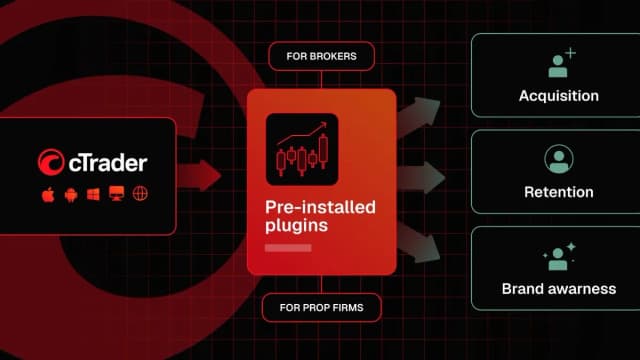
cTrader has opened multi-platform plugins to brokers and prop firms, which can pre-install their own tools for clients or list them in cTrader Store. The plugins run across Mobile, Web, Windows and Mac, and can be built and launched independently of core-platform releases, including trading journals and calculators.
Institutional brokerage and financial infrastructure provider Clear Street has joined TradingView’s broker network, allowing its clients to trade US stocks, exchange-traded funds and options directly through the charting and analysis platform.
Learn how to improve trading psychology, manage fear and greed, avoid revenge trading, and follow your trading strategy with discipline and a trading journal.
GTC Prime has announced a strategic partnership with Centroid Solutions to manage and distribute its liquidity through CS 360 Bridge, Centroid's multi-asset connectivity and execution engine, giving brokers and institutional clients access to tailor-made pricing, low-latency execution and real-time risk management.