
just now


Liquidity Finder Ltd is incorporated in England and Wales, company number 10610740, registered address 167-169 Great Portland Street, Fifth Floor, London W1W 5PF, United Kingdom.
Published: just now
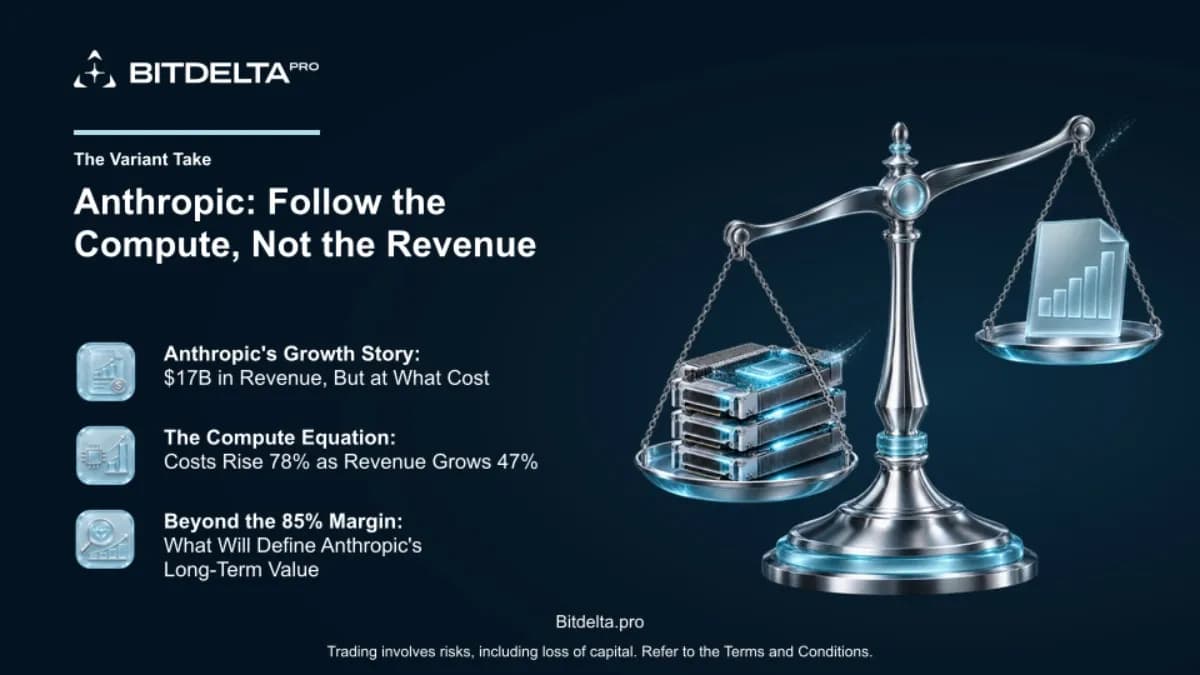
The Variant Take sets out a data-driven view that differs from market consensus, the evidence behind it, and what would prove it wrong. It is a way of thinking about a market question, not a recommendation to trade.
Consensus: Anthropic's growth, customer loyalty and 85% gross margin make it a software-like winner of the AI build-out, and its revenue is the number to watch.
Our take: The demand is real, but revenue is the wrong number to watch. Anthropic's value depends on how much revenue each dollar of computing produces, and in the third quarter that figure fell. The reported margin leaves most of that cost out.
What Happened
Anthropic listed on the Nasdaq last Thursday after the largest IPO on record. It priced at $83, closed its first day at $97.17 and has since slipped to $87.64, a value of about $1.16 trillion. On Monday, when the Nasdaq had its best day since April 2025, it fell 1.4%. Most coverage of the listing has focused on revenue: $17.0 billion in the third quarter, about 12 times a year earlier, and $33.2 billion in the first nine months of 2026. Those numbers are not in dispute. Our argument is that a different line in the prospectus matters more.
The Evidence
1. The reported margin leaves out most of the computing. Cost of revenue was 14.5% of revenue in the first nine months, which gives the 85% gross margin widely quoted. But total spending on computing and infrastructure was $18.8 billion, or 57% of revenue, and most of it is booked in research and development. The filing does not say how much of that computing serves paying customers and how much trains new models. One independent estimate, by Mostly Metrics, puts a fuller gross margin in the low 60s.
2. Computing grew faster than revenue. In the third quarter revenue rose 47% from the second. Computing costs rose about 78%.
| Quarter | Revenue | Computing cost | Revenue per $1 of computing |
| Q2 2026 | $11.6 billion | About $5.5 billion (48%) | About $2.08 |
| Q3 2026 | $17.0 billion | $9.9 billion (58%) | About $1.72 |
Source: Anthropic amended S-1 as reported by The Next Web and SEC-API. Q2 computing cost derived from the 48% share of revenue.
3. The costs ahead are fixed; the revenue is not. Anthropic has committed about $900 billion to computing and infrastructure, with about $71 billion due in the next twelve months. That is roughly equal to its third-quarter revenue annualised. Commitments of this size turn computing into a fixed cost, which rewards the company handsomely if growth continues and squeezes it quickly if growth slows.
4. Its partners sit on both sides of the ledger. Amazon and Google are shareholders, suppliers of computing, sales channels and makers of competing models. Their cloud marketplaces carried 44% of revenue in the first nine months, and cloud providers held 52% of receivables at the end of September. At the IPO, seven chip and cloud suppliers bought $26 billion of shares. When suppliers are also investors, revenue alone cannot show how much growth is self-sustaining.
5. Most revenue is priced per unit of use. Usage-based revenue is 79% of the total. As open-weight models, which are free to download and run, become more capable, customers can compare model providers on price per unit of use. That puts the pressure on revenue per dollar of computing rather than on the headline growth rate.
Where We Could Be Wrong
The case against us is strong. Anthropic says much of the third-quarter jump came from $5.0 billion of short-term capacity bought at a premium to keep up with demand, and that cheaper long-term capacity, including its own data centres, will bring costs down. Its range of suppliers, from Google's TPUs and Amazon's Trainium to Broadcom, AMD and Nvidia, gives it unusual bargaining power over the price of computing. Customers are clearly willing to pay: existing business customers spent about nine times more than a year earlier, and the company generated $6.6 billion of operating cash in nine months. Training spending is also partly discretionary. If growth slows, Anthropic could cut back on training the next model, and its margins would improve quickly.
What would change our mind: computing costs falling back below 50% of revenue in the first reported quarter, disclosure showing a high margin on serving customers once training is separated out, or a further fall in the share of revenue sold through cloud marketplaces.
Revisit date: After Anthropic's first quarterly report as a listed company, expected early next year.
The Bottom Line
Anthropic's revenue answers the question of whether customers want its models. They plainly do. It does not answer whether serving them is getting cheaper or more expensive, and on the evidence of the third quarter it got more expensive. For a company with about $900 billion of computing commitments, revenue per dollar of computing is the number that will decide what the business is worth. The first quarterly report will show whether the third quarter was a blip or a trend.
Research | BitDelta Pro
Dubai, UAE
Disclaimer
BitDelta Securities Financial Services LLC, regulated by the Capital Market Authority under Category 5 (Introduction Only), acts solely as an introducer and does not provide trading, execution, dealing, advisory, portfolio management services. All trading, execution, and investment-related services are provided by BitDelta Limited, regulated by the FSC Mauritius, a licensed Investment Dealer excluding underwriting.
All trading and investments involve risk. The value of investments may fluctuate, and you may receive less than your initial investment.
The information contained in this article is provided for general informational purposes only and does not constitute financial, investment, legal, or professional advice, or a recommendation to buy, sell, or hold any financial product. Readers should seek independent professional advice and conduct their own due diligence before making any decisions. Neither the publisher nor the contributors accept liability for any loss arising from reliance on this content.
Appendix: Sources
Filing and Financials
Anthropic, PBC: Form S-1 (SEC EDGAR)
SEC-API: Anthropic S-1 and S-1/A Filings Analysis
The Next Web: Anthropic’s Compute Costs Rose to 58% of Revenue
Mostly Metrics: Anthropic IPO, S-1 Breakdown
SaaStr: The Top 10 Metrics in Anthropic’s S-1
Offering and Trading
Motley Fool: Anthropic’s $1.4 Trillion IPO, the Ultimate Guide
Trefis: Did Anthropic Stock’s 9% Slide Make It Cheap?
Motley Fool: The Nasdaq Just Had Its Best Day Since April 2025. Anthropic Stock Fell Anyway.
Institutional multi-asset market access across MT5 Ultency, CQG, Iress Pro and BitDelta Terminal, with transparent execution standards and global market coverage.

Select the categories and companies you wish to follow directly to your person rss feed.
Create Custom RSS Feed
just now
Sign up and join over 5,000 professional members who receive personalized news alerts, curated professional connections, and more for free!
The Variant Take sets out a data-driven view that differs from market consensus, the evidence behind it, and what would prove it wrong. It is a way of thinking about a market question, not a recommendation to trade.
Gold rejected 4-hour resistance. See what could take XAUUSD to $3,400 support and what buyers need to reclaim for a recovery toward $3,875.
Webull reported record third quarter 2026 revenue of $218.7 million, up 39% year-over-year, as trading-related revenue rose 53% and options contracts volume grew 79%. Customer assets reached $32.4 billion and DARTs rose 66% to 1.8 million, while net income attributable to the company fell to $31.2 million from $36.9 million.
iSAM Securities Apex has integrated with FCA-regulated Alchemy Prime, expanding its institutional liquidity network and giving CFD brokers access to multi-asset liquidity across FX, precious metals, indices, commodities and cryptocurrency CFDs.
Nasdaq 100 has shifted into a bearish staircase structure following its sharp rally to the 27,094 peak on Monday. After consolidating briefly near the highs, price action rolled over and has consistently printed lower highs and lower lows. The moving averages confirm this downward momentum with a clean bearish stack of MA5, MA10, and MA20.
U.S. stock futures edged lower ahead of fresh inflation data, with Dow futures down 0.1%, S&P 500 futures 0.2% and Nasdaq-100 futures 0.3%.
Gold saw a strong rebound from $3,503. The recovery pushed price to $3,690, but momentum has since stalled and price is now around $3,624. The recent candles are relatively small and overlapping, indicating consolidation.
The Nasdaq 100 rallied nearly 7% after Nvidia reinstated Jensen Huang. Can NAS100 hold 25,665–26,155 as support and extend the recovery toward 28,250?
U.S. stock futures fell on Tuesday, giving back part of Monday’s sharp rally. Nasdaq-100 futures dropped 1%, S&P 500 futures fell 0.4%, and Dow futures slipped 0.1%. The pullback followed a 31% surge in Nvidia on Monday after Jensen Huang’s return as CEO, which reignited the broader AI and semiconductor trade. Nvidia was down more than 3% in pre-market trading Tuesday.
Last week was the worst for US technology stocks since March 2020. The Nasdaq Composite fell 10% and is now down for the year. The S&P 500 fell 8.6%, declining every day, and closed in correction, 11.6% below its October record. The semiconductor index lost about 17%, its worst week since the one after September 11, 2001. All of this came in the same week Nvidia reported revenue more than doubling and raised its outlook again.