just now


Liquidity Finder Ltd is incorporated in England and Wales, company number 10610740, registered address 167-169 Great Portland Street, Fifth Floor, London W1W 5PF, United Kingdom.
Published: just now
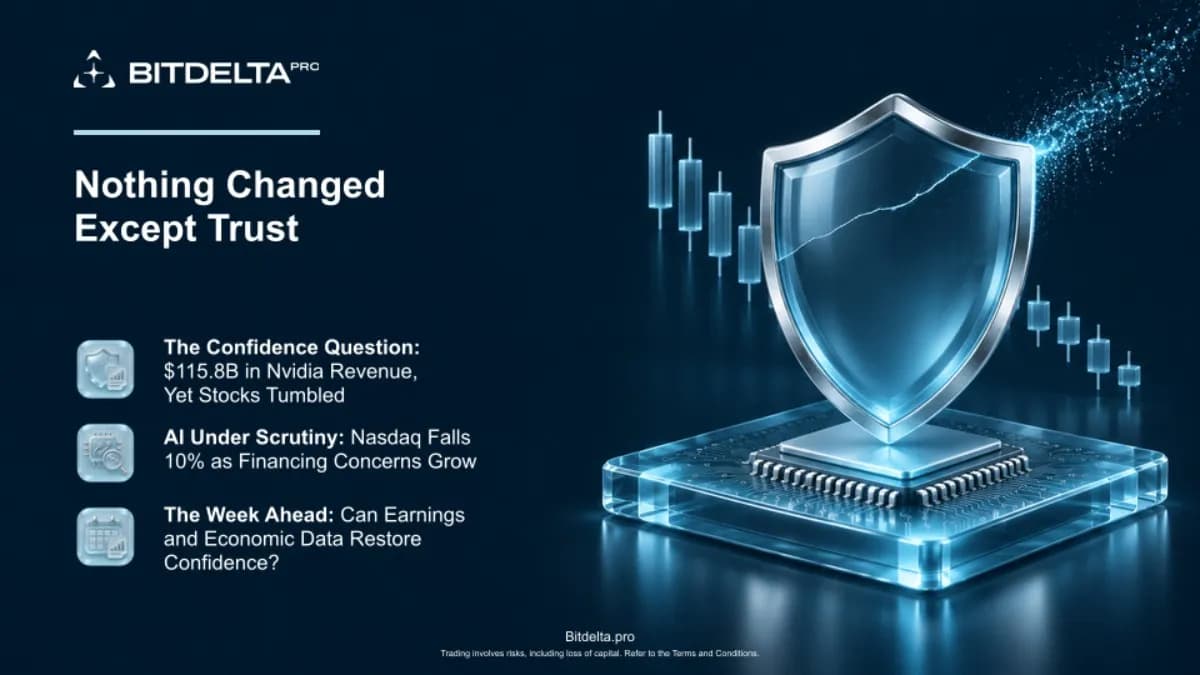
Last week was the worst for US technology stocks since March 2020. The Nasdaq Composite fell 10% and is now down for the year. The S&P 500 fell 8.6%, declining every day, and closed in correction, 11.6% below its October record. The semiconductor index lost about 17%, its worst week since the one after September 11, 2001. All of this came in the same week Nvidia reported revenue more than doubling and raised its outlook again.
Our read is that the earnings did not change. Demand for AI computing is as strong as it was a week ago. What changed was trust: in Nvidia's disclosures, in how the AI build-out is financed, and in the leveraged positions that had been built on both. When trust breaks, investors sell first and read the filings later. This week brings a holiday-shortened calendar, a heavy dose of data on Wednesday and the first big test of AI hardware demand since the sell-off, from Dell.
The Week in Numbers
| Market | Week to Nov 20 | Read |
| S&P 500 | -8.6% to 6,910 | Correction; worst week since April 2025 |
| Nasdaq Composite | -10.0% | Worst week since March 2020; negative for 2026 |
| Semiconductor index (SOX) | about -17% | Worst week since September 2001 |
| Equal-weight S&P 500 | -6.2% | The average stock held up better |
| Nvidia | -22.9% to $125.53 | -14% on Friday alone |
| CoreWeave | -25.6% | AI financing under pressure |
| VIX | 35.89 (from 19.30) | Near-term fear above longer-term |
| 10-year Treasury | 4.91% (from 5.15%) | Flight to safety |
| High-yield credit spread | 3.52% (from 3.23%) | Credit starting to crack |
| Gold / Silver | -8.9% / -16.2% | Sold for cash |
| Bitcoin | -13.9% to about $58,800 | Sold for cash |
| US dollar index | +0.4% to 103.84 | Demand for dollars |
Source: The Glass Desk weekly review and CEO Economy (November 20, 2026), citing market closes and FRED for credit spreads.
What Did Not Change
Nvidia's third-quarter results were among the strongest it has reported. Revenue of $115.8 billion beat expectations by about $7 billion, guidance for the current quarter came in roughly $5 billion above consensus, and the company raised its growth outlook for next fiscal year to around 75%, all assuming no data-centre sales to China. Its customers are running at full capacity, and rental rates for its newest chips are up more than 60% since launch. Anthropic, the largest buyer of AI computing outside the hyperscalers, raised $81.3 billion in a record IPO and closed its first day up 17% at $97.17. None of that describes a business losing demand.
What Changed: Trust in the Numbers
The selling intensified on Friday, when Nvidia fell 14% after a Reuters report that SEC staff are examining possible accounting issues. Reuters said the inquiry does not establish wrongdoing. Earlier in the week, the Wall Street Journal reported a civil SEC probe into whether Nvidia's disclosures misled investors, linked to Singapore-based Megaspeed, which is suspected of routing Nvidia chips to China, and to Nvidia's decision last year to stop reporting Singapore as a separate revenue line. California's attorney general said his office is looking at “red flags” about chip diversion.
Nvidia has also not yet filed its quarterly report with the SEC, breaking its practice of filing on results day. It says it will file in the coming weeks, and the deadline falls around December 4. It released a supplemental document with geographic and customer data instead, and its board has set up a committee to oversee national security and export controls. Separately, the Commerce Department moved to stop Chinese firms renting Nvidia computing power in data centres outside China.
The market is not doubting that Nvidia sold $115.8 billion of products. It is doubting whether it has the full picture of where they went and on what terms, and it will not give the benefit of the doubt until the filing arrives. For a stock that accounts for a large share of the S&P 500, that is enough to drag the whole index.
What Changed: The Financing Is Being Questioned
The second shift was in credit. The spread investors demand to hold high-yield bonds rose to 3.52% from 3.23% in a week, and CoreWeave, the most indebted of the neoclouds, fell 26%. Nvidia has disclosed substantial guarantees and commitments supporting its customers, and the companies building data centres rely heavily on borrowing. When equity prices fall this fast, lenders start asking the same question shareholders did: how much of the build-out depends on financing that might not be renewed on the same terms.
This is the risk we have flagged since October. Demand for AI is not the weak link; the financing chain behind it is. Last week the market began pricing that risk all at once.
What Changed: Everyone Had to Sell
The pattern across assets points to forced selling. Gold fell 8.9% and silver 16.2%, bitcoin dropped 13.9% and ether 16%, while the dollar rose and Treasuries rallied. Assets that usually move in opposite directions fell together, which is what happens when investors facing margin calls sell whatever they can rather than what they want to. The VIX at almost 36, with near-term volatility priced above longer-term, confirms the stress was acute.
Forced selling tends to end abruptly, once the leveraged positions have been cleared, but it rarely ends before the selling is done. The more useful signal is underneath: the equal-weight S&P 500 fell 6.2%, less than the main index, consumer staples fell only 2%, and energy remains up 38% for the year. The rotation away from the largest technology stocks that began in October is still intact.
The Fed Has Its Tightening
Going into the sell-off, futures priced a December rate hike as all but certain, and the minutes of the Fed's October meeting showed almost all officials expected one. The market has since done much of the Fed's work. A 10% fall in the Nasdaq, wider credit spreads, a stronger dollar and a VIX near 36 amount to a sharp tightening in financial conditions, and falling share prices hit spending through household wealth.
We have argued that further hikes are unnecessary because the inflation still in the system comes largely from supply, from fuel, freight and refining, rather than from an overheating economy. Last week strengthens that case. The question for December 9 is no longer whether inflation justifies a hike, but whether the Fed wants to tighten into a market that has just tightened on its own. Wednesday's data will shape the answer.
The Week Ahead
| Day | Data and Events | Earnings |
| Mon Nov 23 | Flash PMIs; New York Fed President Williams speaks | Zoom, HP Enterprise, Symbotic, Agilent |
| Tue Nov 24 | Consumer confidence (92.1 expected) | Analog Devices, Best Buy (before open); Dell, HP, Workday, Autodesk (after close) |
| Wed Nov 25 | Core PCE (+0.3% expected), Q3 GDP (3.5%), durable goods, jobless claims, income and spending, new home sales, Beige Book | Deere (before open) |
| Thu Nov 26 | Thanksgiving: US markets closed | |
| Fri Nov 27 | Goods trade balance; early market close |
Source: FXEmpire week-ahead calendar (consensus estimates). Dates subject to change.
Dell is the report to watch. As the largest maker of AI servers reporting this week, it is a direct read on whether orders are holding up while the stocks fall. Wednesday then delivers almost a week of data in one morning, including the Fed's preferred inflation measure. Trading will be thin around the holiday, which can exaggerate moves in both directions.
What We Are Watching
Nvidia’s quarterly filing. Due around December 4. A clean filing that answers the disclosure questions would remove the main reason for last week’s selling; further delay would extend it.
Dell’s AI server orders. The first hard evidence on demand since the sell-off.
Credit spreads. If high-yield spreads keep widening, the stress is spreading from stocks to the financing of the build-out.
Core PCE and the Fed. A soft reading alongside last week’s tightening in financial conditions would make a December hike harder to justify.
OPEC+ on November 29. Output decisions for 2027, with Brent near $90.
The numbers that drove the AI trade are intact. What broke last week was confidence in the disclosures, the financing and the leverage around them, and rebuilding that takes filings and time rather than another strong quarter.
Research | BitDelta Pro
Dubai, UAE
Disclaimer
BitDelta Securities Financial Services LLC, regulated by the Capital Market Authority under Category 5 (Introduction Only), acts solely as an introducer and does not provide trading, execution, dealing, advisory, portfolio management services. All trading, execution, and investment-related services are provided by BitDelta Limited, regulated by the FSC Mauritius, a licensed Investment Dealer excluding underwriting.
All trading and investments involve risk. The value of investments may fluctuate, and you may receive less than your initial investment.
The information contained in this article is provided for general informational purposes only and does not constitute financial, investment, legal, or professional advice, or a recommendation to buy, sell, or hold any financial product. Readers should seek independent professional advice and conduct their own due diligence before making any decisions. Neither the publisher nor the contributors accept liability for any loss arising from reliance on this content.
Appendix: Sources
Markets
The Glass Desk: Weekly Market Review, November 20, 2026
CEO Economy: Nasdaq’s Worst Week Since March 2020
Invezz: Anthropic Closes at $97.17 on Its First Day of Trading
Nvidia
InvestmentNews: Nvidia Faces SEC Probe as California Attorney General Eyes Action
Longbridge: Why Nvidia Held Back Its Quarterly SEC Report
NVIDIA: Financial Results for Third Quarter Fiscal 2027
Rates and the Week Ahead
FXEmpire: The Week Ahead, PCE in Focus After AI Sell-Off
The Wealth Advisor: Wall Street’s Sell-Off May Spare the Fed More Rate Hikes
Institutional multi-asset market access across MT5 Ultency, CQG, Iress Pro and BitDelta Terminal, with transparent execution standards and global market coverage.

Select the categories and companies you wish to follow directly to your person rss feed.
Create Custom RSS Feed
just now
Sign up and join over 5,000 professional members who receive personalized news alerts, curated professional connections, and more for free!
Last week was the worst for US technology stocks since March 2020. The Nasdaq Composite fell 10% and is now down for the year. The S&P 500 fell 8.6%, declining every day, and closed in correction, 11.6% below its October record. The semiconductor index lost about 17%, its worst week since the one after September 11, 2001. All of this came in the same week Nvidia reported revenue more than doubling and raised its outlook again.
Your Bourse and NetShop ISP have established a private fibre cross-connect between Equinix LD6 and LD4 in London. Available on demand, the link gives brokers using both providers a direct route for pricing and order traffic, bypassing the public internet and helping reduce network latency and jitter.
We spoke with Finalto’s Group Head of Liquidity, Sam Horowitz, and members of his UK team about what defines a modern liquidity operation.
Demo trading feels easier, but live trading changes your decisions. Learn how fear, loss aversion, hesitation, and risk affect your entries, exits, and trading discipline.
The CFD broker added nearly 1.7 million users in 2026 and expanded its range from 800 instruments to more than 1,100, including US share and ETF CFDs available outside regular market hours.
Zodia Markets has appointed Jan Brzezek, Founder of Swiss digital asset firm Crypto Finance AG, as chief executive.
Apolonia Capital has secured a licence to manage investment funds onshore in the United Arab Emirates.
Luramic will attend Finance Magnates London Summit 2026, taking place on 23–24 November at Old Billingsgate in London, UK.
Coinbase, Robinhood and Strategy are among six US stocks set to trade around the clock from Monday, 23 November, on a new venue run by OKX and Intercontinental Exchange
NAS100 faces resistance at 25,665–26,155. See what would confirm a decline toward 24,845 and what buyers need for a bullish breakout above 28,823.