just now


Liquidity Finder Ltd is incorporated in England and Wales, company number 10610740, registered address 167-169 Great Portland Street, Fifth Floor, London W1W 5PF, United Kingdom.
Published: just now


Trading for the first time can feel confusing. Before placing a trade, you need to learn the platform, choose a trade size, and understand how to open and close a position.
A demo trading account lets you practice these steps with virtual money before putting real capital at risk. It gives you space to learn the controls, test a trading plan, and review your mistakes without losing personal money on practice trades.
However, demo trading is preparation. Profits are simulated, cannot be withdrawn, and do not guarantee success in a live account.


A provider gives you access to a simulated trading environment with a virtual balance. Available markets, pricing feeds, and features depend on the platform.
The basic process is straightforward:
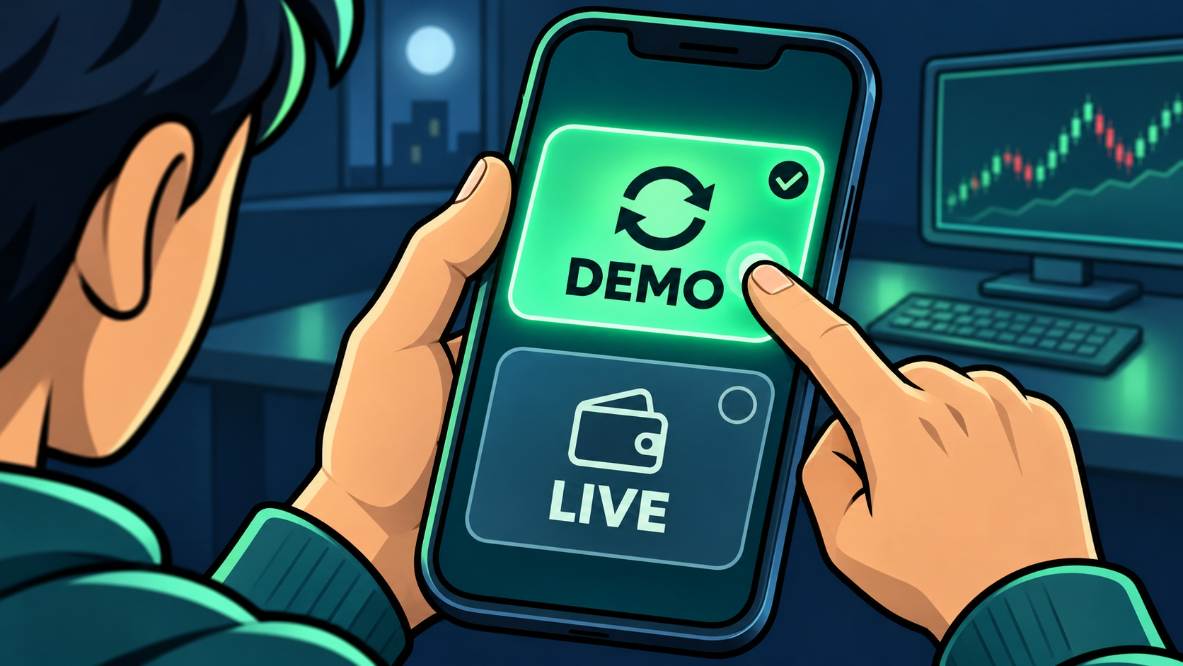
Beginners use demo accounts to learn how trading works before making decisions with real money. A practice account gives you room to become familiar with the platform and spot mistakes in your process.
Practice finding an instrument, opening its chart, entering an order, and closing a position. Learning these controls can help you identify errors such as choosing the wrong trade size or selecting the wrong order type.
A demo account lets you practice clear entry and exit rules. You can record what happened and assess whether you followed the plan consistently. A few successful practice trades, however, do not prove that a strategy will work in live markets.
Your trade history can reveal when you followed your rules and when you entered without a clear reason. This makes demo trading useful for practicing patience, recordkeeping, and a repeatable review process.
The aim is to understand what you are doing and why before real money is involved.
Random practice makes progress difficult to measure. Give each session a clear purpose using this five-step process.
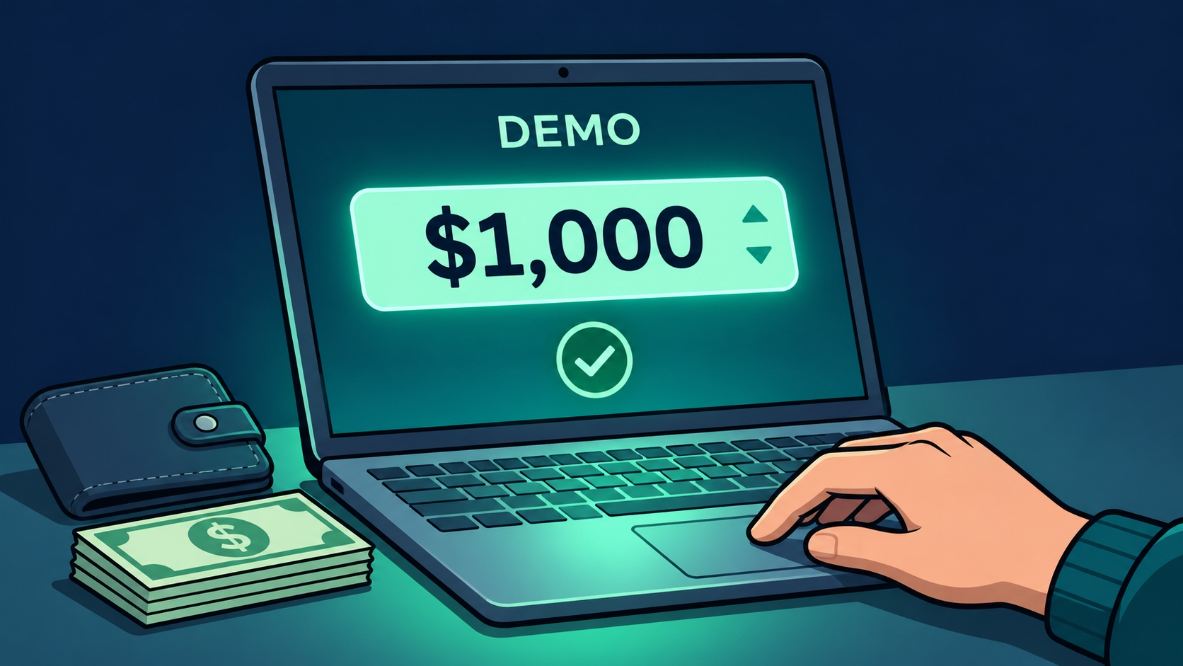
Where the platform allows it, choose a virtual balance close to the amount you realistically expect to trade with.
A large demo balance can make oversized trades appear manageable. A realistic balance makes your practice easier to relate to future decisions.
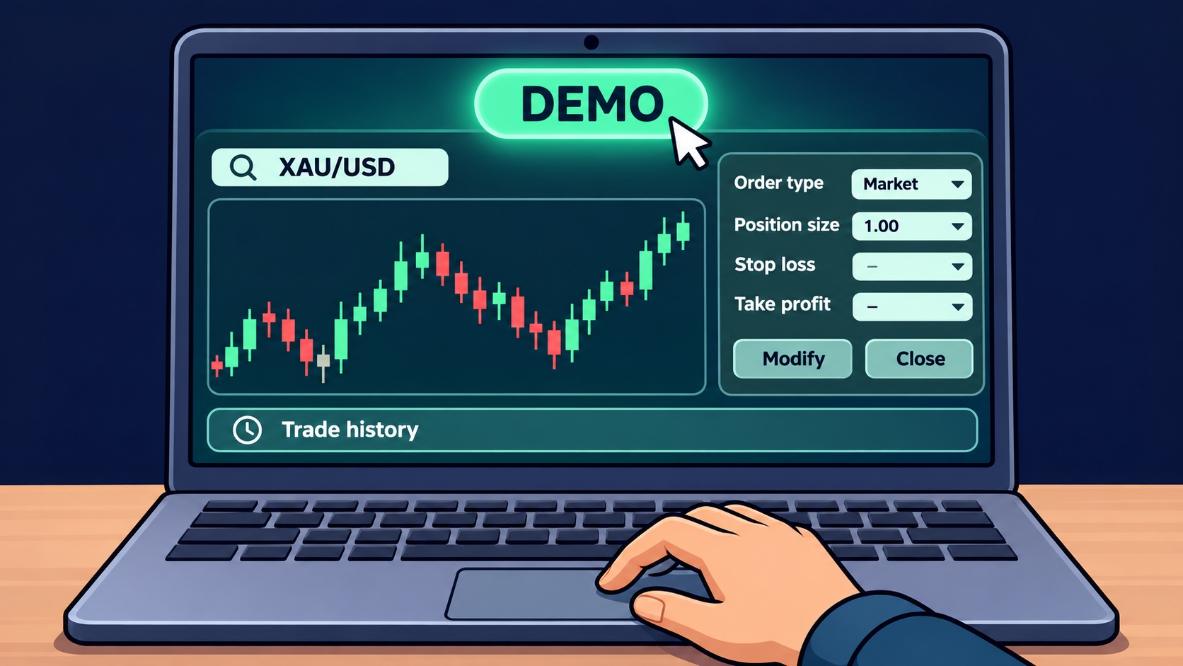
Before testing a strategy, understand how to:
Check that you are in the demo environment before placing an order.
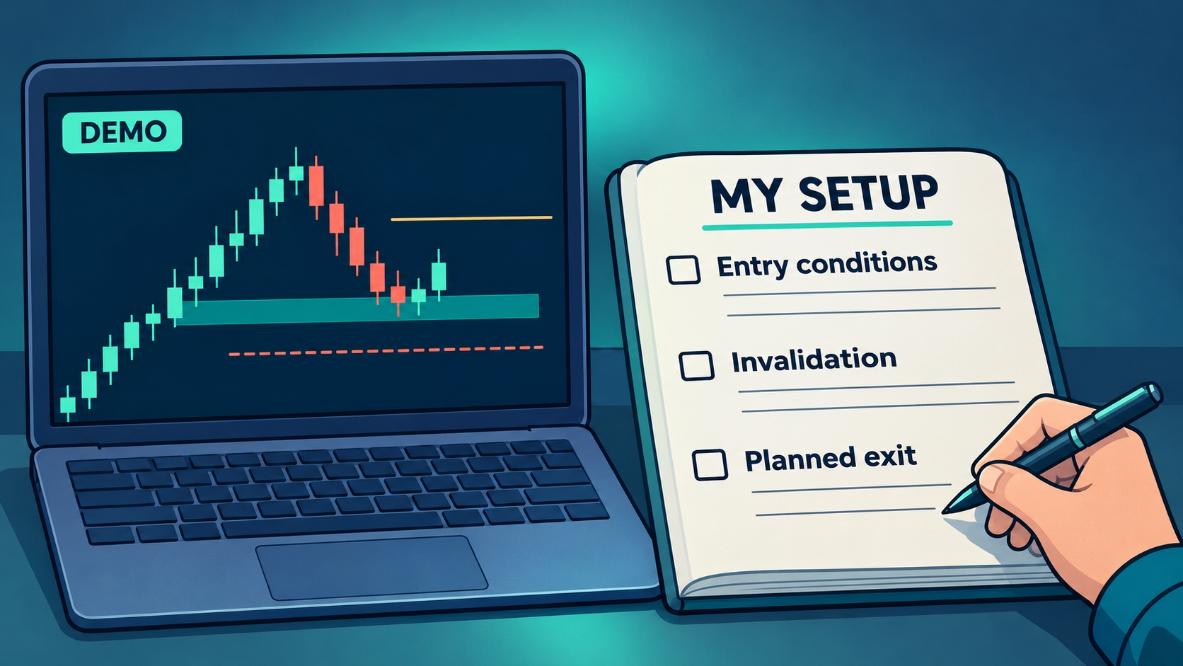
Write down what must happen before you enter.
For example:
“I will wait for price to reach my marked support level and show the confirmation required by my plan.”
Define three things:
This gives you something specific to assess after the trade.
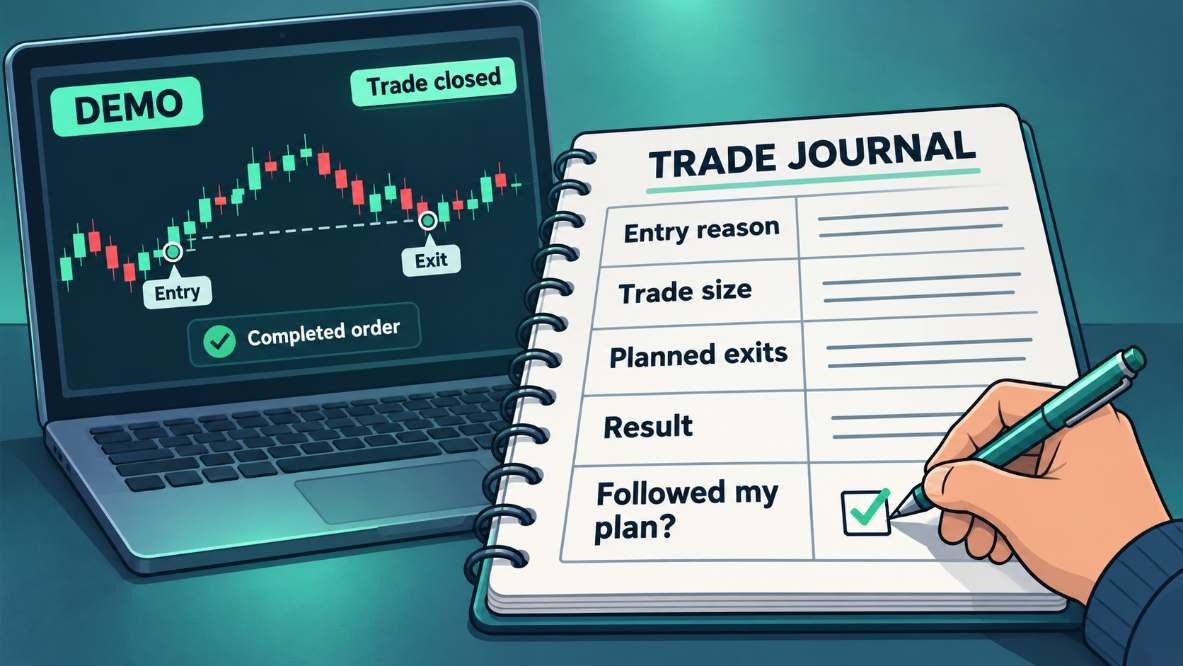
Place the simulated trade according to your plan. Record why you entered, your trade size, planned exits, and the result.
Avoid changing your rules halfway through a trade simply because price moves against you.
Your trading history becomes more useful when you can explain the decisions behind it.

After each practice session, ask:
A winning trade does not automatically mean a good decision. A losing trade does not automatically mean a bad decision.
| FeatureDemo TradingLive Trading | ||
| Capital | Virtual funds | Real money |
| Profits and losses | Simulated | Actual financial outcomes |
| Execution | Simulated conditions | Actual market and provider conditions |
| Emotional pressure | No personal capital lost on practice trades | Real losses can affect decisions |
| Purpose | Learning and testing | Trading with financial exposure |
A demo may not reproduce all trading costs or execution effects.

For your next demo session, focus on opening, managing, and closing a trade correctly.
Write down your plan first. After the trade, compare that plan with your actions and identify one thing to improve in the next session.
Over time, this creates a record you can learn from and a clearer picture of the skills that still need work.
_____________________________________________________________________________________
Many providers offer free demo access. Check whether account expiry, data charges, or feature restrictions apply.
No. Ordinary demo profits are virtual and cannot be withdrawn. They represent the simulated results of your practice trades.
There is no universal deadline. Focus on understanding the platform, following a defined process, and building a record you can meaningfully review.
A short winning streak is not enough to establish readiness for live trading.
Both terms commonly describe simulated trading without real capital. Paper trading can also mean manually recording hypothetical trades instead of using a practice platform.
Use your demo sessions to practice the skills covered in these guides:
Start with the skill you need most, apply it in your next practice session, and review what you learned before moving on.
If you decide to move beyond demo practice, first review the provider’s account terms, trading costs, execution conditions, and risk disclosures.
Make sure you understand the financial exposure involved and use only capital you can afford to lose. Demo experience can help you learn the process, but it cannot guarantee live results.
Explore an ACY Live Trading Account
Follow Ruffy Grant B. Capacio for Gold analysis, Forex trading ideas, price action education, trading psychology, and market insights: LinkedIn
ACY Securities: Join the Discord Server
Disclaimer:
Trading Forex, Gold, CFDs, cryptocurrencies, commodities, indices, and other leveraged financial instruments involves a high degree of risk and may not be suitable for all investors or traders. Market conditions can change rapidly, and leveraged trading can result in losses that occur quickly.
Before trading, carefully consider your investment objectives, level of experience, and risk tolerance. Only trade with capital you can afford to lose and seek independent financial or professional advice where appropriate.
All market analysis, price forecasts, technical commentary, trading scenarios, educational materials, and opinions presented in this content are provided solely for general informational and educational purposes. They do not constitute financial advice, investment advice, a recommendation, solicitation, or an offer to buy or sell any financial instrument.
Past performance and historical price movements are not reliable indicators of future results. Any price levels, targets, scenarios, or market outlooks discussed should be viewed as analysis rather than guarantees of future market performance. November 10, 2026
ACY Securities is one of Australia's fastest growing multi-asset online trading providers, offering ultra-low-cost trading, rock-solid execution, technologically superior account management and premium market analysis.

Select the categories and companies you wish to follow directly to your person rss feed.
Create Custom RSS FeedSign up and join over 5,000 professional members who receive personalized news alerts, curated professional connections, and more for free!
Learn how a demo trading account works, why beginners use it before live trading, and how to practice with virtual funds using a simple five-step guide.
Bitcoin faces resistance at $76,800–$80,800. Explore the BTCUSD bearish setup toward $71,000 and the bullish break-and-retest scenario targeting $86,500.
Raj Sitlani, Jonathan Brewer and Jeff Wilkins have launched JT Prime, a new institutional Prime of Prime business offering aggregated Tier 1 multi-asset liquidity to brokers, funds, family offices and proprietary trading firms, with a regulatory application pending and digital assets planned beyond FX and commodities.
The update adds strategy promotion, cross-platform sharing and guest browsing to STAR Copy.
GTN has appointed former Gemini and Kraken executive Mark Jennings as global head of digital assets, a new role leading its tokenisation strategy as more platforms bring traditional assets on-chain. Jennings previously led Gemini Europe and Crypto Facilities, Kraken’s FCA-regulated institutional derivatives venue.
The Central Bank of Nigeria (CBN) has issued regulations that require issuers of foreign currency stablecoins used by Nigerians to incorporate locally.
US crypto exchange Coinbase has received full approval from the Office of the Comptroller of the Currency (OCC) for its national trust bank, Coinbase National Trust Company.
The Warsaw Stock Exchange (GPW) has launched a pilot with Polish broker XTB that gives the broker’s clients in other EU countries automatic access to instruments listed in Warsaw.
The US Treasury’s Financial Crimes Enforcement Network (FinCEN) has issued an order prohibiting US financial institutions from transmitting funds to or from Seychelles-based crypto exchange MEXC
Kudo has appointed Felice Digennaro as Head of Prop at Kudo Funded. He joins from FunderPro, where he was Head of Affiliates, and will lead the prop business as Kudo pursues diversification and growth plans. Finley Wilkinson, Chief Operating Officer at Kudo, and Digennaro commented on the appointment.