
just now


Liquidity Finder Ltd is incorporated in England and Wales, company number 10610740, registered address 167-169 Great Portland Street, Fifth Floor, London W1W 5PF, United Kingdom.
Published: just now


You open a trade expecting price to move in your favor. Instead, it moves against you. Do you close the trade, or keep waiting for a recovery?
For beginner traders, that decision can become emotional quickly. Having an exit plan before entering helps you prepare for a trade that does not work out.
A stop loss is a preset exit designed to limit a trade’s loss if price moves against you. It helps manage losses, although a standard stop loss does not guarantee the exact price at which you will exit.
Understanding a stop loss in trading starts with knowing when you would exit a losing position. In this guide, you’ll learn how a stop loss works, how to calculate planned risk, and which mistakes to avoid.
Understand how a stop loss works and how to combine them with position sizing to manage trading risk.
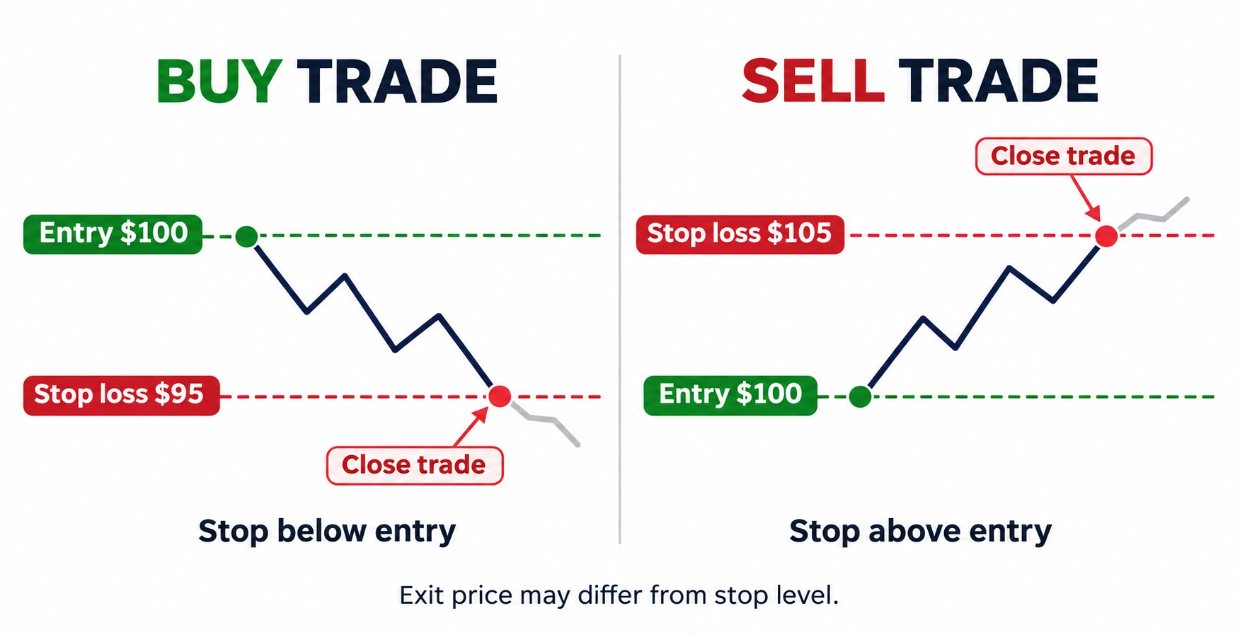
A stop loss is a preset exit level used to manage losses when a trade moves against you. When placed with your broker, it instructs the broker to close the position if the trigger is reached. A standard stop order becomes a market order when triggered, so the final execution price is not guaranteed.
For a buy trade, the protective stop is normally below the entry price. For a short trade, it is normally above

Think of a stop loss like deciding when to leave an outdoor picnic if it starts raining. Before you go, you agree:
“If the rain gets heavy, we’ll pack up and leave.”
That decision is your exit plan. It helps you act instead of staying and hoping the weather improves.
In trading, a stop loss sets that exit point in advance.
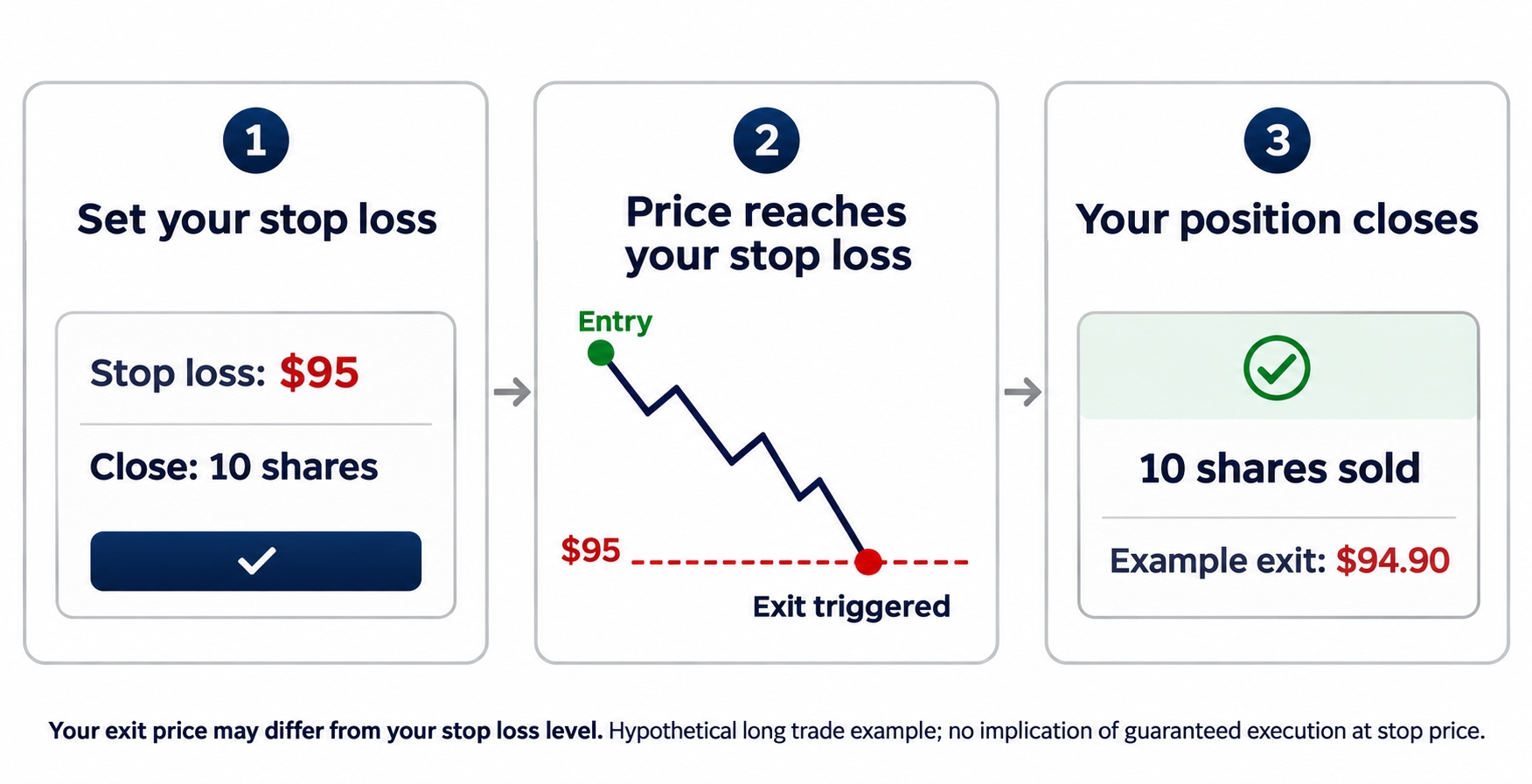
The process has three stages:
Suppose you buy 10 shares at $100 each and set a stop loss at $95.
If the price reaches your stop loss, it triggers the sale of your shares. If they sell at $95, your loss is $5 per share, or $50 before costs. The final selling price may be lower, which would increase your loss.
A stop loss gives you a planned exit, so you don’t have to make the decision while the trade is under pressure.
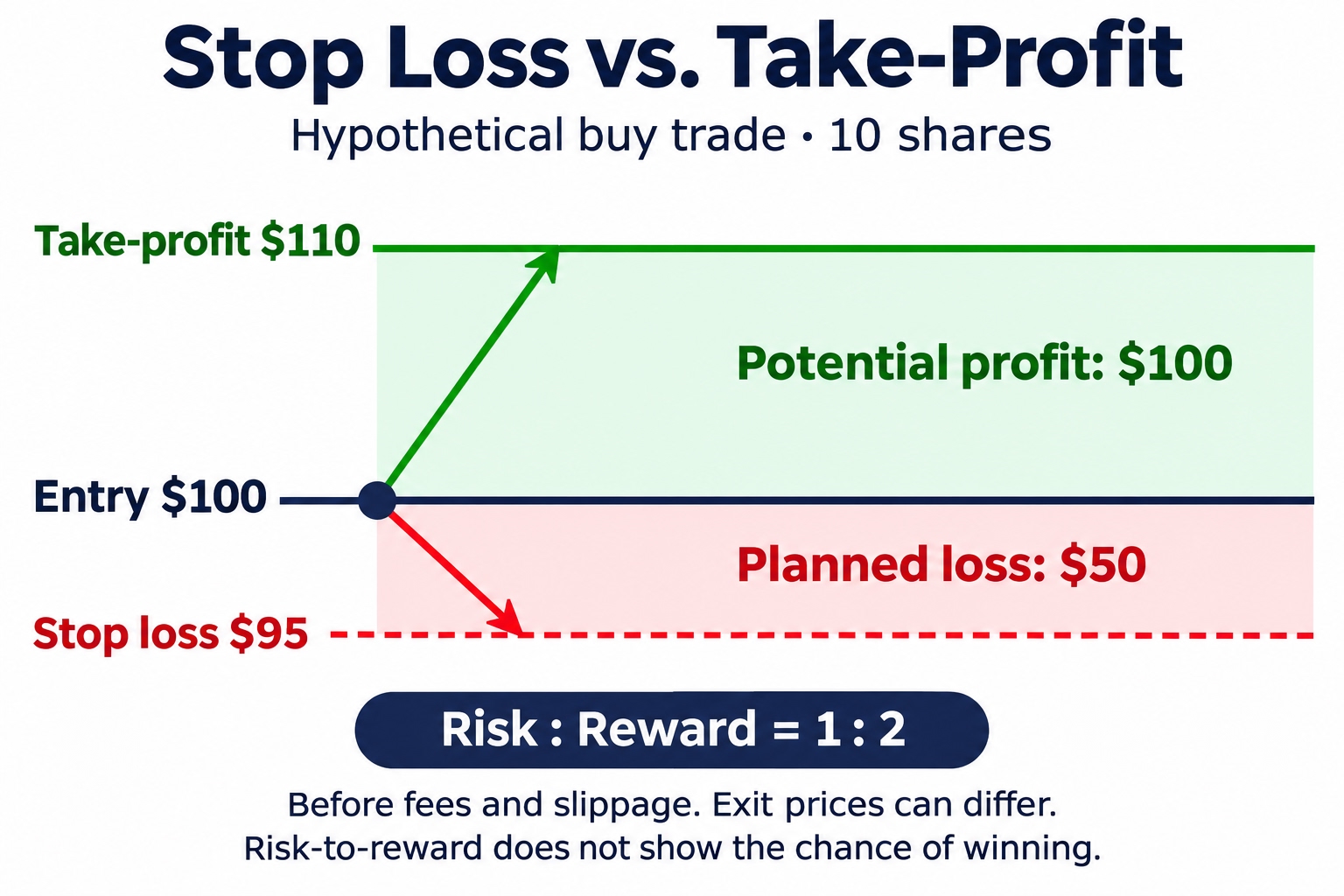
A stop loss is designed to manage an adverse price move. A take-profit is designed to exit when price reaches your profit objective. Your entry is where the trade begins.
| Trade levelPurposeHypothetical buy trade | ||
| Entry | Where you open the trade | $100 |
| Stop loss | Trigger for an exit if price moves against you | $95 |
| Take-profit | Planned exit if price reaches your profit objective | $110 |
For 10 shares, the planned loss at $95 is $50, while the potential profit at $110 is $100, before fees and slippage. That is a 1:2 risk-to-reward ratio; it does not tell you how likely the trade is to win.
No setup is certain. Support can break, a breakout can fail, and a trend can reverse.
A stop loss sets a planned exit if the trade moves against you. It helps you avoid holding a losing position after your original reason for entering no longer applies.
Setting your stop loss before entering helps you answer an important question:
“At what price would this trade idea no longer make sense?”
Having that exit planned can make it easier to follow your trading rules under pressure. Removing your stop loss or moving it farther away simply to avoid accepting a loss increases your exposure.
The larger an account loss, the greater the percentage gain needed to recover.
| Account lossGain needed to recover | |
| 10% | 11.1% |
| 20% | 25% |
| 50% | 100% |
These figures assume no deposits or withdrawals.
A stop loss helps manage downside risk, alongside appropriate position sizing and limits on total exposure. It does not guarantee a maximum loss, because the final exit price can differ from your stop loss level.
Your stop loss level and position size work together to determine your planned risk.
For shares:
Planned risk = distance between entry and stop loss × number of shares
With a $100 entry and a $95 stop loss:
Both trades use the same stop loss level, but the second has ten times the planned risk.
Actual losses can differ because of execution prices and costs. For forex and CFDs, calculations also depend on contract size, pip or point value, and currency conversion.
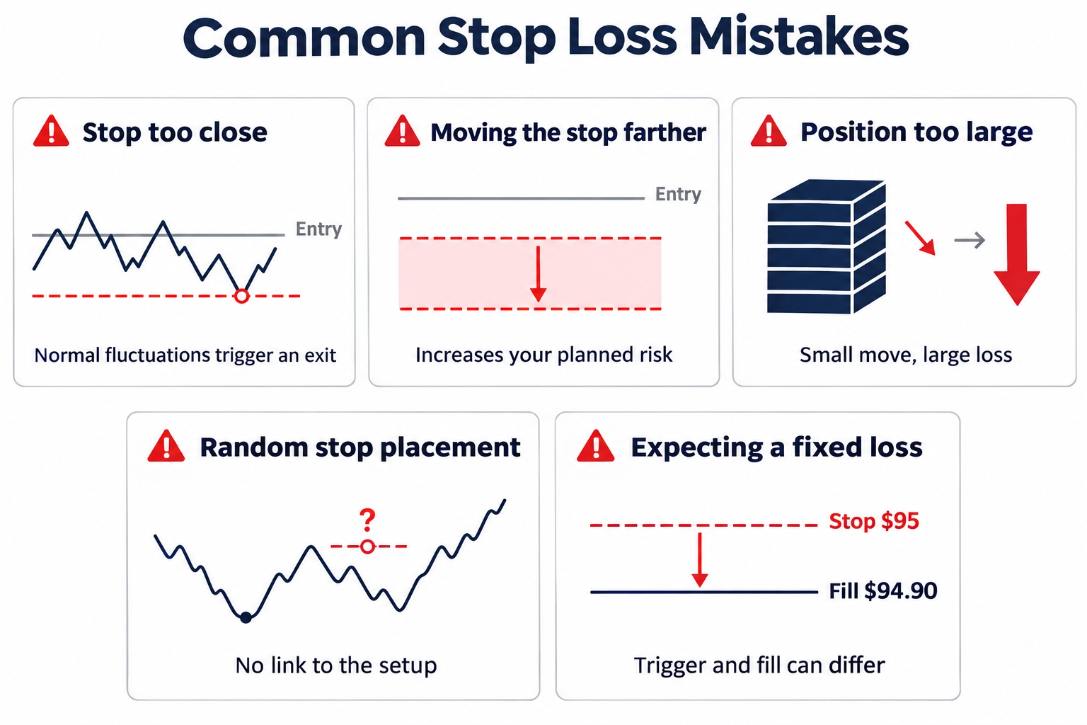
Here are the main risks:
A stop loss helps manage risk, but it cannot make an unprofitable strategy profitable. Oversized positions, repeated losses, and multiple trades exposed to the same market move can still cause substantial losses.
A stop loss gives your trade a planned exit if price moves against you. Used alongside suitable position sizing, it supports risk management in trading by helping you define risk before entering and manage a losing trade with greater discipline.
Start by understanding where your trade idea would no longer make sense, calculate the planned loss, and check how your broker executes stop orders.
A stop loss helps protect your ability to take the next trade.
A stop loss is a preset exit intended to limit losses when price moves against your position. Traders use it to help manage losses and enforce a planned exit.
For a new buy trade, a protective stop normally goes below the entry. For a new short trade, it normally goes above the entry. Placement depends on the setup and the risk plan.
They can trigger during temporary price swings, execute at an unfavorable price, and generate repeated small losses if poorly matched to the strategy. A stop-limit adds the risk of no execution. None of these orders replaces appropriate position sizing.
Stop losses can be part of a professional risk-management process, but practices vary by strategy and market. Do not assume every professional uses the same order type or stop distance. For a beginner, the practical lesson is to define the exit and planned risk before entering.
Not necessarily. A well-planned trade can lose. Review whether you followed your strategy, whether the stop suited the setup, and whether the position size matched your risk plan.
There is no single percentage that suits every trade. Distinguish the percentage price distance to your stop from the percentage of your account you plan to risk.
Adjustments can be part of a predefined strategy, such as trailing a stop as price advances. Moving it farther away merely because a trade is losing changes your original risk commitment.
Move from learning price action to applying it in the real market.
Trade:
Access trading platforms and tools including ACY, MT4, MT5, and Copy Trading.
Create an Account and Start Live Trading
_____________________________________________________________________________________
Build your trading foundation with these step-by-step guides:
Learn to read price action and assess trading setups at key levels:
Learn to recognize bullish, bearish and sideways markets:
Learn to mark key levels and interpret price reactions:
Understand recurring price patterns, retests and false breakouts:
Learn to combine candlestick signals with price action analysis:
Learn to recognize patterns that may signal a change in market direction:
Explore how to combine the exponential moving average with price action:
Bring your technical analysis skills together through a gold swing trading guide:
Learn how risk management and position sizing fit into your trading plan:
Learn how to plan take-profit targets using market structure and risk-reward:
Develop discipline, emotional awareness and a more consistent trading process:
Explore the psychological habits behind a disciplined trading approach:
_____________________________________________________________________________________
Not sure where to begin? Here’s a simple roadmap to guide you:
By building step by step; from basics → real trading → mastering the craft, you’ll gain clarity, confidence, and steady progress without ever feeling overwhelmed.

_____________________________________________________________________________________
Follow Ruffy Grant B. Capacio for Gold analysis, Forex trading ideas, price action education, trading psychology, and market insights: LinkedIn
ACY Securities: Join the Discord Server
Disclaimer:
Trading Forex, Gold, CFDs, cryptocurrencies, commodities, indices, and other leveraged financial instruments involves a high degree of risk and may not be suitable for all investors or traders. Market conditions can change rapidly, and leveraged trading can result in losses that occur quickly.
Before trading, carefully consider your investment objectives, level of experience, and risk tolerance. Only trade with capital you can afford to lose and seek independent financial or professional advice where appropriate.
All market analysis, price forecasts, technical commentary, trading scenarios, educational materials, and opinions presented in this content are provided solely for general informational and educational purposes. They do not constitute financial advice, investment advice, a recommendation, solicitation, or an offer to buy or sell any financial instrument.
Past performance and historical price movements are not reliable indicators of future results. Any price levels, targets, scenarios, or market outlooks discussed should be viewed as analysis rather than guarantees of future market performance. November 5, 2026
ACY Securities is one of Australia's fastest growing multi-asset online trading providers, offering ultra-low-cost trading, rock-solid execution, technologically superior account management and premium market analysis.

Select the categories and companies you wish to follow directly to your person rss feed.
Create Custom RSS FeedSign up and join over 5,000 professional members who receive personalized news alerts, curated professional connections, and more for free!
Explore gold trading sessions, the London–New York overlap and time zone considerations to understand when to watch XAU/USD.
Learn what a stop loss is, how it works, and how to set one. Explore examples, stop-limit comparisons, trailing stops, benefits, and risks.
AUDCAD reached the 0.97900 bearish target after rejecting 0.98500–0.98750 resistance. Review the weekly structure, daily 50 EMA and retest setup.
Plus500US has joined TradingView’s broker network, allowing clients to trade standard, E-mini and Micro futures directly from the platform’s Supercharts interface.
Scope Markets has added pre-IPO CFD trading on Anthropic and OpenAI shares for its retail clients on MetaTrader 5. The instruments are quoted 24/7, require 100% margin and carry no leverage, with free webinars in Arabic and English set for Thursday 12 November. Clients do not acquire shares or gain shareholder rights.
Broadridge's Distributed Ledger Repo processed an average of $345 billion in daily repo transactions in October, with total volumes of $7.6 trillion, as the company expands its digital asset infrastructure through its DLX platform covering issuance, trading, settlement, servicing and distribution of tokenised assets.
Spotware Systems, the company behind cTrader, has launched cAntifraud, an AI-powered fraud detection solution for FX/CFD brokers and prop firms.
Prediction market operator Polymarket has received approval from the National Futures Association (NFA) for its affiliate PM Derivatives, LLC to operate as a Futures Commission Merchant (FCM) on a fully collateralised basis.
Global financial services platform Marex Group has reported record third quarter results, with revenue from both its FX and Prime businesses more than doubling year on year.
etoro has agreed to acquire LB Finanzas, an Argentine all-in-one financial app covering investing and payments, and plans to make Argentina its regional hub in Latin America. There is no immediate impact for etoro users in Argentina, with future integration planned. Financial terms were not disclosed.