
just now


Liquidity Finder Ltd is incorporated in England and Wales, company number 10610740, registered address 167-169 Great Portland Street, Fifth Floor, London W1W 5PF, United Kingdom.
Published: just now

Bitcoin’s recent decline hasn’t happened because of fear or sentiment alone. It’s happening because the global macro environment has shifted sharply against all risk assets — and Bitcoin sits at the furthest end of the risk curve.
To understand the sell-off, we need to look at two forces: real yields and Bitcoin’s technical structure.
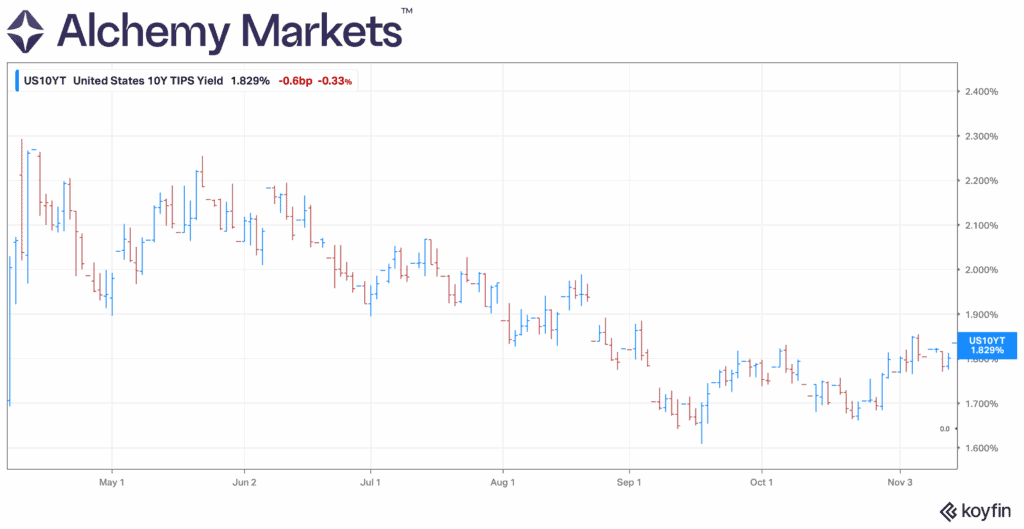
Bitcoin performs best when real yields fall. Real yields are the inflation-adjusted return on government bonds, and they are one of the strongest indicators of global liquidity.
Right now, real yields are rising — and that creates a powerful headwind for Bitcoin because:
When institutions can earn appealing real returns on long-term Treasuries, they allocate less to volatile assets like Bitcoin. This is the single most important macro reason behind the current sell-off.
Real yields rise when the bond market believes the Federal Reserve won’t be cutting rates soon.
That belief comes from two things:
Growth has held up better than expected, reducing recession fears and lowering expectations for rapid policy easing.
The market still sees inflation as persistent. When inflation expectations don’t fall, the Fed stays restrictive, bonds sell off, and real yields climb.
Until either growth weakens or inflation expectations soften, real yields will remain elevated — and Bitcoin will stay under pressure.
Bitcoin does not need a Fed pivot to recover. It simply needs falling real yields, which would signal easier liquidity conditions.
Real yields fall when:
These conditions increase global liquidity and push investors back toward high-beta assets like Bitcoin.
Your chart shows Bitcoin trading inside a clear descending channel that has been respected since early October. Price is now pressing the lower boundary of that channel — a critical technical decision point.
Two scenarios emerge:
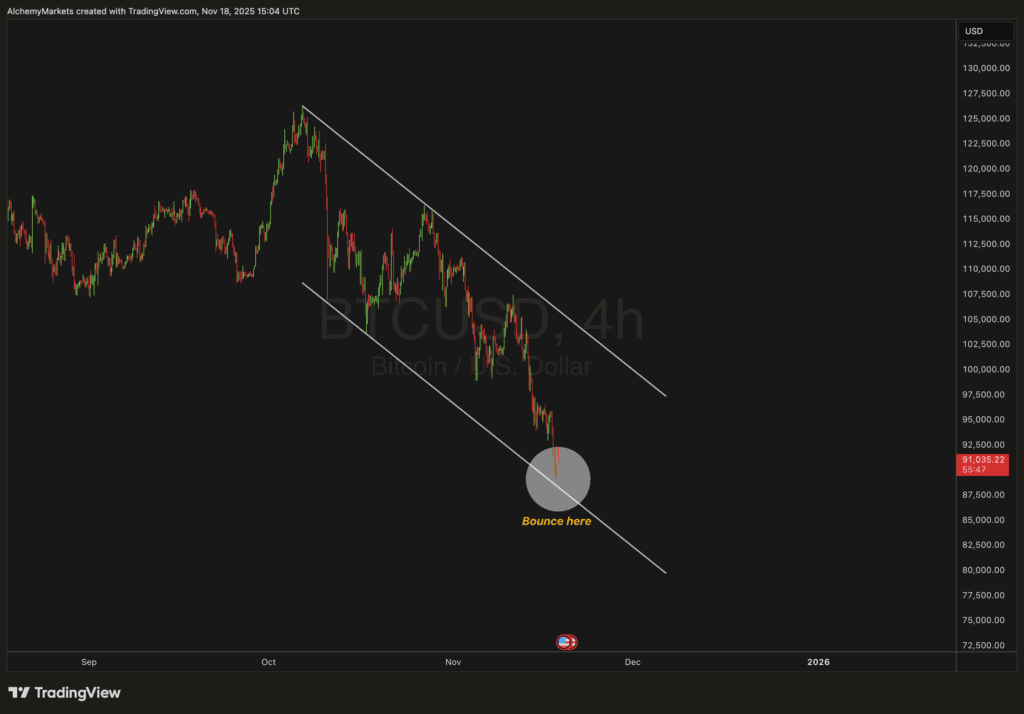
If real yields soften, Bitcoin may bounce off channel support and move back toward the mid-range.
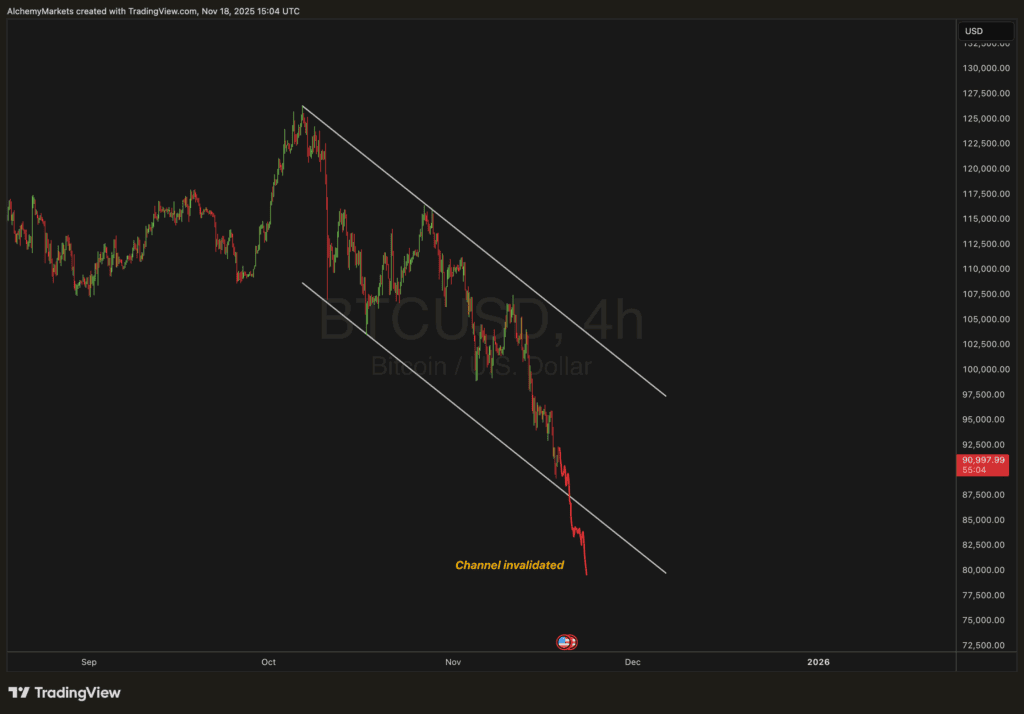
If macro pressures stay tight, Bitcoin could break below the channel and accelerate downward.
The technical and macro landscapes are now aligned — and both are telling the same story: this is a high-pressure inflection zone.
Bitcoin’s decline is not irrational — it’s a logical response to tighter liquidity, rising real yields, firm Treasury rates, and sticky inflation expectations. These forces push capital toward safe real returns and away from speculative assets.
The turning point will come when real yields fall. When the bond market begins pricing future easing or sees softer inflation ahead, liquidity improves and Bitcoin becomes attractive again.
Until then, the downtrend remains orderly, macro-driven, and technically contained within its descending channel.
Alchemy Markets is a multi-asset brokerage providing retail traders with the same elite trading conditions, tools, and transparency typically reserved for institutions.

Select the categories and companies you wish to follow directly to your person rss feed.
Create Custom RSS FeedSign up and join over 5,000 professional members who receive personalized news alerts, curated professional connections, and more for free!
Multi-asset trading broker AvaTrade has agreed to acquire the majority of FXCM Group’s business and brand, in a transaction that would bring a longstanding retail FX franchise into the AvaTrade Group.
LSEG and CMC Markets have signed a multi-year strategic data agreement expanding CMC's access to LSEG's real-time and delayed pricing, reference and corporate actions data, news and analytics, plus AI-ready content, to support new products, entry into new markets and the growth of CMC's institutional and B2B partnerships.
The Tel Aviv Stock Exchange is considering a bid for the Cyprus Stock Exchange, with Israeli media citing its EU licence, trading platform and clearing house. Euronext’s Athens exchange and India’s National Stock Exchange are also seen as contenders, and Cyprus aims to sign a sale agreement by the end of this year.
CME Group will launch baseball futures on 12 October, pending regulatory review, tracking CME FutureSports Performance Indexes built on Official League Data. Standard and micro contracts will start with the 2026 Postseason and the four clubs in the League Championship Series, trading around the clock.
ESMA has published an opinion stating that MiCA-authorised crypto-asset service providers should cease services tied to non-MiCA-compliant stablecoins for EU clients across MiCA crypto-asset services. National authorities should require remediation of existing exposures within three months, by early January 2027.
Nasdaq Ventures has made a strategic investment in Amsterdam-based derivatives and crypto exchange One Trading, with both firms to explore 24/7 trading of equity futures. The undisclosed investment follows Nasdaq's US$100 million investment in Payward, the parent of Kraken, and CME Group's move to 24/7 trading.
cTrader has opened multi-platform plugins to brokers and prop firms, which can pre-install their own tools for clients or list them in cTrader Store. The plugins run across Mobile, Web, Windows and Mac, and can be built and launched independently of core-platform releases, including trading journals and calculators.
Institutional brokerage and financial infrastructure provider Clear Street has joined TradingView’s broker network, allowing its clients to trade US stocks, exchange-traded funds and options directly through the charting and analysis platform.
Learn how to improve trading psychology, manage fear and greed, avoid revenge trading, and follow your trading strategy with discipline and a trading journal.
GTC Prime has announced a strategic partnership with Centroid Solutions to manage and distribute its liquidity through CS 360 Bridge, Centroid's multi-asset connectivity and execution engine, giving brokers and institutional clients access to tailor-made pricing, low-latency execution and real-time risk management.