just now


Liquidity Finder Ltd is incorporated in England and Wales, company number 10610740, registered address 167-169 Great Portland Street, Fifth Floor, London W1W 5PF, United Kingdom.
Published: just now

Oil and gas markets sold off aggressively on Wednesday after reports emerged that Iran is considering a new US proposal aimed at easing tensions and restoring flows through the Strait of Hormuz.
Brent crude briefly fell below $100/bbl, while WTI crude dropped sharply as traders priced out some of the geopolitical risk premium that had built into the market over recent weeks. European natural gas prices also declined as fears of a prolonged disruption to Middle Eastern energy exports eased.
By Thursday morning, however, oil prices had stabilised near the $100 level after an almost 8% one-day decline, highlighting that traders remain cautious despite improving headlines.
The proposed framework reportedly includes a phased reopening of Hormuz and the easing of US restrictions on Iranian port access. While no agreement has been finalised, the market is beginning to price in the possibility of additional supply returning to global markets over the coming months.
Still, this remains a headline-driven environment, and volatility is likely to stay elevated.
The latest EIA inventory report showed US crude stockpiles fell by 2.3 million barrels last week. While supportive on the surface, the draw was slightly smaller than market expectations and far below the API’s earlier estimate of an 8.1 million barrel decline.
A key reason for the smaller draw was a sharp drop in exports, which fell by 1.7 million barrels per day week-on-week after hitting record highs previously.
Additional highlights from the report included:
Overall, the data suggests underlying US demand remains relatively firm, although elevated fuel prices could eventually begin weighing on consumption.
Despite the market sell-off, supply conditions remain historically tight.
According to Bloomberg’s latest OPEC survey, cartel production fell by 420k b/d month-on-month to 20.55m b/d — the lowest level since 1990.
The largest declines came from:
War-related disruptions and constrained export routes through Hormuz continue to impact production and shipping flows across the region.
This is one reason traders remain hesitant to fully unwind bullish positioning despite improving diplomatic headlines.
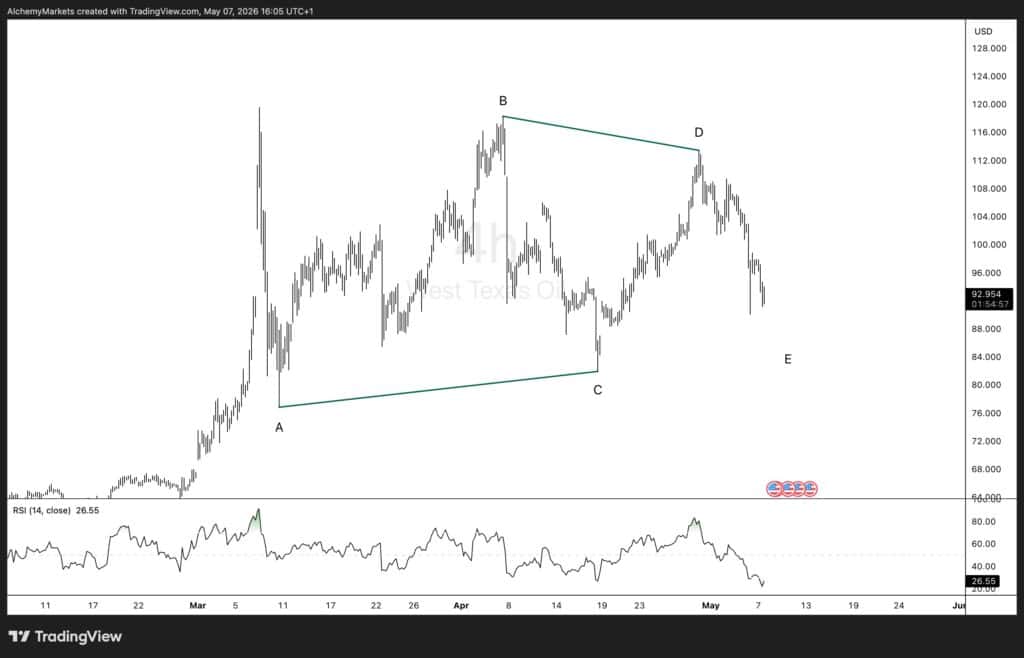
From a technical perspective, one bullish interpretation is that WTI crude may be completing a large Elliott Wave triangle pattern.
The structure appears to show a contracting ABCDE formation, with price respecting converging trendlines over the past several weeks. Under this scenario, the recent sell-off into wave E could represent the final shakeout before a directional breakout higher.
RSI has also moved toward oversold territory on the 4-hour timeframe, which may suggest downside momentum is becoming exhausted.
If buyers regain control, traders will likely watch for:
A confirmed breakout from the triangle could open the door toward a retest of the April highs near the $115-$118 region.
In Elliott Wave theory, triangle patterns often occur before the final impulsive move in the direction of the broader trend, meaning bulls will argue the larger uptrend remains intact unless support decisively breaks.
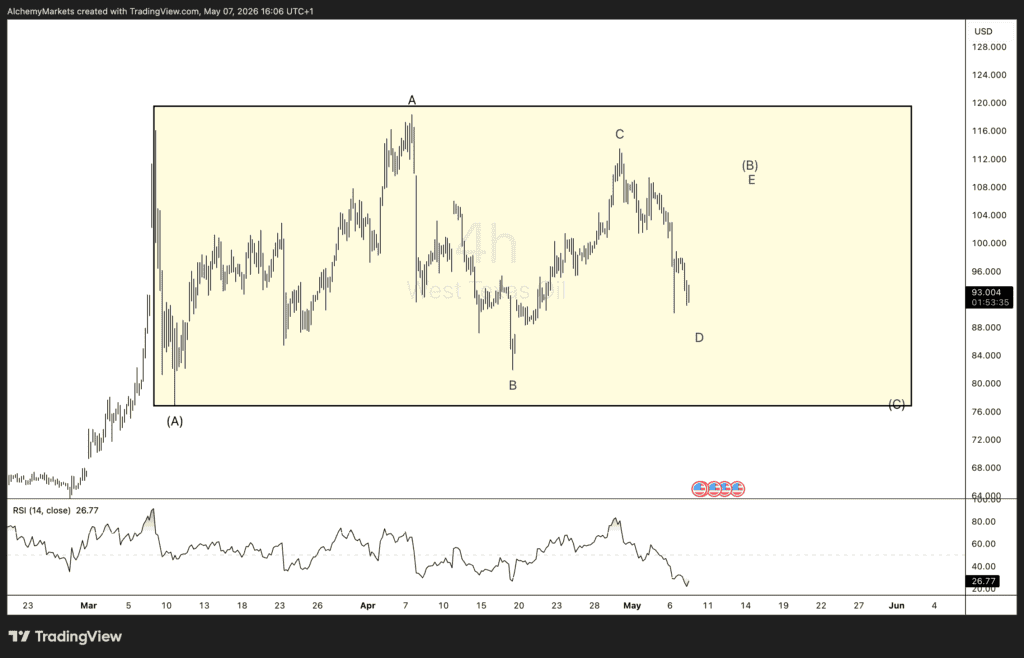
The alternative interpretation is that oil may simply be transitioning into a broader sideways corrective structure rather than preparing for an immediate breakout.
Under this scenario, the recent highs and lows could form part of a larger flat correction, where price continues chopping within a wide range before establishing clearer direction.
This view gains credibility if:
A prolonged consolidation phase could keep WTI trapped between roughly $76 and $118 while traders wait for stronger fundamental catalysts.
The recent drop also broke short-term momentum structure, suggesting buyers may need time to rebuild positioning before any sustained trend continuation occurs.
For swing traders, this environment may favour range-trading strategies rather than aggressive breakout positioning until clearer confirmation develops.
US natural gas prices also remain weak, with Henry Hub hovering near $2.7/MMBtu.
Markets continue to be pressured by:
The market currently expects another sizeable storage build in the upcoming EIA release, reinforcing the bearish near-term outlook for gas prices.
Energy markets remain highly reactive to geopolitical headlines, and the next move in crude oil could depend heavily on developments surrounding US-Iran negotiations.
For now, traders are balancing two competing narratives:
From a chart perspective, WTI sits at an important technical crossroads. Whether this resolves into a bullish Elliott Wave triangle breakout or a prolonged sideways flat correction will likely shape trading conditions over the coming weeks.
As always in volatile commodity markets, confirmation matters more than prediction.
Alchemy Markets is a multi-asset brokerage providing retail traders with the same elite trading conditions, tools, and transparency typically reserved for institutions.

Select the categories and companies you wish to follow directly to your person rss feed.
Create Custom RSS Feed
just now
Sign up and join over 5,000 professional members who receive personalized news alerts, curated professional connections, and more for free!
Multi-asset trading broker AvaTrade has agreed to acquire the majority of FXCM Group’s business and brand, in a transaction that would bring a longstanding retail FX franchise into the AvaTrade Group.
LSEG and CMC Markets have signed a multi-year strategic data agreement expanding CMC's access to LSEG's real-time and delayed pricing, reference and corporate actions data, news and analytics, plus AI-ready content, to support new products, entry into new markets and the growth of CMC's institutional and B2B partnerships.
The Tel Aviv Stock Exchange is considering a bid for the Cyprus Stock Exchange, with Israeli media citing its EU licence, trading platform and clearing house. Euronext’s Athens exchange and India’s National Stock Exchange are also seen as contenders, and Cyprus aims to sign a sale agreement by the end of this year.
CME Group will launch baseball futures on 12 October, pending regulatory review, tracking CME FutureSports Performance Indexes built on Official League Data. Standard and micro contracts will start with the 2026 Postseason and the four clubs in the League Championship Series, trading around the clock.
ESMA has published an opinion stating that MiCA-authorised crypto-asset service providers should cease services tied to non-MiCA-compliant stablecoins for EU clients across MiCA crypto-asset services. National authorities should require remediation of existing exposures within three months, by early January 2027.
Nasdaq Ventures has made a strategic investment in Amsterdam-based derivatives and crypto exchange One Trading, with both firms to explore 24/7 trading of equity futures. The undisclosed investment follows Nasdaq's US$100 million investment in Payward, the parent of Kraken, and CME Group's move to 24/7 trading.
cTrader has opened multi-platform plugins to brokers and prop firms, which can pre-install their own tools for clients or list them in cTrader Store. The plugins run across Mobile, Web, Windows and Mac, and can be built and launched independently of core-platform releases, including trading journals and calculators.
Institutional brokerage and financial infrastructure provider Clear Street has joined TradingView’s broker network, allowing its clients to trade US stocks, exchange-traded funds and options directly through the charting and analysis platform.
Learn how to improve trading psychology, manage fear and greed, avoid revenge trading, and follow your trading strategy with discipline and a trading journal.
GTC Prime has announced a strategic partnership with Centroid Solutions to manage and distribute its liquidity through CS 360 Bridge, Centroid's multi-asset connectivity and execution engine, giving brokers and institutional clients access to tailor-made pricing, low-latency execution and real-time risk management.