
Explore Companies BySectors & Categories
Explore Companies ByUse Cases
Explore Companies ByProducts & Services
Explore Companies ByRankings & Reviews
Featured NewsCompaniesMarketsCryptoTechRegulatoryCommentaryUKUSWorldMore

    Latest Wires

      Daily Newsletter

      LF Daily News

      Daily industry focused newsletter giving you an overview for the financial & finTech industry.

      See All Newsletters
      By clicking "Sign Up" you are agreeing to our Terms of Service and Privacy Policy

      Slippage Absorption: Control What Your Clients See

      Posted: just now

      Global
      Visual content

      Slippage Absorption: Control What Your Clients See

      When a client places a large order, it gets matched across multiple layers of liquidity. The client receives a volume-weighted average price, and depending on market depth, that price may differ from what they requested. This is slippage, and it happens on every execution venue.

      The question for brokers is not whether slippage occurs. It is who absorbs it, how much of it, and under what conditions.

      Slippage Absorption gives brokers granular control over this at the execution level, configurable per symbol, per group, and per account.


      How it works:

      The system calculates slippage on raw prices before any markups are applied, so markup changes are never misidentified as slippage. Brokers then set tiered absorption rules based on pip magnitude.

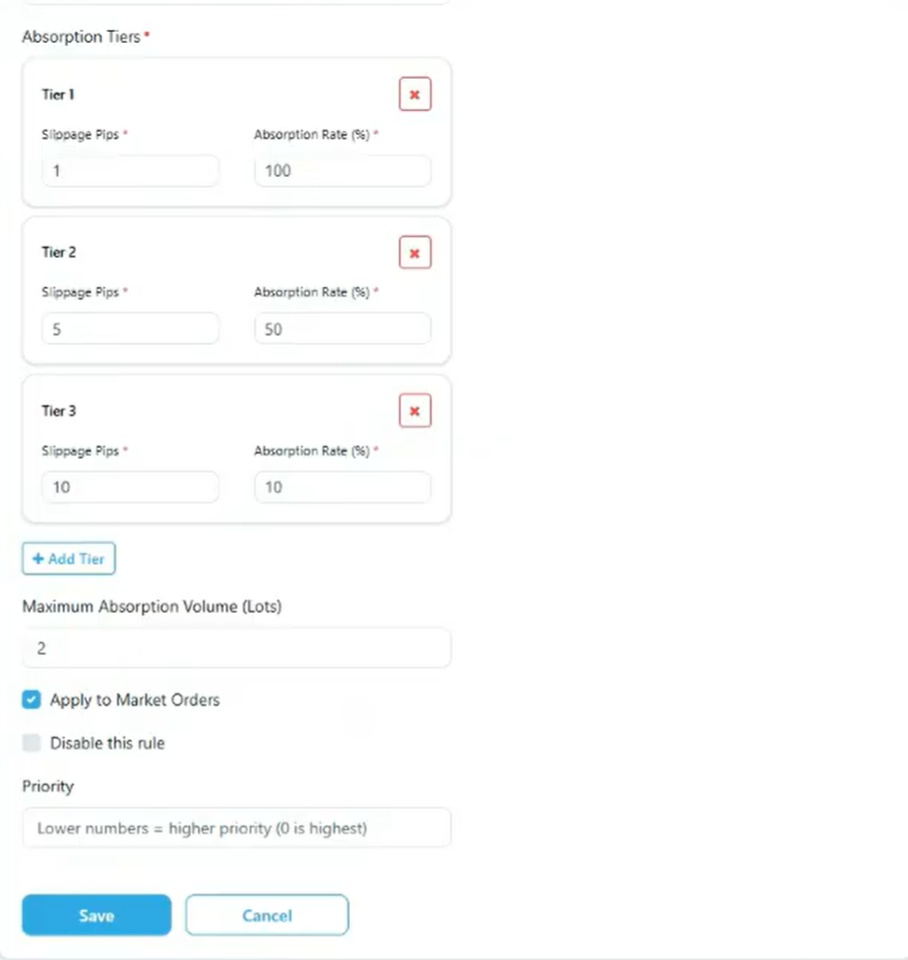
      For example, a broker might configure:

      • Up to 1 pip of slippage: 100% absorbed. The client sees no slippage at all.
      • Up to 5 pips: 50% absorbed. The broker splits the difference.
      • Up to 10 pips: 10% absorbed. The client bears most of it.
      • Above 10 pips: passed through fully.

      This tiered approach lets brokers protect client experience on routine small slippage without taking on unlimited liability during extreme moves.

      Visual content
       

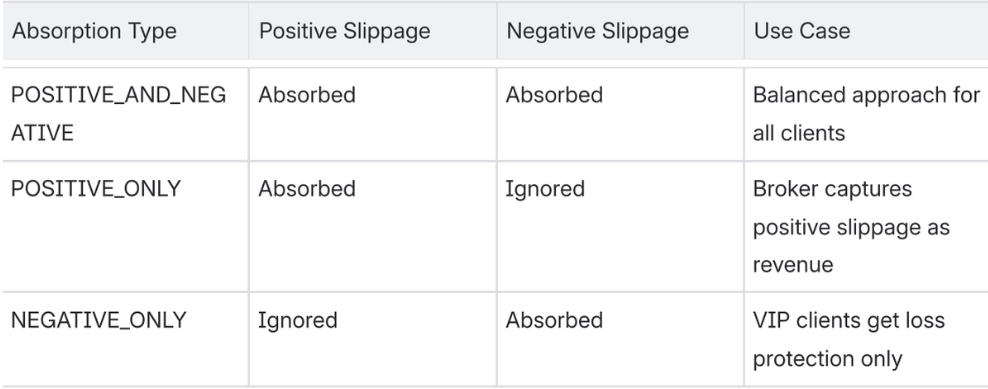
      Positive, negative, or both:

      Each absorption rule specifies which direction of slippage to handle.

      Visual content

      Negative slippage means the client receives a worse price than requested. A broker absorbing negative slippage is taking on that cost to protect the client from unfavourable fills. This is a common configuration for VIP segments or high-value accounts where execution quality directly affects retention.

      Positive slippage means the market moved in the client's favour between order placement and execution. A broker capturing positive slippage retains that price improvement as additional revenue rather than passing it through. This is a revenue tool, and it works without affecting the client's requested price.

      Brokers can also configure both directions simultaneously with different absorption rates per tier. For example, absorb 100% of negative slippage under 2 pips to protect clients, while capturing 80% of positive slippage across all tiers as revenue.


      Configuration and priority:

      Rules are set per symbol, per group, and per account. Account-level overrides take priority over group defaults, so brokers can run broad policies across client segments while applying custom rules to specific accounts.

      Brokers can also set a maximum absorption volume in lots, capping exposure on any single rule, and choose whether absorption applies to market orders.


      How it fits into execution:

      The feature is built directly into the bridge execution path. The order of operations is:

      1. Slippage is calculated on raw prices (before any markups)

      2. Absorption is applied to adjust the raw price

      3. All markups (spread, price band, target spread) are applied on top of the adjusted price

      No separate plugin, no additional infrastructure is required. Configuration is handled through the existing admin interface.


      Want to see how it works in practice?

      Book a demo with the Your Bourse team and we will walk through slippage absorption configuration for your setup.

      Book a Demo 


      Best Regards,

      Your Bourse Team

      Image for Slippage Absorption: Control What Your Clients See
      Comments
      Most Recent
      Create Your FREE Account
      Get access to latest news, updates, real-time data, brokerage and trading firm insights and customized information feeds.

      Integral's weekly newsletter Sunday November 29 looking at prediction markets, AI, Gold and more

      just now

      HM Treasury expects 90% of benchmark administrators to fall outside the new regime. The FCA is asking how firms will assess the benchmarks they use.

      just now

      Indonesia has expanded ownership disclosures and raised its free-float requirement. MSCI is seeking evidence of lasting improvements before deciding whether to retain emerging-market status.

      just now

      Bank staff estimate wider central clearing could free up £19bn of dealer capacity in normal markets and £24bn under stress. A policy roadmap is due in the first half of 2027.

      just now

      Reports mentioning suspected AI use rose from 193 to 956 in a year. An FCA survey found that 38% of under-35s would check a firm’s authorisation before investing.

      just now

      Australia’s new digital asset laws take effect on 8 April 2027. ASIC has sought feedback on licensing, custody, settlement and financial requirements for operators.

      just now

      Bitget’s new facility lets institutions borrow up to three times the value of eligible crypto held with Copper, OSL or Cactus Custody, giving trading desks up to four times their pledged capital to trade.

      just now

      Michał Copiuk takes over on 1 December after 14 years building XTB’s institutional business. He succeeds Michał Karczewski at the company behind Match-Trader.

      just now

      ATFX Connect, the institutional brokerage arm of ATFX Group, has moved its London office to the 35th floor of Tower 42 on Old Broad Street


      just now

      The second estimate of third-quarter GDP, released on November 25, revised US growth up to an annualised 4.3% from 3.4% in the advance estimate and 2.2% in the second quarter. That is the fastest pace since the third quarter of 2023. The same morning, the October personal income and outlays report showed core PCE inflation rising 0.3% on the month and 3.3% on the year, up from 3.1% in September.

      just now
      Feed