Gold
Cooling trade tensions lowered demand for safe-haven assets later in the week, capping gold’s gains.
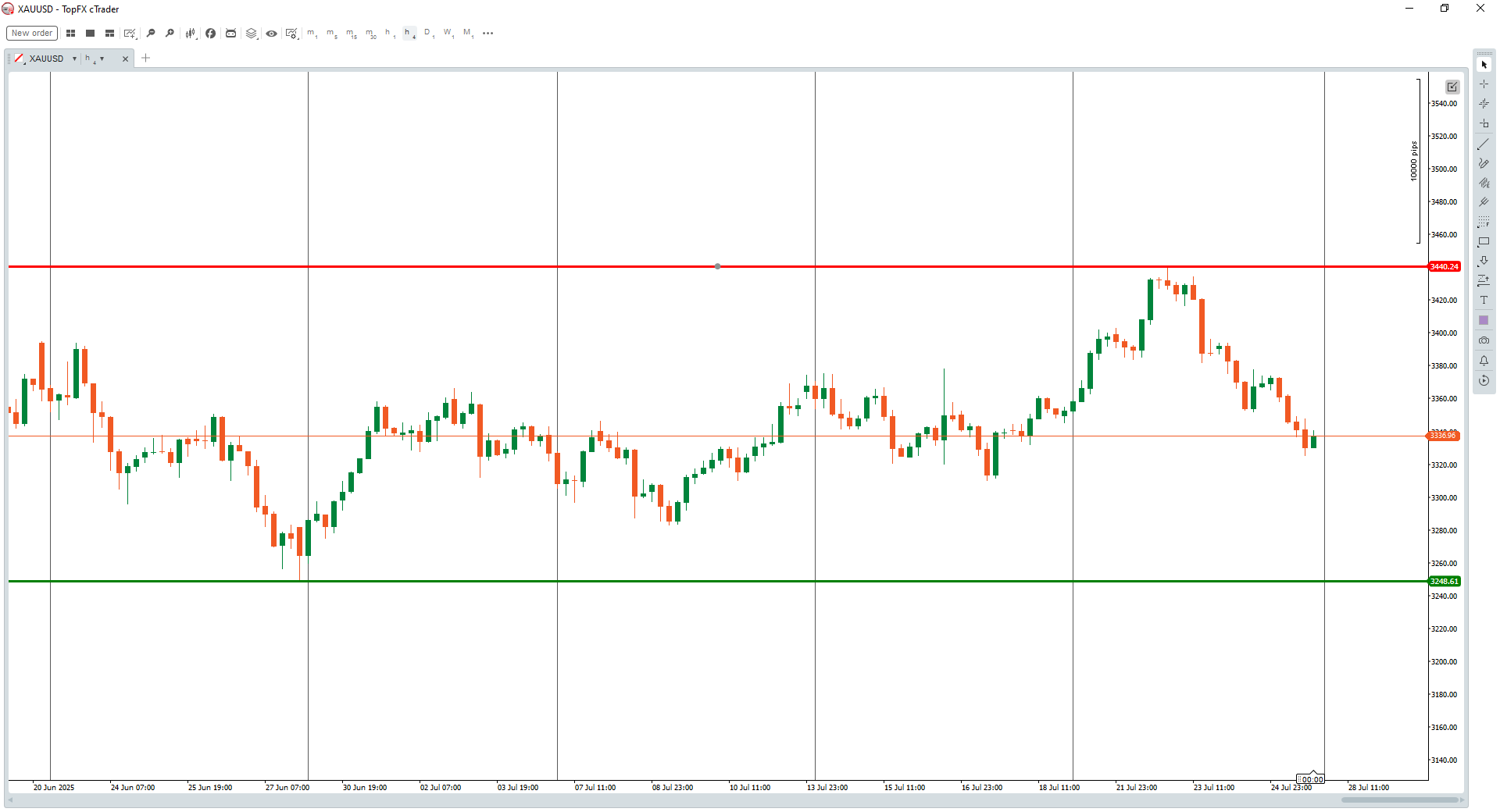
Gold prices were volatile last week, rising from $3,340 to $3,440 per ounce mid-week, then paring gains and dropping back to $3,340 per ounce. If gold prices rise, they may encounter resistance at $3,440 per ounce, while if gold prices decline, support may be encountered near $3,244 per ounce.
Gold prices moved in a tight range last week, driven by a mix of cautious risk sentiment and shifting expectations on Fed monetary policy. Gold prices gained strength early in the week, supported by a softer dollar and renewed speculation that the Federal Reserve could cut rates sooner than expected.
Cooling trade tensions lowered demand for safe-haven assets later in the week, however, capping gold’s gains. The announcement of a U.S.-Japan trade deal improved risk sentiment. In addition, a U.S.–EU trade deal was announced over the weekend and is expected to cause volatility in gold prices at the start of this week as markets assess rising trade optimism ahead of the August 1 deadline.
Gold prices have typically been directed by the dollar’s movement, as the competing dollar typically loses appeal as an investment when the dollar rises. The dollar dipped last week, and the dollar index dropped from 98.6 to 97.3. U.S. Treasury yields remained steady, providing support for the dollar, with the US 10-year bond yielding approximately 4.42%.
US President Donald Trump is putting pressure on the Fed to cut interest rates immediately. Fed Chair Jerome Powell has repeatedly warned that high US tariffs are pushing inflation up, delaying rate cuts. The clash between Trump and Fed Chair Jerome Powell continued with renewed vigor last week. A member of Trump’s administration has accused Fed Chair Jerome Powell of perjury. Fed rate cut expectations were not affected by the allegations, but the US dollar and yields sank, boosting gold prices.
Gold prices are supported by rising Fed rate cut expectations. The Fed held interest rates steady at 4.25–4.50% in June, as expected. The Fed is expected to leave rates unchanged again at its meeting this Wednesday, July 30. Powell’s speech after the meeting will attract considerable market attention, and his stance is likely to affect the dollar’s direction.
Markets are pricing in a 60–65% probability of a first 25 bps cut in September, and a total of around 1.7 cuts by year-end. Policymakers have emphasized their commitment to a patient, data-dependent approach and are concerned about tariff-driven inflation.