just now


Liquidity Finder Ltd is incorporated in England and Wales, company number 10610740, registered address 167-169 Great Portland Street, Fifth Floor, London W1W 5PF, United Kingdom.
Published: just now

Last night’s AI earnings basically gave the rally what it wanted: actual revenue, better guidance and another reason to keep the AI trade alive. But this was not all the same quality of earnings. AMD was the cleanest print. SMCI was messy but saved by guidance. Navitas was still the speculative power-chip story, but not a complete disaster.
For traders, the bigger question now is whether Nasdaq uses this as another launch pad, or whether the market pulls the classic gap-up-and-fade move. The AI story survived last night. Now price has to prove whether that story was already priced in.
| Asset | Earnings Result | Guidance / Outlook | AI Read-Through | Market Read |
| AMD | Beat. Revenue came in around $10.3B, with non-GAAP EPS of $1.37. | Q2 revenue guided to ~$11.2B +/- $300M, with non-GAAP gross margin around 56%. | Data Center revenue rose 57% YoY, driven by EPYC CPUs and Instinct GPU shipments. | Cleanest bullish confirmation of the night. |
| SMCI | Mixed. EPS beat, but revenue missed expectations. | Q4 revenue guided to $11.0B-$12.5B, with non-GAAP EPS of $0.65-$0.79. | Demand for AI servers still looks strong, even if the quarter itself was not spotless. | Messy print, but guidance saved the chart. |
| NVTS | Small base. Revenue rose 18% sequentially to $8.6M. | Q2 revenue guided to ~$10.0M +/- $0.5M, implying more sequential growth. | High-power markets, including AI data centres, are becoming the bigger part of the story. | Still speculative, but the AI power angle is not dead. |
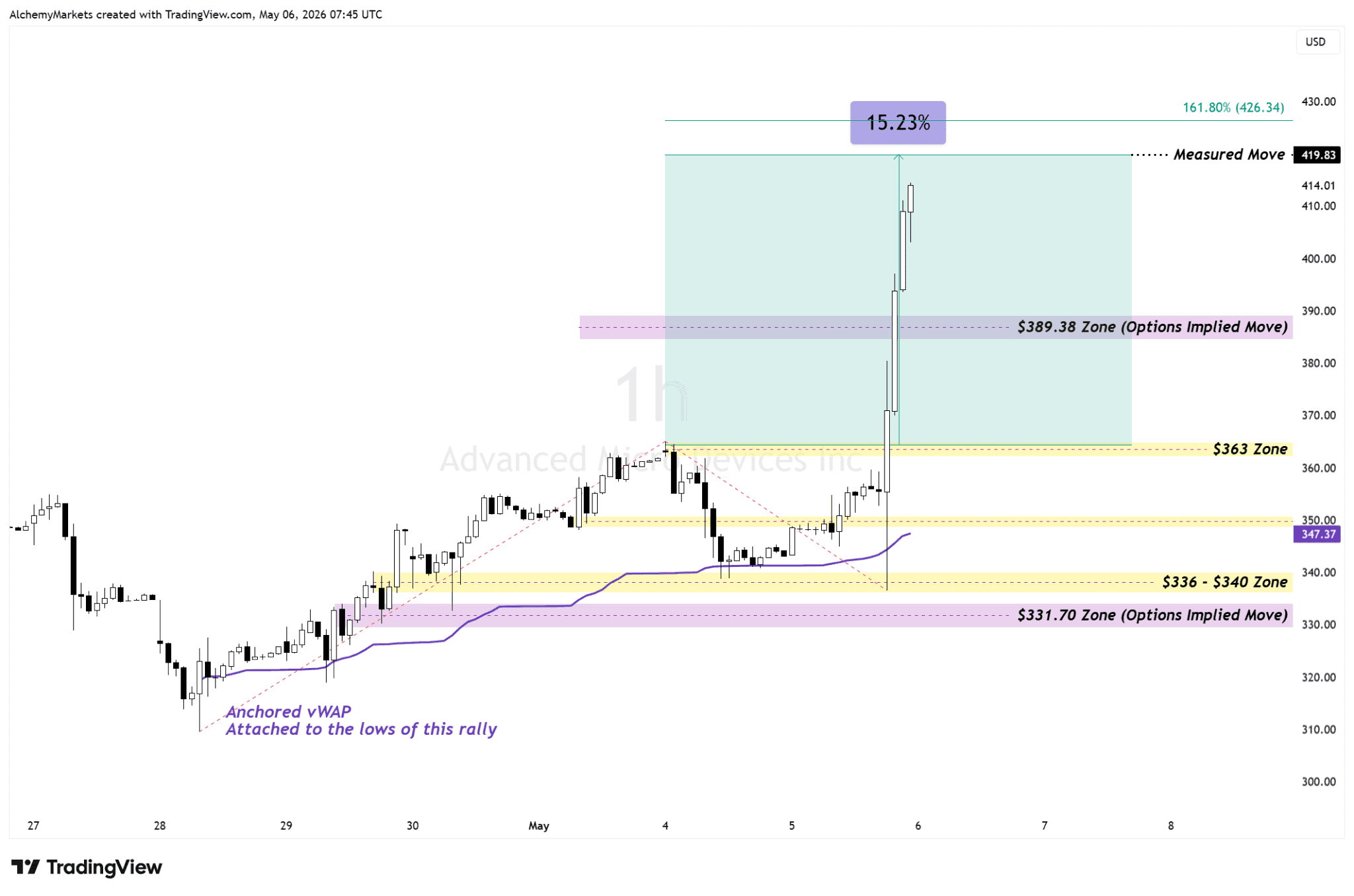
AMD’s blowout earnings led to a more than 20% overnight rally after initially dropping into the anchored VWAP drawn from around $310. This completely blew past the $389.38 options implied move, and honestly, it surprised me.
While I did have an inkling that AMD could reach $400, this thing flew. There’s no real telling where this choo-choo train stops now, but it is clear that AI spending is driving AMD’s revenues, in line with the current market trend.
A potential take-profit target could be around $420 (funny number), where the cup-and-handle measured move sits. This pattern formed during the breakout after market hours and has a neckline around $363. But again, this is only a subjective target as AMD trades into blue sky territory. The 1.618 Fib extension target sits near $426.34, which adds another layer of confluence.
General outlook / new developments:
AMD now has the cleanest “AI is spreading beyond Nvidia” story from this batch. Data Centre is no longer just a supporting segment; it is now the main growth engine, helped by EPYC server CPUs, Instinct GPU shipments and stronger customer engagement around future MI450 and Helios deployments.
The bullish case is not that AMD suddenly becomes Nvidia overnight. It is that the market now has a real second AI winner to price, and that is why the move had so much force behind it.
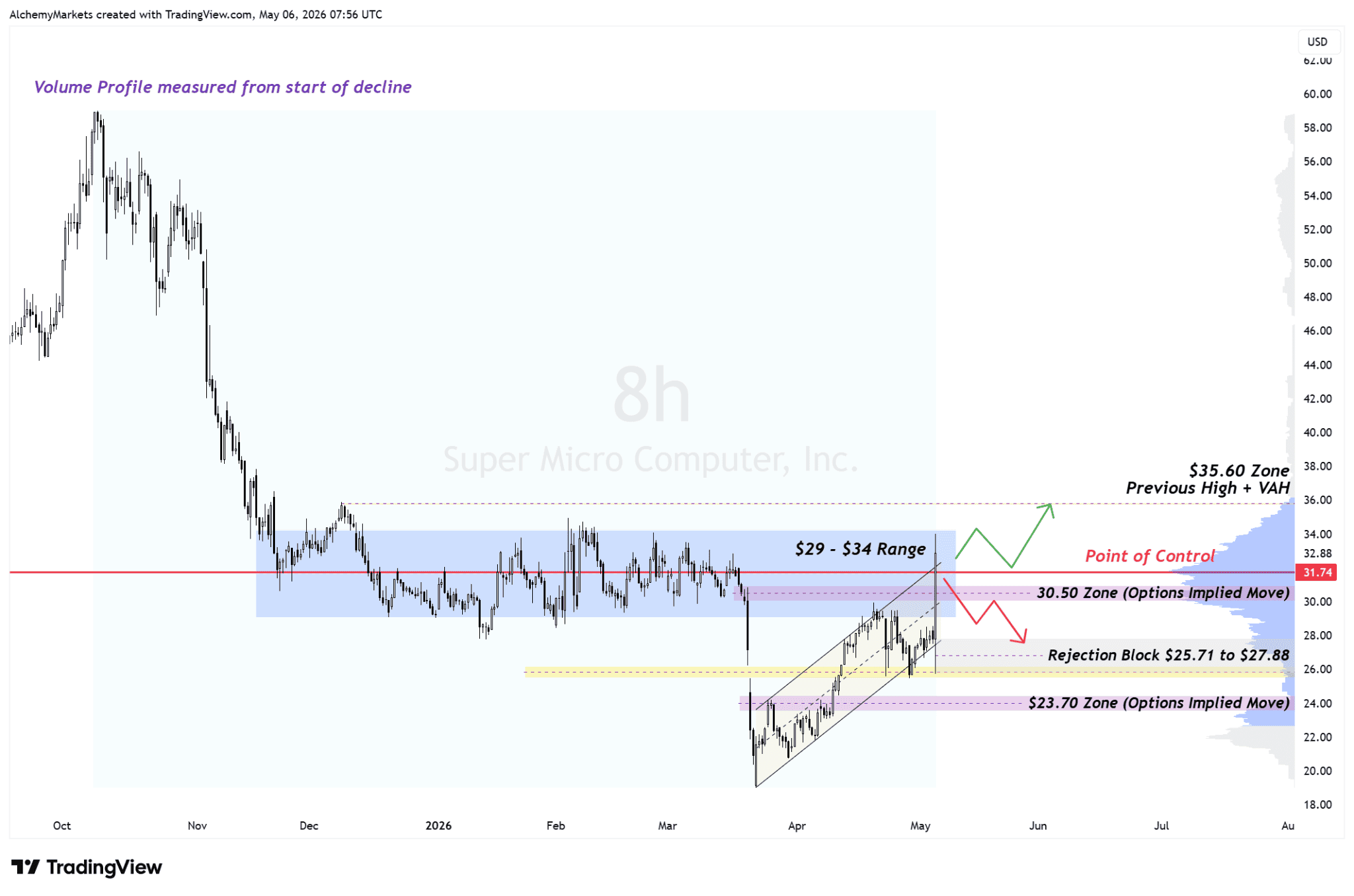
SMCI is also painting a similar technical picture. After a quick decline due to a liquidity grab at around $26, the yellow marked zone, SMCI shot up after hours to around $33.99, narrowly missing $34. Either way, that high lines up with many of its March highs, so as a take-profit target or rally slow-down zone, it makes total sense.
For this rally to be sustained, we need to see the $30.50 price level HOLD before the Friday options expiry. If this happens, a pool of buy liquidity could enter the market, potentially giving SMCI the fuel to continue higher.
There are two key supports to watch: the $31.74 point of control, which is the highest volume-traded level since the decline in November 2025, and the $30.50 options wall itself.
If price slumps below that wall, we want to see a reclaim, or a failed reclaim through a successful bearish retest, to switch short-term bias to the downside. From there, price may retrace back into the long wick at $25.71 to $27.88, where we can assume large amounts of buy orders entered the market.
General outlook / new developments:
SMCI was not a clean earnings winner. Revenue missed, cash flow was ugly, and the company still carries baggage. But the market chose to focus on guidance, margin recovery and AI server demand instead. That makes this a momentum trade first and a fundamentals victory lap second.
If $30.50 holds, bulls still have a reason to press. If it fails, the “guidance saved us” narrative starts looking much thinner.
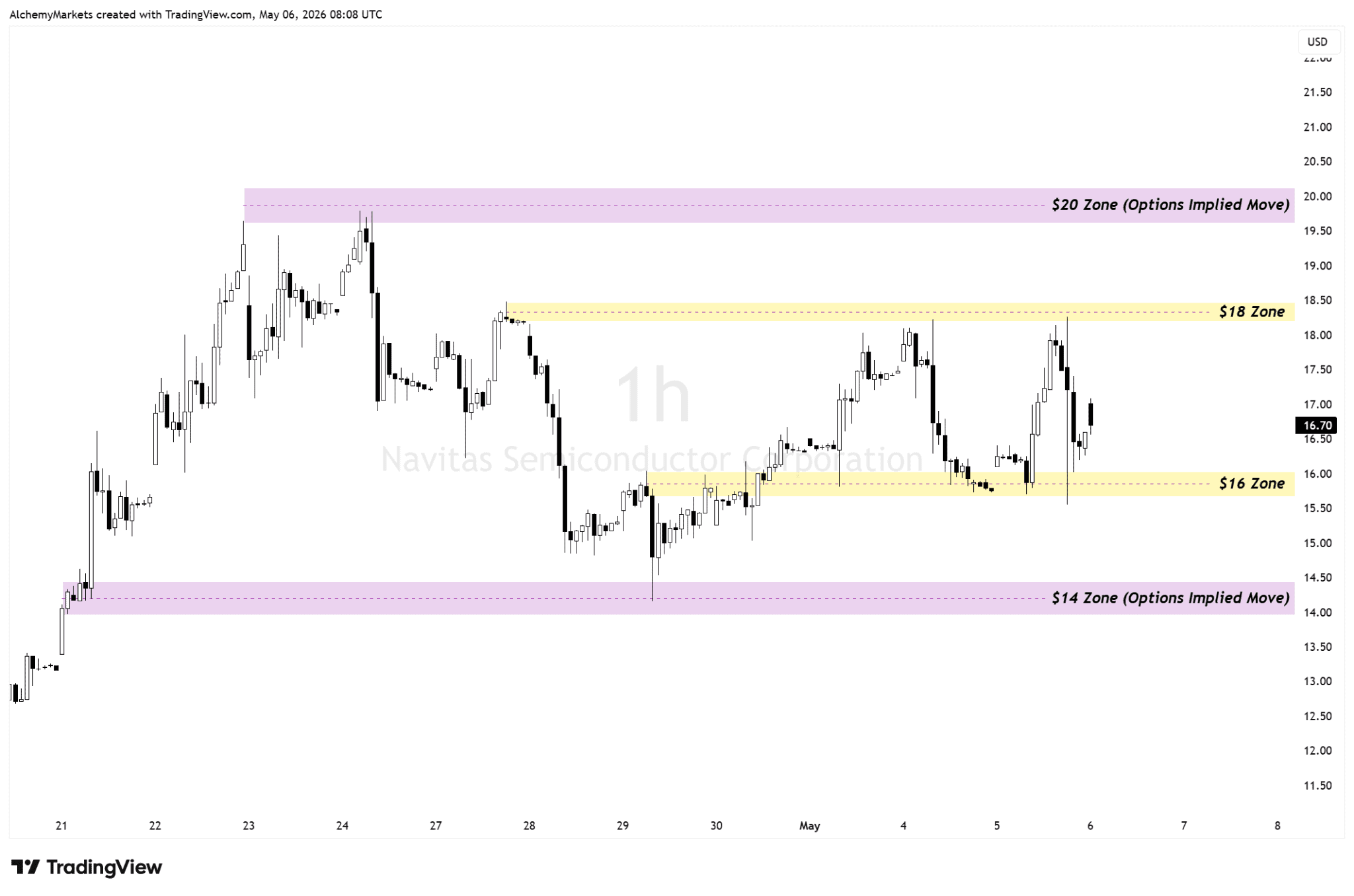
Navitas was more of a lame duck compared with AMD and SMCI. Price simply worked both sides of its range, but eventually chose to slump back down toward the range low around $16.
Technically, we are still range-bound on this asset, and both options implied move zones, around $20 and $14, remain valid levels to watch. Until price actually accepts above the range, this is still a trader’s range more than a breakout trend.
General outlook / new developments:
Navitas is not an AMD-style revenue machine. It is still a small, speculative AI infrastructure play. The new development is that its high-power markets, including AI data centres, grid infrastructure, performance computing and industrial electrification, are becoming a larger part of revenue.
That keeps the story alive, but the chart is still telling us not to get too excited until the range breaks with actual follow-through.
Now onto the more actionable insight for traders without access to AMD, SMCI and NVTS stocks: the Nasdaq-100 itself.
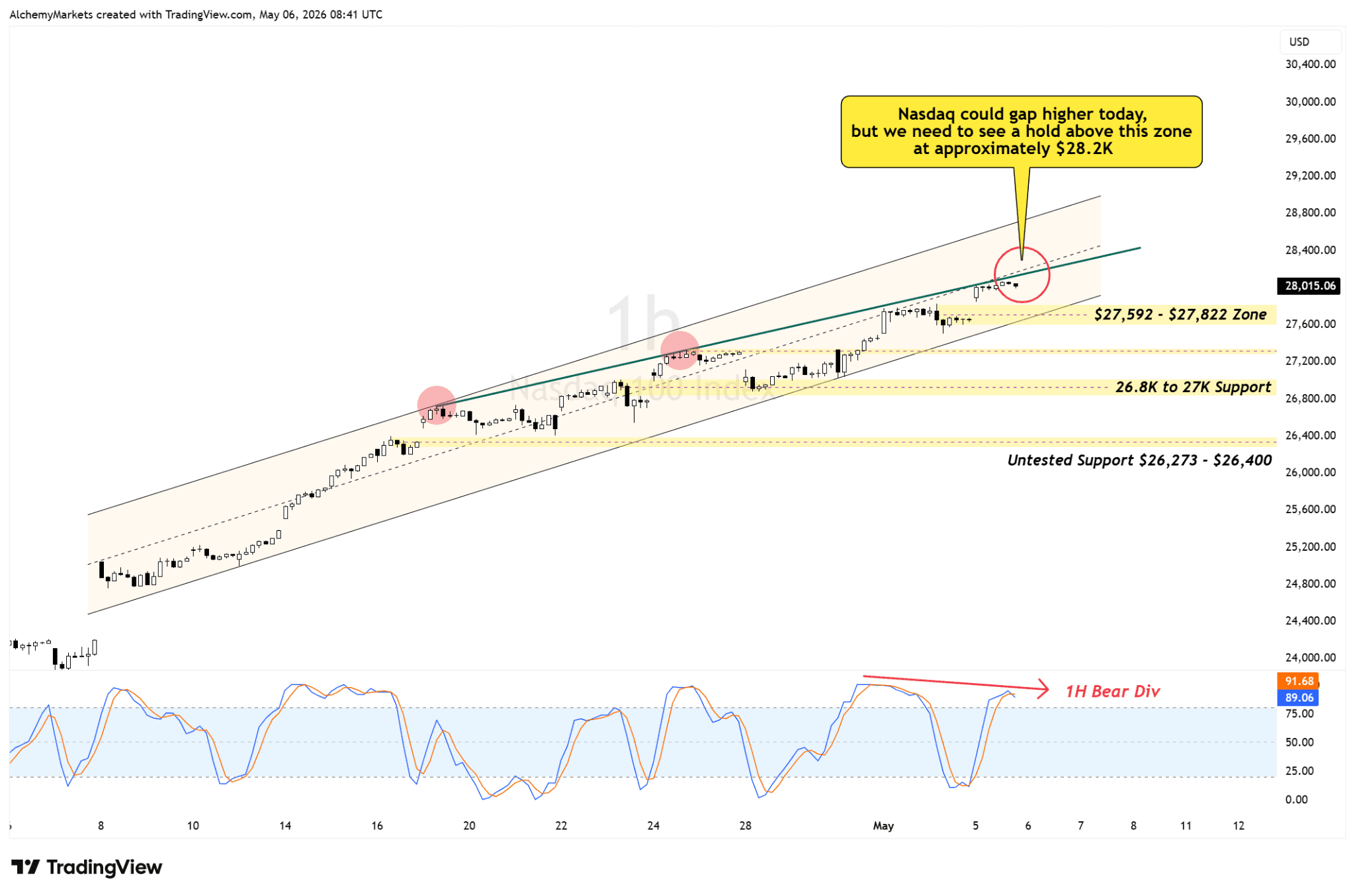
Nasdaq-100 closed at 28,015, and with positive AI earnings after hours, the idea of a gap up is plausible. But I would be careful with the wording here: the earnings create a strong reason for futures and premarket sentiment to lean higher, but the cash session still has to confirm whether buyers actually want to chase the move.
There are two exhaustion signals on Nasdaq that should not be ignored:
If Nasdaq gaps up, we need to see the following to prove that markets still want to climb higher and are not just using the AI earnings pop as exit liquidity:
It is worth noting that Nasdaq has so far been finding support at previous highs during this rally. The first support zone would kick in around 27,592 to 27,822, which also lines up with the rising channel’s lower area.
Should a break of the rising channel occur, it would be a sign that strong AI earnings may have already been priced in, especially if AMD, SMCI and the wider chip complex also start pulling back. Prior highs sit around 27.3K, 27K and 26.4K, all potential support zones if the first layer breaks.
General outlook / new developments:
The Nasdaq setup is not bearish by default. It is stretched. That is the difference. Strong AMD and SMCI reactions give the index a reason to gap higher, but if that gap cannot hold, the market may be telling us that the AI trade is becoming too crowded in the short term.
The cleaner read is simple: a hold above the channel midline keeps the rally alive; a failed gap and channel break turns the strong earnings reaction into a possible exhaustion signal.
Last night’s AI earnings were bullish, but not equally bullish across the board. AMD delivered the cleanest confirmation. SMCI gave traders enough forward guidance to forgive a messy revenue miss. Navitas kept the AI power-chip story alive, but it still needs price confirmation.
For Nasdaq, the gap-up assumption is accurate as a plausible setup, not as a conclusion. The market has a reason to open higher. Now it has to prove it can stay higher.
DISCLAIMER: For educational purposes only. Trading comes with substantial risk, leading to possible loss of your capital. Traders are advised to do their own due diligence before investing.
Alchemy Markets is a multi-asset brokerage providing retail traders with the same elite trading conditions, tools, and transparency typically reserved for institutions.

Select the categories and companies you wish to follow directly to your person rss feed.
Create Custom RSS Feed
just now
Sign up and join over 5,000 professional members who receive personalized news alerts, curated professional connections, and more for free!
Bybit has launched Perp Options, described as the first options contracts built on TradFi perpetuals, giving traders round-the-clock access to US equity options. SpaceX and Nvidia are the first underlying assets, with USDT settlement and integration into Bybit's Unified Trading Account.
Use this trading preparation checklist to plan your session, define entry rules, manage risk, and build a disciplined trading routine in seven steps.
Your Bourse expands its crypto liquidity ecosystem with Caladan, giving brokers access to broader market coverage, institutional execution capacity and streamlined settlement.
Scope Markets, the retail brokerage part of Rostro Group, has appointed Ibrahim Hossny as Head of Research and Marketing for the Middle East and North Africa.
Hantec Prime, the institutional division of Hantec Markets, has reported trading volume up more than 300% year-to-date, alongside the addition of 42 new institutional clients since December, capping one of its strongest years of growth to date.
Learn how to refine XAUUSD support and resistance on the daily chart using candle bodies, market structure and weekly gold levels for swing trading. A slug alone cannot guarantee a top Google ranking. Keep it focused rather than adding every supporting keyword.
The week in Dubai will be focused on connecting directly with the industry and discussing how technology can help modern brokerages simplify operations, automate workflows, strengthen operational control, and scale efficiently.
Devexperts has launched a turnkey solution giving brokers in South Korea access to US equity markets, combining its DXtrade trading platform, dxFeed market data, and execution services. The offering targets South Korea's growing retail demand for US stocks, worth several billion USD monthly.
Assess why WTI crude oil surged past $105 per barrel amid Saudi pipeline disruptions, record tanker charter rates, and escalating geopolitical tensions.
Bitcoin price forecast: BTC/USD retests $78,460–$80,215 resistance. Watch bearish confirmation toward $72,480 or a bullish breakout toward $86,150.