just now


Liquidity Finder Ltd is incorporated in England and Wales, company number 10610740, registered address 167-169 Great Portland Street, Fifth Floor, London W1W 5PF, United Kingdom.
Published: just now

Trading during Second Quarter (Q2) and mid-year earnings creates a unique psychological environment. While Q1 sets initial expectations and Q4 provides final audits, Q2 acts as the ultimate reality check.
By July and August, the market has spent six months trading on hype and assumptions. Q2 earnings force a confrontation between early-year optimism and hard macroeconomic data, frequently triggering two specific psychological traps:
Pre-Earnings Over-Extrapolation
Traders often assume that a strong start to the year guarantees future success (the representativeness heuristic). If Q1 was excellent, they aggressively buy into the stock during the five days leading up to the Q2 announcement, driving prices to overvalued levels. This setup creates an emotional glass house even a tiny metric miss delivers a massive psychological shock, causing sharp, violent price reversals.
The Recency Effect & Blind Spots
Many businesses have highly seasonal revenue cycles, yet human psychology naturally overweights the most recent three months of data while ignoring historical, year-over-year baselines.
Information Processing
Retail traders are substantially impacted by attention-based trading, which means that important news articles, social media mood, and financial media headlines have a significant impact on their decisions. Institutional investors, on the other hand, base their position adjustments only on the degree to which the data deviates from past mathematical baselines and rely on algorithmic and quantitative models.
Risk Management
Retail investors are particularly vulnerable to the disposition effect when it comes to risk management. This emotional bias causes them to terminate winning trades early in order to secure a win, but they obstinately hang onto losing positions in the hopes of breaking even. In contrast, institutional investors rebalance their portfolios in a methodical manner, adjusting hedges and reducing losing assets based on rigid, predetermined risk limits rather than optimism.
Behavioral Alignment
Retail trading behavior is defined by herd mentality, with individual orders systematically correlating as crowds buy or sell in concert based on mass psychology. Institutional market-makers utilize counter-cyclical liquidity, capitalizing on these retail overreactions by absorbing liquidity during periods of panic selling or exuberant buying.

During Q2 earnings, the immediate price reaction is rarely about whether a company was profitable; it is almost entirely about how the results compare to the market consensus. This creates a complex psychological loop:
Social Trading
In contemporary markets, social media platforms exacerbate the psychological strain of earnings season. Retail investors become less satisfied with their own strategic performance as a result of upward social comparison brought on by constant exposure to high-performing peers on social media.
FOMO (fear of missing out) lead to spontaneous, unplanned trading at a high-stakes period such as Q2 earnings. Because of this, just before an announcement is made, retail players often stuff their portfolios with extremely hazardous assets or speculative options.
Drivers to watch
With global energy supply shocks driving oil toward $110 and pressuring corporate profit margins across sensitive retail and manufacturing sectors, the mid-year earnings season faces a harsh macroeconomic reality check. International central banks have been obliged to adopt a hawkish stance due to this sticky, supply-driven inflation; Japan is under tremendous pressure to defend its currency, while the UK and Europe are hinting at impending rate increases. In contrast, the U.S. Due to a deteriorating domestic labor market, the Federal Reserve is content to maintain an extended pause while remaining profoundly divided and structurally on hold. The U.S. is comparatively protected against mid-year recessions, while energy-exposed Europe and Asia-Pacific are extremely susceptible due to this policy disparity, which reveals a stark economic imbalance. Lastly, the market's psychological anchor for speculative tech growth has surged as global bond yields rise. Consequently, institutional investors will aggressively punish any companies failing to show immediate, quantifiable revenue from their massive AI capital expenditures.
Trading gaps define earnings season because corporations report results outside normal market hours (Before Market Opens or After Market Closes). When the opening bell rings, the stock skips intermediate prices and instantly restarts at a new level, leaving no chance to trade in between.
In today’s tense macroeconomic climate, these gaps trigger three distinct market behaviors:
1. The Asymmetric Downward Gap
Because the market is already anchored to high early-year optimism, the penalty for disappointing news is exceptionally brutal. Missing official estimates or issuing cautious forward guidance triggers a massive downward opening gap, with underperforming stocks routinely facing steep single-day sell-offs.
2. The Sell-the-News Trap
This occurs when a stock aggressively rallies in the days leading up to its announcement. Even if the actual financial results are positive and meet expectations, institutional algorithms often use the post-market liquidity surge to take profits, sparking a downward opening gap that catches retail buyers off guard.
3. Structural Execution Risks
To manage this volatility, professional traders rarely hold full positions through an announcement. They either cut their trade size by 50% to 75% ahead of the release or wait for the initial 30-minute emotional rush of the opening session to subside before entry.
During the mid-year reporting cycle (July and August), major economic indicators do not just impact currencies they validate or violently disrupt corporate financial narratives. When micro corporate data collides with macro uncertainty, specific economic releases trigger massive structural volatility across the stock market.
Economic indicators driving market movements or volatility during Q2 season, ranked by market impact:
Consumer Price Index (CPI) & Core PCE
With headline inflation hovering near 3.8% due to sticky raw input costs and global energy shocks, inflation data dictates the absolute apex of market volatility.
2. Non-Farm Payrolls (NFP) & Average Hourly Earnings
Any sharp decline in employment entirely changes the present trading strategy as central banks shift their attention to the labor market.
3. ISM or Institute for Supply Management Manufacturing & Services PMI
PMI or Purchasing Managers' Index figures act as a reliable leading indicator of corporate health before companies actually publish their quarterly report cards.
4. Retail Sales
Because retail trading behavior is heavily driven by herd mentality and headline-grabbing news, this release attracts massive trading volume.
Disclaimer: This content may have been written by a third party. ACY makes no representation or warranty and assumes no liability as to the accuracy or completeness of the information provided, nor any loss arising from any investment based on a recommendation, forecast or other information supplies by any third-party. This content is information only, and does not constitute financial, investment or other advice on which you can rely.
ACY Securities is one of Australia's fastest growing multi-asset online trading providers, offering ultra-low-cost trading, rock-solid execution, technologically superior account management and premium market analysis.

Select the categories and companies you wish to follow directly to your person rss feed.
Create Custom RSS FeedSign up and join over 5,000 professional members who receive personalized news alerts, curated professional connections, and more for free!
Multi-asset trading broker AvaTrade has agreed to acquire the majority of FXCM Group’s business and brand, in a transaction that would bring a longstanding retail FX franchise into the AvaTrade Group.
LSEG and CMC Markets have signed a multi-year strategic data agreement expanding CMC's access to LSEG's real-time and delayed pricing, reference and corporate actions data, news and analytics, plus AI-ready content, to support new products, entry into new markets and the growth of CMC's institutional and B2B partnerships.
The Tel Aviv Stock Exchange is considering a bid for the Cyprus Stock Exchange, with Israeli media citing its EU licence, trading platform and clearing house. Euronext’s Athens exchange and India’s National Stock Exchange are also seen as contenders, and Cyprus aims to sign a sale agreement by the end of this year.
CME Group will launch baseball futures on 12 October, pending regulatory review, tracking CME FutureSports Performance Indexes built on Official League Data. Standard and micro contracts will start with the 2026 Postseason and the four clubs in the League Championship Series, trading around the clock.
ESMA has published an opinion stating that MiCA-authorised crypto-asset service providers should cease services tied to non-MiCA-compliant stablecoins for EU clients across MiCA crypto-asset services. National authorities should require remediation of existing exposures within three months, by early January 2027.
Nasdaq Ventures has made a strategic investment in Amsterdam-based derivatives and crypto exchange One Trading, with both firms to explore 24/7 trading of equity futures. The undisclosed investment follows Nasdaq's US$100 million investment in Payward, the parent of Kraken, and CME Group's move to 24/7 trading.
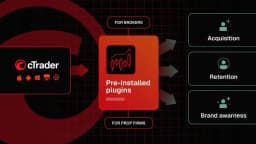
cTrader has opened multi-platform plugins to brokers and prop firms, which can pre-install their own tools for clients or list them in cTrader Store. The plugins run across Mobile, Web, Windows and Mac, and can be built and launched independently of core-platform releases, including trading journals and calculators.
Institutional brokerage and financial infrastructure provider Clear Street has joined TradingView’s broker network, allowing its clients to trade US stocks, exchange-traded funds and options directly through the charting and analysis platform.
Learn how to improve trading psychology, manage fear and greed, avoid revenge trading, and follow your trading strategy with discipline and a trading journal.
GTC Prime has announced a strategic partnership with Centroid Solutions to manage and distribute its liquidity through CS 360 Bridge, Centroid's multi-asset connectivity and execution engine, giving brokers and institutional clients access to tailor-made pricing, low-latency execution and real-time risk management.