

just now


Liquidity Finder Ltd is incorporated in England and Wales, company number 10610740, registered address 167-169 Great Portland Street, Fifth Floor, London W1W 5PF, United Kingdom.
Published: just now


Recently, the Bank of England (BoE) opted to hold its ground on monetary policy, taking a markedly cautious stance compared to the US Federal Reserve’s aggressive rate cuts (I’ve covered this topic on HERE). While the Fed boldly implemented a significant 50 basis point reduction to fuel economic growth, the BoE chose to leave interest rates unchanged. The UK's central bank remains laser-focused on curbing inflationary pressures, underscoring a stark divergence in monetary strategies between the two economies.
Rate Decision BOE

This decision by the BoE highlights its unwavering commitment to managing inflation, an issue that has been particularly challenging in the UK due to post-pandemic supply chain disruptions, Brexit-related uncertainties, and volatile energy prices. On the other hand, the Federal Reserve’s priority has shifted towards bolstering growth, driven by concerns over a slowing US economy. These contrasting priorities—fighting inflation in the UK versus stimulating growth in the US—reflect the different economic conditions and risks faced by the two countries. The BoE’s reluctance to follow the Fed in cutting rates signals a more tempered approach, with an eye on inflationary risks that still loom large in the UK.
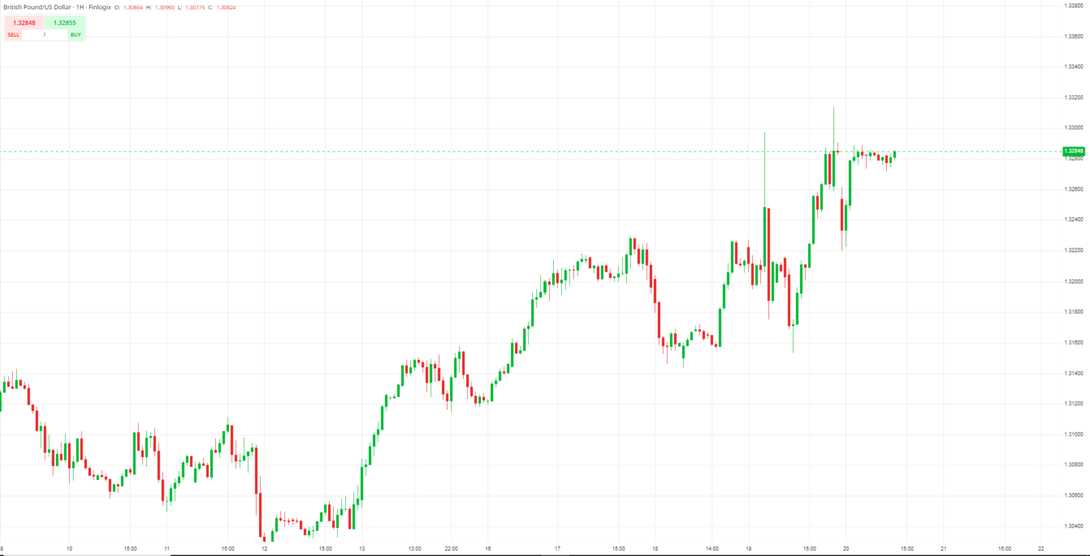
GBPUSD H1
The MPC’s Vote and a Dovish Minority
The Bank of England’s Monetary Policy Committee (MPC) vote largely reflected consensus on the need for caution, with the majority favouring the status quo. However, Swati Dhingra, a prominent dovish voice on the committee, advocated for a modest 25 basis point rate cut. Her position aligns with those who fear that the BoE’s overly hawkish stance could unnecessarily hamper economic growth, especially with inflation already showing signs of easing.
Deputy Governor Dave Ramsden’s vote for no change, in contrast, reinforced the BoE’s cautious tone. His decision was echoed by Governor Andrew Bailey, who emphasized the risks of cutting rates too quickly, potentially fuelling inflation before it has been fully tamed. Bailey's remarks are crucial, suggesting that the BoE is wary of repeating past mistakes when easing policies prematurely led to inflation spiralling out of control. These narrative paints a central bank determined to tread carefully, favouring stability over short-term stimulus.
Looking Forward: Uncertainty and Market Expectations
Despite the BoE’s decision to hold rates steady, markets remain focused on the possibility of future rate cuts. Expectations for cuts by year’s end have been scaled back slightly, with investors now pricing in 43 basis points of reductions—an indication of ongoing uncertainty. This recalibration suggests that while a rate cut by December seems less likely, November remains a key month for potential action. The BoE’s stance will heavily depend on incoming economic data, particularly inflation and wage growth metrics.
One complicating factor is the BoE’s decision to keep the pace of quantitative tightening (QT) unchanged at £100 billion for the next 12 months. Some analysts had anticipated a quicker pace of QT, especially given the maturity profile of the BoE’s gilt holdings. By opting for a steady reduction, the BoE is signalling a more cautious approach, balancing its desire to normalize monetary conditions with the need to avoid undue pressure on government finances. This steady pace of QT also gives Chancellor Rachel Reeves more fiscal room to manoeuvre, potentially reducing the cost of government borrowing.
Impact on the British Pound and Economic Policy
The BoE’s cautious approach could have significant implications for the British pound, which has enjoyed recent strength. A slowdown in the pace of rate cuts may dampen the currency’s momentum, particularly if economic data points to weakening domestic demand. Inflation and wage growth will be key factors driving future policy decisions, but the upcoming Labour government budget is also a wildcard. Expected tax increases could slow economic activity, providing the BoE with additional justification for more accommodative monetary policies in the future.
However, the BoE’s decisions won’t occur in isolation. Global economic conditions, particularly in the US and Europe, will play a crucial role in shaping UK monetary policy. The US Federal Reserve, facing potential weakness in jobs data, may signal further cuts, and a struggling German economy adds another layer of complexity to the BoE’s calculus. If global growth slows and inflation moderates, the BoE may come under pressure to accelerate its easing measures. In this scenario, the pound could underperform as markets adjust to the possibility of faster and deeper rate cuts.
The Risks of Diverging Central Bank Strategies
The divergence in strategies between the BoE and the Federal Reserve reflects the differing economic landscapes each central bank must navigate. While the Fed is focusing on reigniting economic growth amid recession fears, the BoE remains primarily concerned with controlling inflation, which has stubbornly remained above target. The challenge for the BoE lies in balancing inflation control with the need to support an economy that could face headwinds from higher taxes, slower wage growth, and a cooling housing market.
For the US, the risk of cutting rates too aggressively is that it may stoke inflation again, especially if supply chain issues or commodity prices surge. For the BoE, the opposite risk exists—if it holds rates too high for too long, it could dampen growth and stifle economic recovery, particularly if inflationary pressures ease more quickly than anticipated. This delicate balancing act means that both central banks will be closely watching not just their domestic data but also international developments.
In summary, while the BoE has maintained its cautious, inflation-focused stance for now, the balance of risks is clearly shifting. As the UK economy evolves, the BoE will face mounting pressure to adjust its approach. Key domestic indicators—particularly inflation and wage growth—will play a central role in shaping future decisions, but global economic conditions and fiscal policy shifts will also influence the central bank’s path. Whether the BoE continues with its gradual approach or moves towards a more aggressive easing cycle remains to be seen, but the months ahead will be critical in determining the trajectory of both the UK economy and the pound.
This content may have been written by a third party. ACY makes no representation or warranty and assumes no liability as to the accuracy or completeness of the information provided, nor any loss arising from any investment based on a recommendation, forecast or other information supplies by any third-party. This content is information only, and does not constitute financial, investment or other advice on which you can rely.
Why Is Forex Trading So Difficult?
How To Master MT4 & MT5 - Tips And Tricks For Traders
The Importance Of Fundamental Analysis In Forex Trading
Forex Leverage Explained: Mastering Forex Leverage In Trading & Controlling Margin
The Importance Of Liquidity In Forex: A Beginner's Guide
Close All Metatrader Script: Maximise Your Trading Efficiency And Reduce Stress
Best Currency Pairs To Trade In 2024
Forex Trading Hours: Finding The Best Times To Trade FX
MetaTrader Expert Advisor - The Benefits Of Algorithmic Trading And Forex EAs
ACY Securities is one of Australia's fastest growing multi-asset online trading providers, offering ultra-low-cost trading, rock-solid execution, technologically superior account management and premium market analysis.

Select the categories and companies you wish to follow directly to your person rss feed.
Create Custom RSS FeedSign up and join over 5,000 professional members who receive personalized news alerts, curated professional connections, and more for free!
Multi-asset trading broker AvaTrade has agreed to acquire the majority of FXCM Group’s business and brand, in a transaction that would bring a longstanding retail FX franchise into the AvaTrade Group.
LSEG and CMC Markets have signed a multi-year strategic data agreement expanding CMC's access to LSEG's real-time and delayed pricing, reference and corporate actions data, news and analytics, plus AI-ready content, to support new products, entry into new markets and the growth of CMC's institutional and B2B partnerships.
The Tel Aviv Stock Exchange is considering a bid for the Cyprus Stock Exchange, with Israeli media citing its EU licence, trading platform and clearing house. Euronext’s Athens exchange and India’s National Stock Exchange are also seen as contenders, and Cyprus aims to sign a sale agreement by the end of this year.
CME Group will launch baseball futures on 12 October, pending regulatory review, tracking CME FutureSports Performance Indexes built on Official League Data. Standard and micro contracts will start with the 2026 Postseason and the four clubs in the League Championship Series, trading around the clock.
ESMA has published an opinion stating that MiCA-authorised crypto-asset service providers should cease services tied to non-MiCA-compliant stablecoins for EU clients across MiCA crypto-asset services. National authorities should require remediation of existing exposures within three months, by early January 2027.
Nasdaq Ventures has made a strategic investment in Amsterdam-based derivatives and crypto exchange One Trading, with both firms to explore 24/7 trading of equity futures. The undisclosed investment follows Nasdaq's US$100 million investment in Payward, the parent of Kraken, and CME Group's move to 24/7 trading.
cTrader has opened multi-platform plugins to brokers and prop firms, which can pre-install their own tools for clients or list them in cTrader Store. The plugins run across Mobile, Web, Windows and Mac, and can be built and launched independently of core-platform releases, including trading journals and calculators.
Institutional brokerage and financial infrastructure provider Clear Street has joined TradingView’s broker network, allowing its clients to trade US stocks, exchange-traded funds and options directly through the charting and analysis platform.
Learn how to improve trading psychology, manage fear and greed, avoid revenge trading, and follow your trading strategy with discipline and a trading journal.
GTC Prime has announced a strategic partnership with Centroid Solutions to manage and distribute its liquidity through CS 360 Bridge, Centroid's multi-asset connectivity and execution engine, giving brokers and institutional clients access to tailor-made pricing, low-latency execution and real-time risk management.