just now


Liquidity Finder Ltd is incorporated in England and Wales, company number 10610740, registered address 167-169 Great Portland Street, Fifth Floor, London W1W 5PF, United Kingdom.
Published: just now

This week began quietly in FX markets, but momentum shifted decisively following the release of the U.S. June Consumer Price Index (CPI). Traders had priced in modest volatility, anticipating the print to hit the 0.3% month-over-month consensus. As it turns out, that’s exactly what happened — but the market reaction has been anything but muted.
Adding fuel to this shift were broader macro narratives, including softer-than-feared Russian sanctions and China’s stronger-than-expected Q2 GDP, which both leaned into a slightly risk-positive backdrop.
All eyes were on the U.S. dollar index (DXY), which had been consolidating inside a falling wedge pattern. With the CPI print confirming expectations, the DXY broke out of the wedge in textbook technical fashion — a potentially bullish signal for the greenback going forward.
The Bureau of Labor Statistics reported that U.S. consumer prices rose 0.3% in June, exactly in line with market forecasts. This outcome marked a continuation of the disinflationary trend, albeit with some stickiness in core inflation components like housing and services.
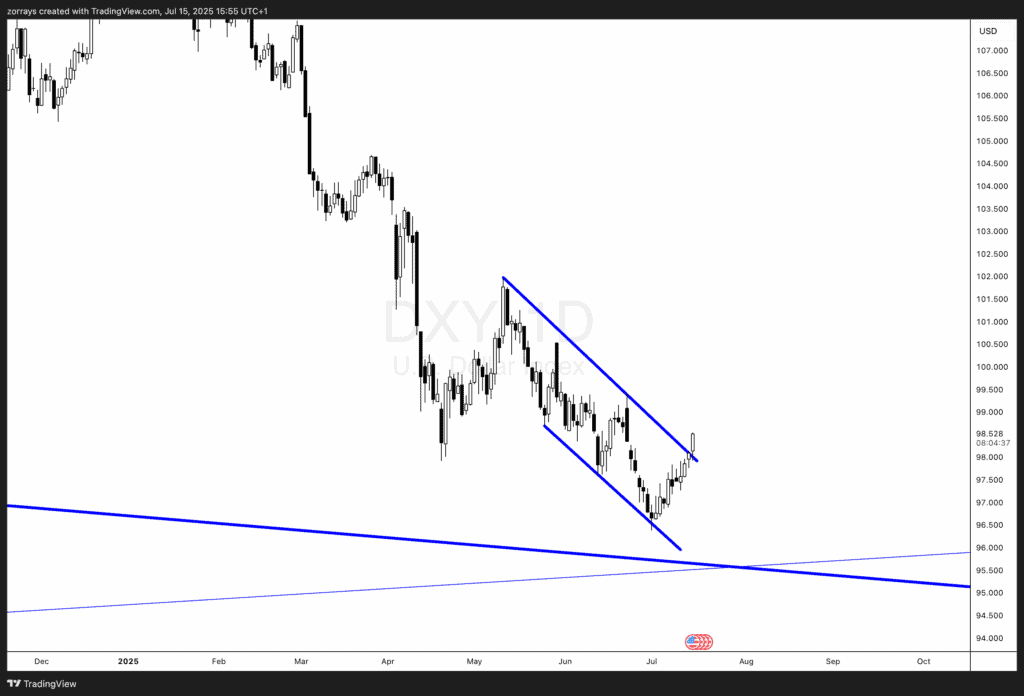
A falling wedge is a bullish reversal pattern formed by converging trendlines that slope down. It suggests a slowdown in bearish momentum, with potential for a breakout higher once resistance is breached.
Over the past two months, the DXY was tracing a clear falling wedge on the daily chart — marked by lower highs and lower lows. As we approached July, the price action began to compress, with a base forming near 96.80–97.00.
As seen in the chart, today's candle has decisively broken above the upper trendline of the wedge.
A measured move from this pattern points to potential upside toward 100.50–101.00, assuming the breakout sustains.
Before the CPI release, markets priced in 16 basis points of Fed easing by September — implying a small but non-zero chance of a cut. Post-CPI, that easing probability is diminishing as sticky inflation persists, albeit at manageable levels.
With core inflation remaining elevated and labor markets strong, the Fed may lean toward patience. A strong dollar post-CPI aligns with expectations that any rate cuts will likely occur later in 2024 or early 2025 — not imminently.
Alchemy Markets is a multi-asset brokerage providing retail traders with the same elite trading conditions, tools, and transparency typically reserved for institutions.

Select the categories and companies you wish to follow directly to your person rss feed.
Create Custom RSS Feedjust now
Sign up and join over 5,000 professional members who receive personalized news alerts, curated professional connections, and more for free!
Webull reported record third quarter 2026 revenue of $218.7 million, up 39% year-over-year, as trading-related revenue rose 53% and options contracts volume grew 79%. Customer assets reached $32.4 billion and DARTs rose 66% to 1.8 million, while net income attributable to the company fell to $31.2 million from $36.9 million.
iSAM Securities Apex has integrated with FCA-regulated Alchemy Prime, expanding its institutional liquidity network and giving CFD brokers access to multi-asset liquidity across FX, precious metals, indices, commodities and cryptocurrency CFDs.
Nasdaq 100 has shifted into a bearish staircase structure following its sharp rally to the 27,094 peak on Monday. After consolidating briefly near the highs, price action rolled over and has consistently printed lower highs and lower lows. The moving averages confirm this downward momentum with a clean bearish stack of MA5, MA10, and MA20.
U.S. stock futures edged lower ahead of fresh inflation data, with Dow futures down 0.1%, S&P 500 futures 0.2% and Nasdaq-100 futures 0.3%.
Gold saw a strong rebound from $3,503. The recovery pushed price to $3,690, but momentum has since stalled and price is now around $3,624. The recent candles are relatively small and overlapping, indicating consolidation.
The Nasdaq 100 rallied nearly 7% after Nvidia reinstated Jensen Huang. Can NAS100 hold 25,665–26,155 as support and extend the recovery toward 28,250?
U.S. stock futures fell on Tuesday, giving back part of Monday’s sharp rally. Nasdaq-100 futures dropped 1%, S&P 500 futures fell 0.4%, and Dow futures slipped 0.1%. The pullback followed a 31% surge in Nvidia on Monday after Jensen Huang’s return as CEO, which reignited the broader AI and semiconductor trade. Nvidia was down more than 3% in pre-market trading Tuesday.
Last week was the worst for US technology stocks since March 2020. The Nasdaq Composite fell 10% and is now down for the year. The S&P 500 fell 8.6%, declining every day, and closed in correction, 11.6% below its October record. The semiconductor index lost about 17%, its worst week since the one after September 11, 2001. All of this came in the same week Nvidia reported revenue more than doubling and raised its outlook again.
Your Bourse and NetShop ISP have established a private fibre cross-connect between Equinix LD6 and LD4 in London. Available on demand, the link gives brokers using both providers a direct route for pricing and order traffic, bypassing the public internet and helping reduce network latency and jitter.
We spoke with Finalto’s Group Head of Liquidity, Sam Horowitz, and members of his UK team about what defines a modern liquidity operation.