just now


Liquidity Finder Ltd is incorporated in England and Wales, company number 10610740, registered address 167-169 Great Portland Street, Fifth Floor, London W1W 5PF, United Kingdom.
Published: just now

EUR
The EUR/USD pair has bounced back from its recent low of 1.0450, but it could struggle to find enough buyers as it approaches the 1.0530/1.0550 range. The US dollar remains an unattractive sell, and there is currently no compelling narrative in the eurozone to counter the exceptionalism story in the United States. The recent sharp decline in eurozone retail sales in August further underscores this point.
The ability of the EUR/USD pair to maintain its position around 1.0500 is closely tied to the performance of the US bond market, which has seen some relief over the past two days. This relief might be due to the absence of significant US economic data yesterday, apart from jobless claims. However, there is a real possibility that the pair could face further downward pressure with the release of US payrolls data tomorrow.
On the domestic front, the eurozone economic calendar is relatively quiet today. However, there are scheduled speeches from several ECB speakers, including Joachim Nagel, Luis de Guindos, François Villeroy, and Philip Lane. Additionally, they will participate in a panel discussion alongside Ben Broadbent from the Bank of England and Anna Breman from Riksbank.
Riksbank made headlines recently when it prompted a short-lived rally in the SEK (Swedish Krona). The bank has asked the Swedish Debt Office to consider a slower phase-out of foreign currency exposure to avoid hindering the krona's revaluation. Sweden's foreign currency debt as a percentage of its total debt has decreased from 21% to just below 9% over the past year. FX swaps, which account for most of the foreign currency exposure, have seen a significant reduction from SEK 24 billion in November 2021 to SEK 1.3 billion as of March 2023.
The Debt Office plans to eliminate its foreign exchange exposure by the end of 2026, which is a relatively long timeframe for a relatively small residual amount. This suggests that the impact on the krona's value should be minimal. Even the Riksbank appears to acknowledge that there are limited direct implications for the exchange rate, but they expressed concerns about the divergence between their actions (buying SEK) and the Debt Office's actions (selling SEK). This highlights the increased attention the Riksbank has placed on the SEK and may imply that their FX hedging operations serve a dual purpose of risk management and supporting SEK appreciation.
The first set of data on the Riksbank's hedging operations is expected at the end of this week or the next. It will provide insight into whether the Riksbank is indeed purchasing more SEK, potentially at higher exchange rates like USD/SEK and EUR/SEK. Given the Riksbank's apparent challenges in controlling the FX market, both currency pairs may continue to experience upward pressure in the current volatile risk environment.
CHF
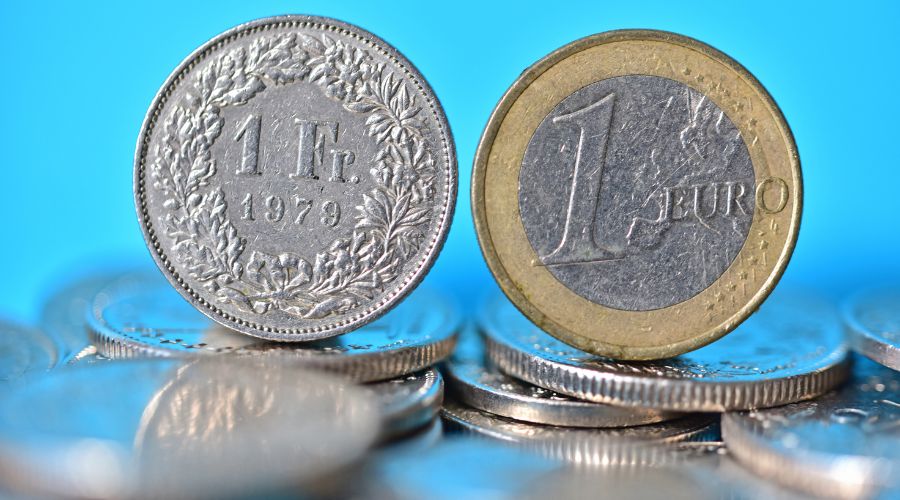
EUR/CHF is continuing its downward trajectory following a spike to 0.97 in September, a move that coincided with the Swiss National Bank (SNB) maintaining its interest rates at 1.75%. This decline in EUR/CHF can be attributed, at least in part, to the ongoing intervention efforts by the SNB. The SNB has been actively intervening in the foreign exchange market to push up the nominal trade-weighted Swiss franc, aiming to counteract Switzerland's inflation differential compared to its trading partners. In essence, the SNB's goal is to maintain the stability of the real Swiss franc.
During the second quarter of 2023, the SNB sold CHF30 billion in foreign exchange as part of this intervention campaign, and they strongly hinted in September that they are prepared to sell even more. This commitment by the SNB to support the Swiss franc has contributed to making it the strongest currency among the G10 currencies this year. Given the likelihood of the US dollar maintaining its strength in the coming months, the SNB will likely need to further strengthen the Swiss franc by pushing EUR/CHF lower. This is why we anticipate seeing it trade back down to 0.95 in the coming months.
Additionally, factors that could aid in driving EUR/CHF lower include developments in European politics and the potential clash between the reintroduction of the Stability and Growth Pact and loose fiscal policies in southern Europe. These political and economic dynamics may put further pressure on the euro, thereby contributing to the downward movement of EUR/CHF.
This content may have been written by a third party. ACY makes no representation or warranty and assumes no liability as to the accuracy or completeness of the information provided, nor any loss arising from any investment based on a recommendation, forecast or other information supplied by any third-party. This content is information only, and does not constitute financial, investment or other advice on which you can rely.
ACY Securities is one of Australia's fastest growing multi-asset online trading providers, offering ultra-low-cost trading, rock-solid execution, technologically superior account management and premium market analysis.

Select the categories and companies you wish to follow directly to your person rss feed.
Create Custom RSS Feed
just now
Sign up and join over 5,000 professional members who receive personalized news alerts, curated professional connections, and more for free!
Wall Street closed mostly higher on Tuesday, led by a nearly 1% gain in the Dow. In Asia, South Korea’s Kospi rebounded 2.7% and Japan’s Nikkei gained 0.8%.
Brent crude is trading at $111.70. The latest price action show the recovery continuing toward $111.70, suggesting that demand has returned after the sharp correction.
FOREX.com has introduced weekend trading for US SP 500 and US Tech 100 CFDs in Japan, operated by StoneX Securities Co., Ltd., a StoneX Group Inc. subsidiary. Investors can manage positions seven days a week, including Saturday and Sunday sessions, without waiting for underlying markets to reopen on Monday.
FINMA has approved Switzerland’s first exchange-traded fund investing directly in Bitcoin, classed as an other alternative investment fund under Swiss law. The regulator cited investor protection and transparency, and warned that Bitcoin investments remain highly risky despite the approval. Others have applied.
Plus500 has conditionally agreed to acquire Guru, a regulated broker-dealer in Brazil, the second largest derivatives market globally. The deal builds on its Nelogica partnership and Colombian presence, and will be funded from existing cash of over $860m as of 30 June 2026. Closing is subject to regulatory approvals.
Market maker and technology provider iSAM Securities has integrated multi-asset liquidity provider Evenox into iSAM Securities Apex.
AUDCAD turns bearish after breaking key support and the 50 EMA. Watch 0.98455–0.98720 resistance for confirmation, with 0.98075 the downside target.
Gold (XAU/USD) holds weekly support as bulls eye $4,265. Explore key resistance at $4,175–$4,195, breakout signals and downside risk toward $3,935.
XTB has launched the largest advertising campaign in its history, bringing in former heavyweight world champion Tyson Fury to appear alongside its existing global ambassador, former Sweden international footballer Zlatan Ibrahimović.
DXtrade, the white-label trading platform from Devexperts, has launched a dedicated cryptocurrency interface for spot traders. It includes an exchange-style order book, flexible order sizing and trading from charts, and is available on web and mobile with broker branding options. Open APIs support integrations.