just now

Liquidity Finder Ltd is incorporated in England and Wales, company number 10610740, registered address 167-169 Great Portland Street, Fifth Floor, London W1W 5PF, United Kingdom.
Published: just now
Key Highlights
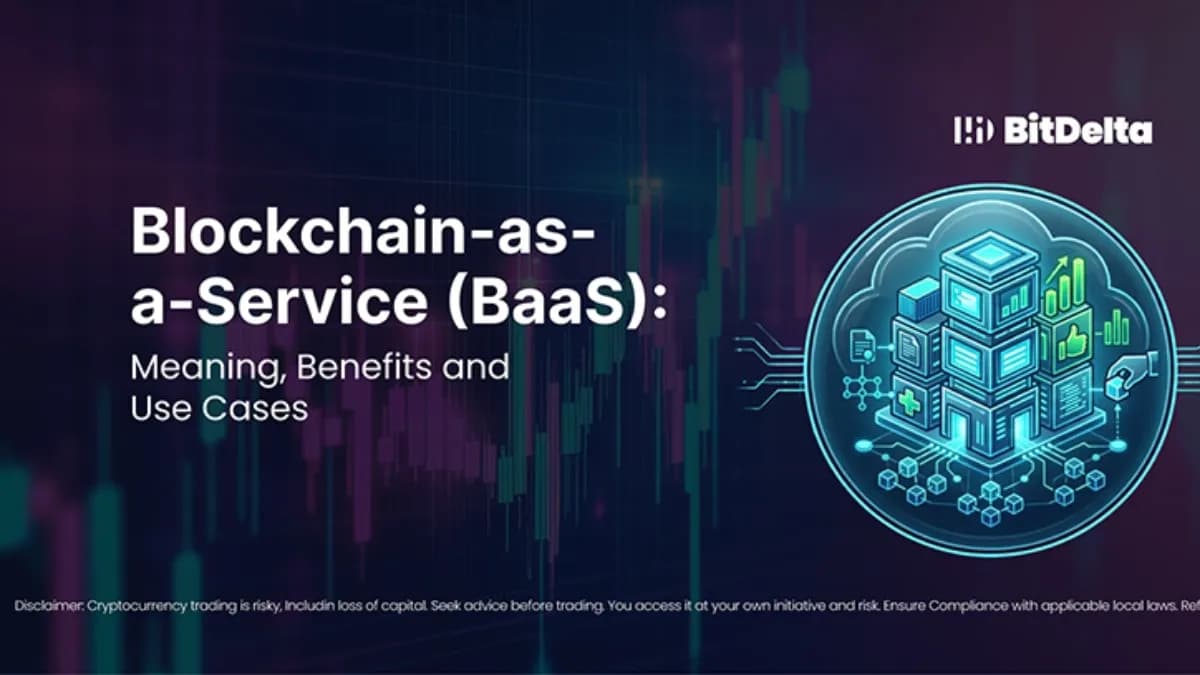
Blockchain sounds powerful in theory, but building something on it from scratch is not simple. It requires infrastructure, technical expertise and ongoing maintenance. That is where Blockchain-as-a-Service, often called BaaS, comes in.
Instead of setting up and managing everything yourself, BaaS lets you use blockchain through a service provider. In the same way that cloud computing removed the need to own physical servers, BaaS removes the need to build blockchain systems from the ground up.
It makes blockchain more accessible, especially for businesses that want to experiment or deploy solutions without getting into the complexity behind it.
In the early days, working with blockchain meant building everything yourself. You needed to set up nodes, manage networks, ensure security and handle updates. For most companies, that level of involvement was not practical.
BaaS changed that approach.
Instead of focusing on infrastructure, companies can now focus on what they actually want to build. The service provider handles the backend, while users interact with the system through tools and interfaces.
This shift has made blockchain more usable in real-world scenarios.
What Is Blockchain-as-a-Service
Blockchain-as-a-Service is a model where a third-party provider offers blockchain infrastructure and tools through a cloud-based platform.
Users can create, host and manage blockchain applications without directly dealing with hardware, network setup or system maintenance.
The provider takes care of:
This allows users to focus on building applications rather than managing the underlying technology.
How Blockchain-as-a-Service Works
BaaS works in a way that is similar to other cloud services.
A provider sets up and maintains a blockchain network. Users access this network through a platform where they can build and deploy applications.
Instead of installing software locally or maintaining servers, everything runs through the provider’s infrastructure.
Example
A company wants to build a system to track goods in a supply chain. Instead of building a blockchain network from scratch, they use a BaaS provider.
They create their application on top of the existing infrastructure, while the provider handles performance, updates and security.
Benefits Of Blockchain-as-a-Service
Lower Entry Barrier
BaaS removes the need for deep technical knowledge. Teams can start building without learning how to manage blockchain infrastructure.
Faster Development
Since the backend is already set up, development becomes quicker. Projects that would take months can be started much faster.
Cost Efficiency
Building a blockchain system from scratch can be expensive. BaaS reduces upfront costs by offering a ready-to-use environment.
Scalability
As usage grows, the provider adjusts the system to handle increased demand. This removes the need for manual scaling.
Use Cases Of BaaS
Supply Chain Management
Companies use blockchain to track products from origin to delivery. BaaS makes it easier to build such systems without handling infrastructure.
Financial Services
Banks and financial platforms use blockchain for faster and more transparent transactions. BaaS helps them test and deploy solutions quickly.
Data Security
Sensitive data can be stored and verified on blockchain systems. BaaS provides a structured way to implement this without building the system from scratch.
Why BaaS Is Gaining Attention
As blockchain adoption grows, more companies are looking for practical ways to use it.
Not every organisation wants to become a blockchain expert. Most just want the benefits without the complexity.
BaaS fits that need. It simplifies the process while still allowing access to the core advantages of blockchain technology.
What This Means Going Forward
Blockchain is moving beyond experimentation. It is becoming part of real systems used by businesses.
Services like BaaS are playing a role in that shift. They make it easier to adopt the technology without changing everything at once.
As more companies explore blockchain, models like BaaS are likely to become more common.
Making Blockchain More Practical
Blockchain-as-a-Service is not about replacing blockchain. It is about making it easier to use. By removing the need to manage infrastructure, it allows more people and businesses to build on top of blockchain without getting slowed down by technical barriers.
As digital systems continue to evolve, access to tools and platforms becomes just as important as the technology itself.
BitDelta gives you access to markets, tools and insights built around this evolving ecosystem. Whether you are exploring blockchain concepts or actively trading digital assets, the platform is designed to help you stay connected to how the space is actually developing.
Select the categories and companies you wish to follow directly to your person rss feed.
Create Custom RSS FeedSign up and join over 5,000 professional members who receive personalized news alerts, curated professional connections, and more for free!
Exchange FZE (GCEX) has appointed Alya Marrakchi as Managing Director, following approval from Dubai's Virtual Assets Regulatory Authority (VARA). Marrakchi joined GCEX in June 2025, building institutional relationships across the UAE and GCC. Her promotion follows Mohammed A. Mulla's appointment as a GCEX Dubai board member.
XS.com has appointed Kasem Hekal as Senior Business Development Manager in Dubai, UAE. He brings over 15 years of financial services experience, including a decade in FX and derivatives sales, and previously held roles at Accuindex MENA, ATFX, MultiBank Group, GKFX and FXOpen.
ATFX Connect has supplied institutional multi-asset liquidity to a new South African FX and CFD brokerage, supported by white-label infrastructure from strategic partner L7 Prime. Founded on an existing IB network across Southern Africa, the brokerage launched in under four weeks and generated recurring revenue within 90 days.
MarketsVox has introduced 24/7 trading on Gold, Silver, WTI and Brent crude CFDs, giving clients round-the-clock access to key commodity markets. The launch is part of the broker's 2026 roadmap, alongside Client Area and Partner Area updates. CEO Joe Roeder says clients "should not have to wait for a trading session to open."
Bybit has launched Perp Options, described as the first options contracts built on TradFi perpetuals, giving traders round-the-clock access to US equity options. SpaceX and Nvidia are the first underlying assets, with USDT settlement and integration into Bybit's Unified Trading Account.
Use this trading preparation checklist to plan your session, define entry rules, manage risk, and build a disciplined trading routine in seven steps.
Your Bourse expands its crypto liquidity ecosystem with Caladan, giving brokers access to broader market coverage, institutional execution capacity and streamlined settlement.
Scope Markets, the retail brokerage part of Rostro Group, has appointed Ibrahim Hossny as Head of Research and Marketing for the Middle East and North Africa.
Hantec Prime, the institutional division of Hantec Markets, has reported trading volume up more than 300% year-to-date, alongside the addition of 42 new institutional clients since December, capping one of its strongest years of growth to date.
Learn how to refine XAUUSD support and resistance on the daily chart using candle bodies, market structure and weekly gold levels for swing trading. A slug alone cannot guarantee a top Google ranking. Keep it focused rather than adding every supporting keyword.