just now


Liquidity Finder Ltd is incorporated in England and Wales, company number 10610740, registered address 167-169 Great Portland Street, Fifth Floor, London W1W 5PF, United Kingdom.
Published: just now
If there’s one thing you already feel but maybe haven’t named, it’s this: your results are limited by your mental energy management in trading, not just by your strategy. You can have a solid edge, a clean Smart Money playbook, and a refined entry model, but if you show up mentally drained, stressed, or emotionally overloaded, discipline collapses fast. That’s exactly what Mark Douglas unpacks in The Disciplined Trader and also what I expanded on in Trading in the Zone: Thinking in Probabilities: the market isn’t your enemy - your unmanaged inner state is.
Think about the days you trade after a long shift, a fight, lack of sleep, or a losing streak. The same candles that looked “clean” yesterday suddenly feel threatening today. One small red candle feels like an attack. One missed move feels like a betrayal. That isn’t the chart changing - that’s your mental energy being low.
In this part, we’ll talk about how market stress drains that energy, how to avoid emotional exhaustion, how to keep focus during losing streaks, and why anger and revenge trading are basically the symptoms of a tired, overloaded mind.
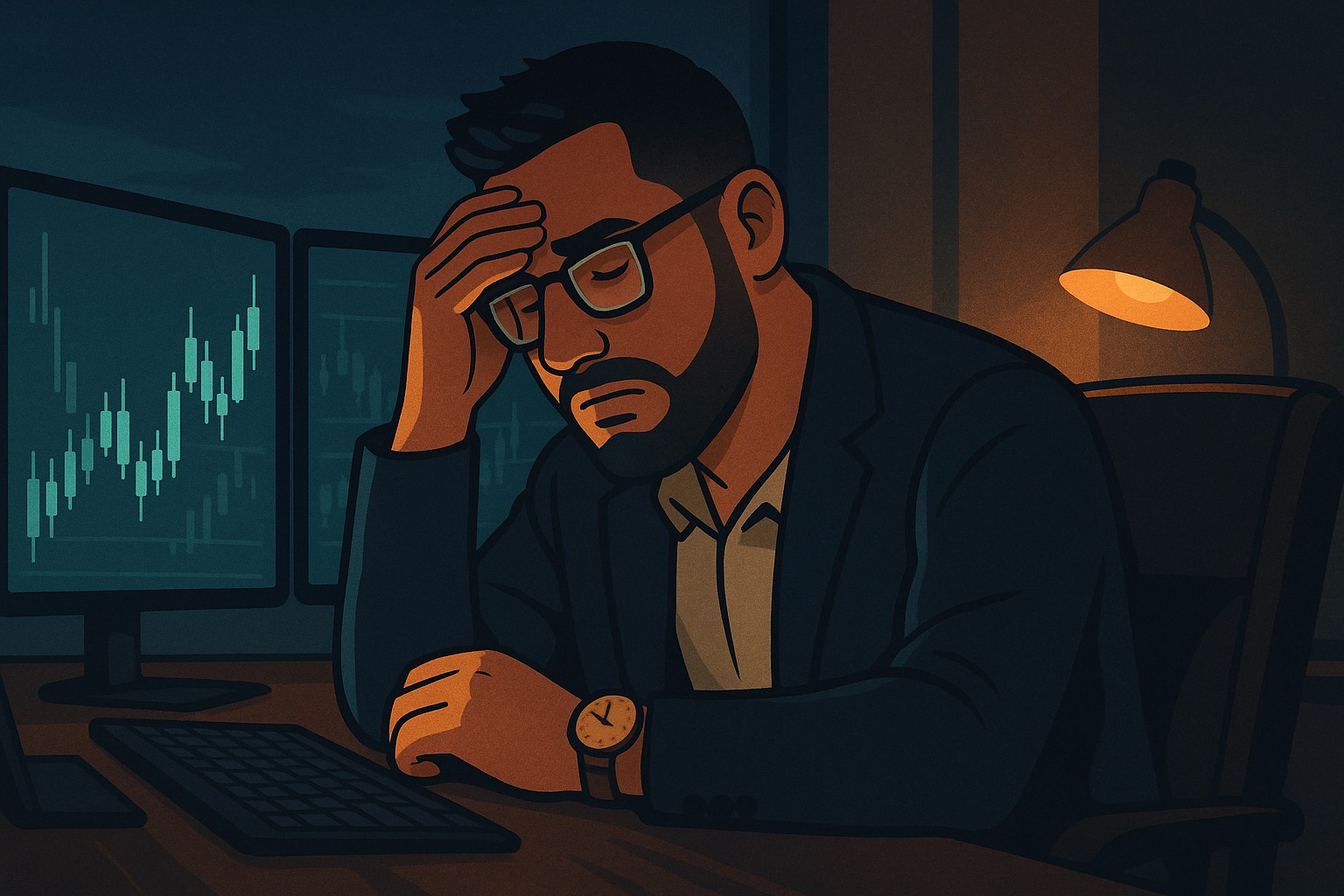
Douglas describes thoughts and emotions as forms of energy. The more emotional charge you attach to a thought - like “I can’t lose this trade” - the more power it has over you. When you keep replaying a loss, reliving an embarrassing mistake, or obsessing over a missed move, you’re feeding that energy until it starts hijacking your decisions, just like I discussed in The Enemy Within: Limiting Beliefs and Emotional Conflict in Trading.
Psychology calls a version of this ego depletion or decision fatigue - the idea that self-control draws from a limited pool of mental resources and that repeated decision-making eventually weakens your ability to regulate impulses (you’ll see this a lot in research on decision fatigue and ego depletion). When that pool is low, you don’t stop knowing your rules - you just stop following them.
So if you’ve ever asked yourself, “Why am I doing things I know I shouldn’t do?” the answer is often simple:
Your mental battery is already half-dead before you even open the charts.

Trading is not a normal environment. There’s:
That alone is mentally expensive. You’re constantly making micro-decisions: “enter or wait?”, “close or hold?”, “add or walk away?”. Over a session, it adds up. When you combine that with fear of missing out and the temptation to overtrade, you get the exact emotional environment that leads to the kind of performance anxiety I unpack in The Hidden Threat in Trading: How Performance Anxiety Sabotages Your Edge.
The key thing: stress doesn’t just make you feel bad - it narrows your awareness. You see fewer options, fewer perspectives, fewer scenarios. All you see is what hurts or what you’re afraid to lose.
And the lower your energy, the more you default to survival mode, not structured trader mode.

Most traders think emotional exhaustion comes from the market being “hard.” In reality, a big part of it comes from:
This is also why so many traders feel stuck in cycles of emotional trading, even if they’ve read pieces like Top 10 Ways to Prevent Emotional Trading and Stay Disciplined in the Markets. The issue isn’t lack of knowledge - it’s lack of energy to apply it.
A simple rule to avoid emotional exhaustion:
If your life is already heavy, your trading session must be light.
On days when you’re already mentally loaded, your risk, frequency, and expectations must all be dialed down. Otherwise, you’re asking a tired mind to make high-stakes decisions inside a high-pressure environment.
Let’s be real: losing streaks hit deeper than we admit.
They make you question your edge, your talent, your future, even your identity. But from a mental energy standpoint, the real damage comes from what you tell yourself during those streaks.
Those narratives drain energy faster than the actual financial loss. This is also where the fear of loss vs fear of missing out becomes loud, and it links directly with what I shared in The Psychology of Risk in Trading: Fear of Loss vs Fear of Missing Out.
To protect your focus in a losing streak:
A trader with mental energy and a 50% win rate will always outperform a drained trader with a “perfect” strategy.

Revenge trading almost always comes from the same core pattern:
This is why in Overcoming FOMO & Revenge Trading in Forex - Why Patience Pays, we treated revenge not as a strategy error, but as an emotional reaction to unaccepted loss.
Revenge trades don’t start from logic. They start from depletion.
By the time you’re revenging, your mental battery is usually red bar, 5% left, alarms flashing - and that is when you’re trying to make one of the most dangerous decisions of the day.
So instead of asking, “How do I stop revenge trading?”
Ask: “What state am I in before I revenge trade?”
Then build your rules around that state, not just around the chart.
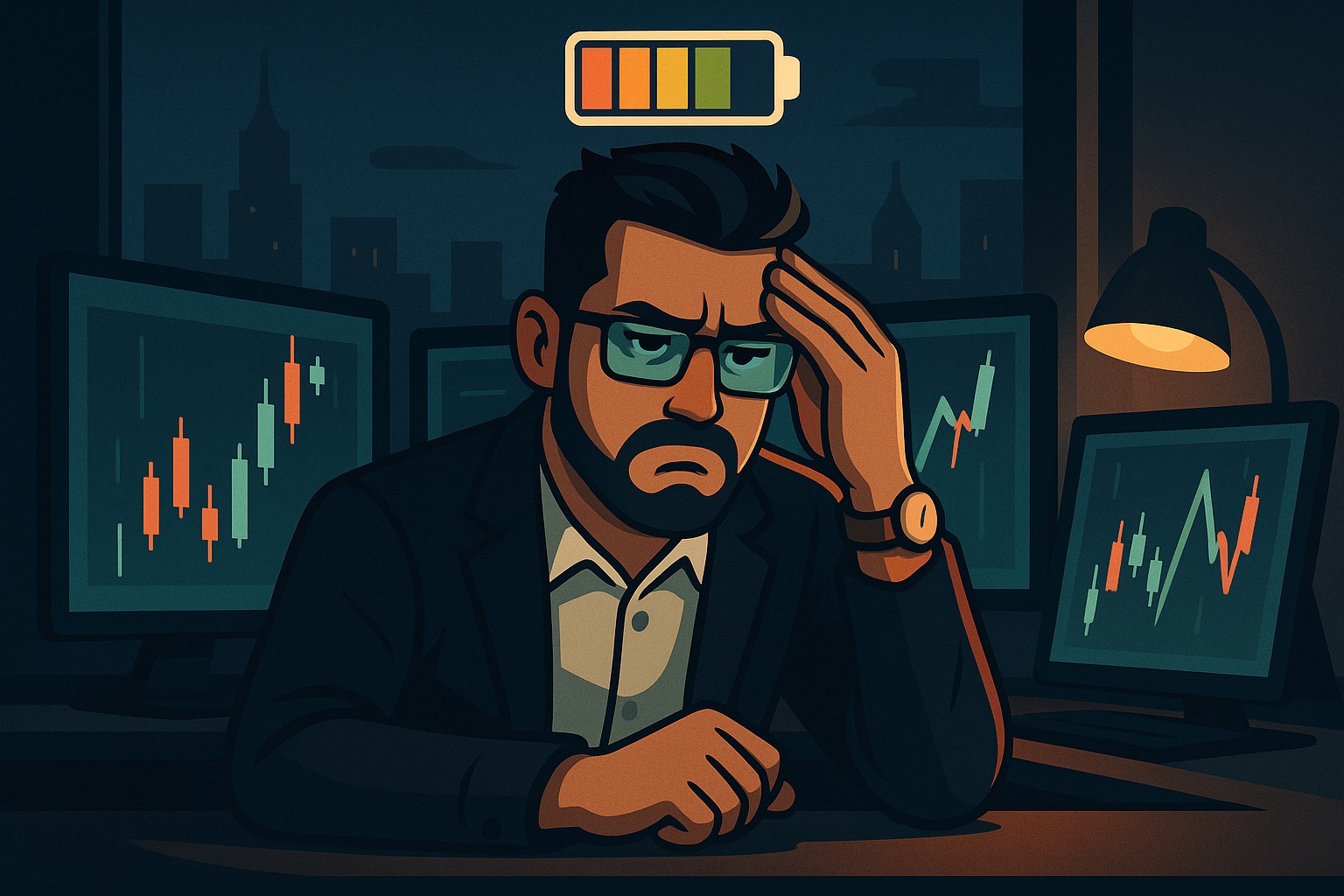
Imagine your mental energy like your phone battery:
Most traders never plug into anything that actually recharges them. No deliberate recovery, no boundaries, no mental hygiene. Then they wonder why they can’t hold winners or follow simple rules.
The truth is:
You’re not broken.
You’re just trading on 3% all the time.
This is where routines, rest, and structure do the heavy lifting. Simple habits like journaling, pre-market checklists, and structured review are what slowly refill the battery, as I kept emphasizing in Trading Mindset Mastery: Building Confidence Through Data.
Let’s make this simple and usable:
Rule 1: No heavy decisions on a heavy day.
If your day was emotionally loaded, trade smaller or not at all.
Rule 2: End your session when your clarity drops.
Not when your P&L hits some random emotional number.
Rule 3: Take losses fast, process them slowly.
Emotionally accept first, analyze later. Not the other way around.
Rule 4: Protect the battery, not the ego.
Losing trades with a full battery are recoverable. Losing your mental edge is not.
Rule 5: Build routines that refill you.
Sleep, boundaries, walks, prayer, journaling, gym - these are not “extras,” these are edge multipliers.
If you combine this with the kind of structured habits I lay out in Top 10 Habits Profitable Traders Follow Daily to Stay Consistent, mental energy stops being random and starts becoming part of your system.

If you want to grow, stop asking, “What else do I need to learn?” and start asking, “How do I want to feel when I trade?”
Mental energy management in trading is not a soft topic - it’s as real as your stop-loss. You can rebuild an account. Rebuilding a burned-out mind takes much longer.
As you keep refining your edge, your structure, and your psychology, the natural next step is simple: take what you’ve learned, protect your mental battery, and then apply it in real time on live charts with small, controlled risk as you grow.
Because trading compresses a lot of high-impact decisions into a short window. You’re dealing with uncertainty, money, fear, and expectation all at once - that cocktail drains mental energy fast, especially if you don’t have routines to reset.
Watch for signs: you rush entries, ignore your checklist, jump timeframes, or feel urgent, frustrated, or numb. If you can’t slow down your breathing and think clearly for 60 seconds, you’re not in a good state to risk money.
Yes. A strong strategy with a weak mind still loses; a strong mind with a decent strategy has a chance to consistently execute. The market doesn’t pay you for knowing - it pays you for doing what you know at the right time.
Low mental energy increases your tendency to chase, overreact, and seek emotional relief from the market. That’s why revenge trades and FOMO entries almost always happen near the end of a mentally draining session, not at the beginning.
It’s time to go from theory to execution!
Create an Account. Start Your Live Trading Now!
Looking for step-by-step approaches you can plug straight into the charts? Start here:
Sharpen your edge with proven tools and frameworks:
News moves markets fast. Learn how to keep pace with SMC-based playbooks:
From NASDAQ opens to DAX trends, here’s how to approach indices like a pro:
Gold remains one of the most traded assets - here’s how to approach it with confidence:
Candlesticks are the building blocks of price action. Master the most powerful ones:
Ready to go intraday? Here’s how to build consistency step by step:
Markets swing between calm and chaos. Learn to read risk-on vs risk-off like a pro:
Step inside the playbook of institutional traders with SMC concepts explained:
Forex pairs aren’t created equal - some are stable, some are volatile, others tied to commodities or sessions.
If you’ve ever been stopped out right before the market reverses - this is why:
Mindset is the deciding factor between growth and blowups. Explore these essentials:
The real edge in trading isn’t strategy - it’s how you protect your capital:
If you’re not sure where to start, follow this roadmap:
This way, you’ll grow from foundation → application → mastery, instead of jumping around randomly.
Follow me for more daily market insights!
Jasper Osita - LinkedIn - FXStreet - YouTube
This content may have been written by a third party. ACY makes no representation or warranty and assumes no liability as to the accuracy or completeness of the information provided, nor any loss arising from any investment based on a recommendation, forecast or other information supplies by any third-party. This content is information only, and does not constitute financial, investment or other advice on which you can rely.
ACY Securities is one of Australia's fastest growing multi-asset online trading providers, offering ultra-low-cost trading, rock-solid execution, technologically superior account management and premium market analysis.

Select the categories and companies you wish to follow directly to your person rss feed.
Create Custom RSS FeedSign up and join over 5,000 professional members who receive personalized news alerts, curated professional connections, and more for free!
Standard Chartered has signed definitive agreements to acquire 100% of Zodia Custody UK Limited, folding its regulated digital asset custody business into Securities Services. Zodia Solutions will be set up under SC Ventures with bank investors including Northern Trust, NAB Ventures, Emirates NBD and Investcorp.
Bybit Fintech FZE has secured a Virtual Asset Service Provider licence from Dubai’s Virtual Assets Regulatory Authority for Exchange Services, covering spot trading. Bybit’s Peter Loo said the firm hopes to add derivatives, subject to regulatory approvals. Its international Dubai headquarters opened in 2022.
ATFX Connect has released its Q4 2026 Institutional Edge, examining the geopolitical, monetary policy and fiscal pressures shaping global financial markets in the final quarter of the year.
The Nasdaq 100 is trading at 29,382. After reaching a recent high of 29,957, the index reversed sharply and has been recording a series of lower highs and lower lows.
propfunding.com's free-entry instant funding changes the order of prop funding. Start trading first. Its free-entry instant funding model offers two qualification attempts without an upfront activation fee.
FM Summit London returns to Old Billingsgate on 24 November 2026 for its 15th edition, with a curated one-day format aimed at senior executives. LMAX Group, Plus500, oneZero and MetaQuotes are among confirmed exhibitors, with Business Connect meetings, roundtables and an opening event at The Folly on 23 November.
GCEX has launched European-style, fiat-settled options on Bitcoin and Ethereum with monthly expiries for eligible professional and institutional clients. The service runs through the GCEX OTC desk, with pricing from Tier 1 liquidity providers and reporting on XplorPortal. GC Exchange Limited is authorised by the UK FCA
Wall Street closed mostly higher on Tuesday, led by a nearly 1% gain in the Dow. In Asia, South Korea’s Kospi rebounded 2.7% and Japan’s Nikkei gained 0.8%.
Brent crude is trading at $111.70. The latest price action show the recovery continuing toward $111.70, suggesting that demand has returned after the sharp correction.
FOREX.com has introduced weekend trading for US SP 500 and US Tech 100 CFDs in Japan, operated by StoneX Securities Co., Ltd., a StoneX Group Inc. subsidiary. Investors can manage positions seven days a week, including Saturday and Sunday sessions, without waiting for underlying markets to reopen on Monday.