just now

Liquidity Finder Ltd is incorporated in England and Wales, company number 10610740, registered address 167-169 Great Portland Street, Fifth Floor, London W1W 5PF, United Kingdom.
Published: just now

PU Prime has launched its operations in Australia through its locally incorporated entity, PU Prime Trading Pty Ltd, which has been granted regulatory approval by the Australian Securities and Investments Commission (ASIC).
PU Prime Trading Pty Ltd holds Australian Financial Services Licence (AFSL) No. 410681, enabling the firm to offer services directly to Australian clients under ASIC's regulatory framework.
Following the granting of its ASIC licence, PU Prime has invested in the resources and infrastructure required to support Australian clients, including local operations, a dedicated customer support team, and systems aligned with regulatory requirements.

Cristian Moreno, Director, PU Prime
Cristian Moreno, Director, PU Prime commented:
"This launch marks the beginning of our long-term commitment to the Australian market. We will meet our obligations under the ASIC framework and deliver transparent and regulated services to our Australian clients,"
With the launch, Australian clients can now onboard directly through PU Prime's ASIC-regulated entity. The firm said the move expands access to its trading products and services while reinforcing its commitment to operating within established regulatory frameworks, further strengthening its global regulatory footprint.
Trading derivatives carries significant risk and is not suitable for all investors.
Wholesale clients could lose substantially more than their initial investment. When trading CFDs, clients do not own the underlying assets and have no rights to them. Past performance is no indication of future performance, and tax laws are subject to change. Individuals are advised to read the relevant legal documents and be fully aware of the associated risks before acquiring any financial products.
PU Prime was founded in 2015 and is a global fintech company and CFD broker offering regulated financial products across forex, commodities, indices, shares, and bonds. It operates in more than 190 countries and has recorded over 40 million app downloads.
Found this interesting? Become a member of LiquidityFinder and get daily industry news direct to your inbox — join here: https://liquidityfinder.com/join
We're the largest marketplace to connect with brokers, Fintech companies & digital asset firms. Want to partner? Let's get in touch.

Select the categories and companies you wish to follow directly to your person rss feed.
Create Custom RSS FeedSign up and join over 5,000 professional members who receive personalized news alerts, curated professional connections, and more for free!
Alta, a new blockchain designed for banks and payment firms, has raised a $47.5 million Series A led by Index Ventures, with GV joining, taking total funding to $80 million. What caught my eye is that Airwallex CEO Jack Zhang is a co-founder and Airwallex is an early design partner, giving Alta access to fiat rails in around 200 countries from day one. Privacy and compliance built into the chain itself is exactly what institutions have been asking for.
DriveWealth, the embedded brokerage engine behind a long list of fintech apps, has secured MiCA authorisation from the Bank of Lithuania. Its EU entity already held a MiFID II licence, so one Vilnius-based firm can now offer partners securities and crypto-assets under a single regulatory roof, with crypto services due in the new year. Add the recent Ripple tie-up for RLUSD settlement and the direction is obvious: stocks, stablecoins and tokenised assets through one API. A shot across the bows for white-label brokerage rivals in Europe.
Revolut has been handed a conditional banking licence by the Bank of Israel, only the third new bank licence there since 2019 in a market long dominated by Hapoalim and Leumi. It cannot take customers yet, but with former Leumi chairman Muli Ben Zvi and ex-Pepper CEO Uri Nathan running the show, it clearly means business. Israel is a sophisticated, internationally minded market where FX and cross-border payments matter, so Revolut's multi-currency proposition should land well. Another notch on a remarkable 2026 licence tally.
Two weeks after launching round-the-clock RFQ trading in DAX 40 shares on 360X, Deutsche Börse has gone further: all 40 DAX constituents are now available as tokenised xStocks, built with Kraken parent Payward and within reach of investors in more than 110 markets. When an exchange group of this calibre distributes its own blue chips on-chain, tokenised equities stop being a crypto-native experiment. Brokers offering German stock CFDs to Asian and LatAm clients should be paying close attention.
eToro's Q3 numbers made for uncomfortable reading. Net income fell 74% to $15 million and net contribution slipped 13% to $186 million as crypto activity cooled, and the shares touched an all-time low. Yet funded accounts grew 18% to 4.39 million, so the client franchise is intact; this is a revenue mix problem, not a growth problem. The $250 million buyback tells you management thinks the market has it wrong. My take: the multi-asset story only works if capital markets can carry the quarters when crypto goes quiet.
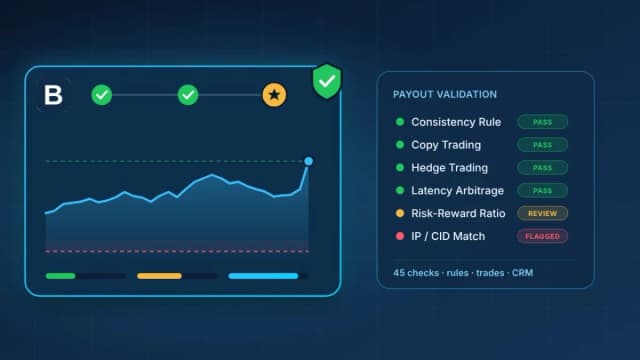
Challenge rules are a prop firm’s first line of defence – but only if they can be enforced. Straight from the dealing room, this guide shows how to write measurable rules, what a realistic funded-account rulebook looks like, how to catch network-level abuse early, and how Broktinger validates every payout against 45 checks.
MultiBank Group has announced the formation of a predominantly Emirati Board of Directors for MultiBank Exchange Holding, the first interbank trading platform in the BRICS and emerging countries, which achieved in October 2026 a turnover of over US$ 0.5 Trillion.
Monday saw a sharp rebound in Wall Street, with the Dow Jones rising 2.2%, the S&P 500 2.4%, and the Nasdaq 2.7%.
The Central Bank of Nigeria (CBN) has issued regulations that require issuers of foreign currency stablecoins used by Nigerians to incorporate locally.
Last week delivered the worst day for US technology stocks in six years. On Thursday, November 5, the Philadelphia Semiconductor Index fell 12%, its steepest daily drop since 2020, the Nasdaq Composite fell 5.5% into correction territory and the S&P 500 fell 4.3%. Micron and AMD each lost more than 17% in a single session. Then on Friday, the same stocks bounced, after a jobs report that came in at more than double expectations.