
just now

Liquidity Finder Ltd is incorporated in England and Wales, company number 10610740, registered address 167-169 Great Portland Street, Fifth Floor, London W1W 5PF, United Kingdom.
Published: just now

The dream for many traders is to scale from a small account into something much bigger. For some, that vision looks like passing evaluations; for others, it’s compounding their own capital until trading becomes a meaningful income stream. Here’s the reality though: the true target isn’t a larger account - it’s consistency. Without it, more size only magnifies mistakes. With it, growth becomes a logical byproduct of process.

Scaling your edge is not about racing to prove yourself. It’s about building a track record of steady execution, risk discipline, and psychological resilience. Just as no business expands to new branches before the first location proves reliable, no trader should scale until their foundation is rock solid. If you want a practical primer on how professionals protect that foundation, start with this high-level risk management compilation and keep it bookmarked as your north star.
It’s easy to think, “If only I had more capital, I’d finally make this work.” Capital isn’t the bottleneck - discipline is.
Consistency proves your strategy is robust, your risk management is sound, and your psychology can handle market swings. This is where measuring your edge matters. Before anything else, learn to track expectancy, win/loss distribution, and drawdown behavior with clarity using Measuring Your Edge: Metrics That Matter. Those metrics become your dashboard for every scaling decision afterward.
Most traders chase size long before they’re ready. Ads shout “go bigger,” friends post highlight trades, and FOMO creeps in. The danger is simple:
At this stage, you need clean data - not hopes. Build that data step by step: first backtest without bias to get a baseline, then forward test live with small size to prove your rules under uncertainty. Only then should you consider dialing up risk.
There are two practical frameworks that keep scaling sensible and aligned with performance.
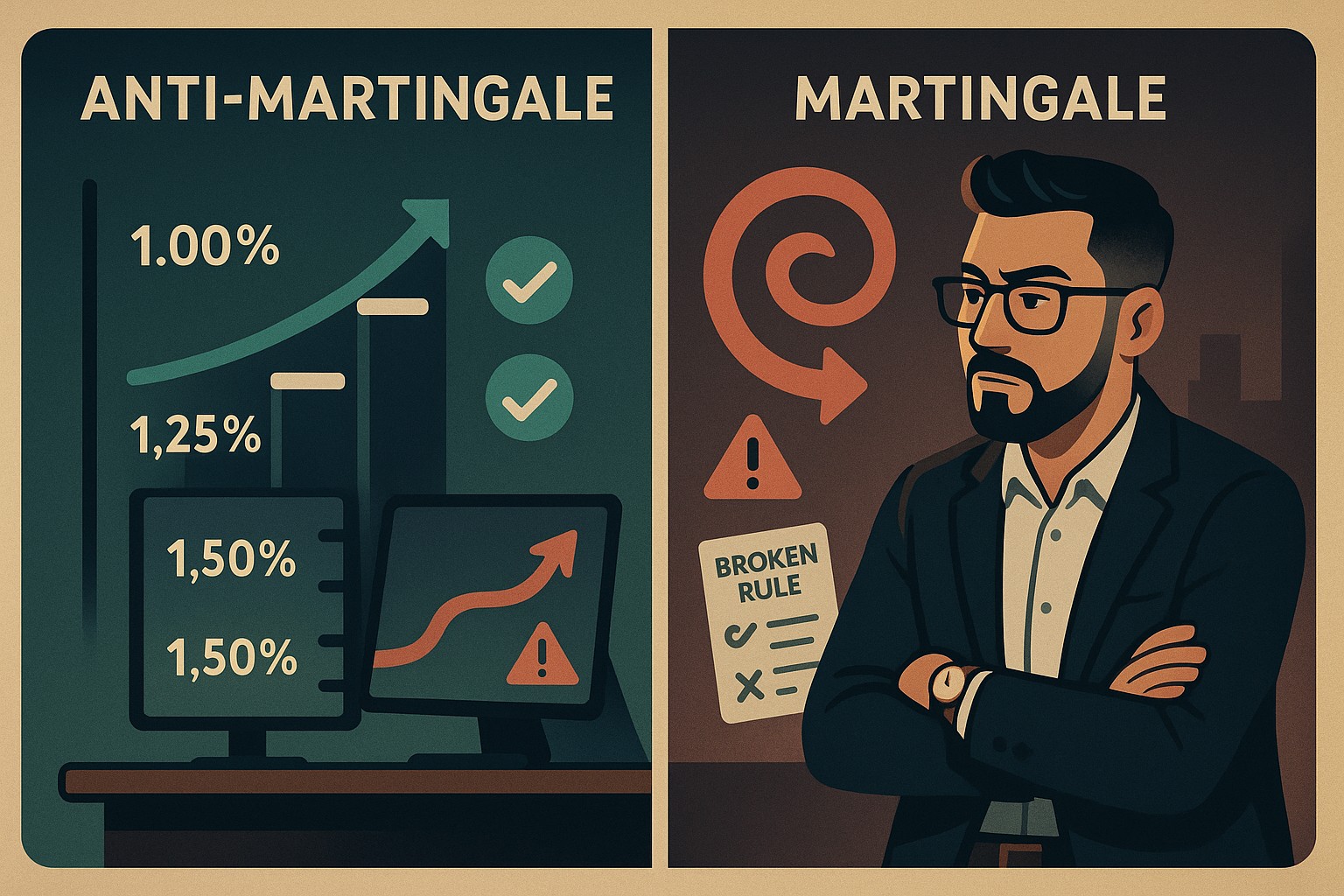
This model is built on strength. Instead of chasing losses, you gradually increase risk only after your system demonstrates stability.
This approach rewards consistency rather than emotion. If you’re curious about when “adding size” becomes reckless, study how martingale thinking sneaks in and why it’s dangerous via Martingale Strategy in Trading: Double-Edged Sword?.
This method is simple and durable: risk a fixed percentage of equity (e.g., 1%) every trade.
If you want to operationalize this, pair it with a clear plan for sizing and execution using Mastering Position Sizing and calibrate your baseline risk with How Much Should You Risk per Trade?.

Scaling shouldn’t come from a feeling - it should come from proof. Before you increase size, your trading record should show:
If your results are unstable with small size, scaling will only magnify instability. If they’re consistent, stepping up becomes a logical continuation of what already works. This is also where survival math matters - revisit Risk of Ruin to ensure your system’s parameters give you a statistically durable path as you scale.
Scaling isn’t just numbers - it’s a mindset stress test.
A practical way to anchor this mindset is to adopt a rules-first approach to moving averages and trend context - they help you act on structure, not impulses. For a crisp systems overview to keep your thinking organized, see the Moving Averages Strategy Playbook.

Imagine a small restaurant. At first, the focus isn’t franchising; it’s getting the basics right - serving great food, managing costs, and building a loyal customer base. If the restaurant runs at a loss, opening two more locations won’t fix it. You’d only multiply losses. But if the single branch runs smoothly and profitably month after month, expansion becomes a natural next step.
Trading works the same way. Your small account is that first branch. Your trade journal is the profit-and-loss statement. If the statements prove reliability, scaling is no longer a gamble - it’s a reflection of consistency. And if you want to refine edges without breaking what works, keep iterating intelligently with Refining Your Edge - Iteration Without Overfitting so your improvements stay grounded in reality, not curve-fit fantasies.

Scaling your edge is not a sprint - it’s a reflection of mastery. If you can execute with discipline, respect risk, and prove consistency on a small account, scaling stops being about hope and starts being about logic. The only voice that should decide is your data. Your records must speak louder than your emotions, and your risk plan has to protect the base so your wins can compound.
Here’s a simple challenge for this week: audit your last 50 trades. Note your expectancy, your largest drawdown, and any rule breaks. Then answer this honestly: would you be comfortable running that same performance at 1.25x size without changing your behavior? If not, tune the process before you touch the size. If yes, you’re already doing the real work that makes growth possible.
It’s time to go from theory to execution - risk-free.
Create an Account. Start Your Free Demo!
Looking for step-by-step approaches you can plug straight into the charts? Start here:
Sharpen your edge with proven tools and frameworks:
News moves markets fast. Learn how to keep pace with SMC-based playbooks:
From NASDAQ opens to DAX trends, here’s how to approach indices like a pro:
Gold remains one of the most traded assets - - here’s how to approach it with confidence:
Candlesticks are the building blocks of price action. Master the most powerful ones:
Ready to go intraday? Here’s how to build consistency step by step:
Markets swing between calm and chaos. Learn to read risk-on vs risk-off like a pro:
Step inside the playbook of institutional traders with SMC concepts explained:
Forex pairs aren’t created equal - - some are stable, some are volatile, others tied to commodities or sessions.
If you’ve ever been stopped out right before the market reverses - - this is why:
Mindset is the deciding factor between growth and blowups. Explore these essentials:
The real edge in trading isn’t strategy - it’s how you protect your capital:
If you’re not sure where to start, follow this roadmap:
This way, you’ll grow from foundation → application → mastery, instead of jumping around randomly.
Follow me for more daily market insights!
Jasper Osita - LinkedIn - FXStreet - YouTube
This content may have been written by a third party. ACY makes no representation or warranty and assumes no liability as to the accuracy or completeness of the information provided, nor any loss arising from any investment based on a recommendation, forecast or other information supplies by any third-party. This content is information only, and does not constitute financial, investment or other advice on which you can rely.
ACY Securities is one of Australia's fastest growing multi-asset online trading providers, offering ultra-low-cost trading, rock-solid execution, technologically superior account management and premium market analysis.

Select the categories and companies you wish to follow directly to your person rss feed.
Create Custom RSS FeedSign up and join over 5,000 professional members who receive personalized news alerts, curated professional connections, and more for free!
FM Summit London 2026 returns to Old Billingsgate on 24 November for its 15th edition, with LMAX Group, Plus500 and oneZero among confirmed exhibitors. The one-day event adds Business Connect meetings and roundtables, and opens with a networking evening at The Folly on 23 November.
Finance Magnates Summit London returns to Old Billingsgate on 24 November 2026 for its 15th edition. The one-day event brings together brokers, liquidity providers, institutional firms, trading technology vendors, payments businesses and digital asset firms.
iSAM Securities Apex has integrated with Match-Prime, giving brokers access to liquidity across more than 2,000 instruments, with tailored pricing and up to 10 levels of market depth.
propfunding.com's free-entry instant funding changes the order of prop funding. Start trading first. Its free-entry instant funding model offers two qualification attempts without an upfront activation fee.
US stocks closed higher on Wednesday, with the Nasdaq gaining 1%, the S&P 500 rising 0.6%, and the Dow advancing 0.7%, as renewed enthusiasm for AI-related stocks lifted market sentiment.
SpaceX went public in June as a rocket company. On October 20 it reported as something else entirely: an AI infrastructure business, financed by a satellite broadband network, with a launch division attached. Rockets generated 12% of third quarter revenue and lost money. The AI segment generated 52% of revenue and consumed 84% of capital expenditure. Starlink generated 85% of operating profit.
Standard Chartered has signed definitive agreements to acquire 100% of Zodia Custody UK Limited, folding its regulated digital asset custody business into Securities Services. Zodia Solutions will be set up under SC Ventures with bank investors including Northern Trust, NAB Ventures, Emirates NBD and Investcorp.
Bybit Fintech FZE has secured a Virtual Asset Service Provider licence from Dubai’s Virtual Assets Regulatory Authority for Exchange Services, covering spot trading. Bybit’s Peter Loo said the firm hopes to add derivatives, subject to regulatory approvals. Its international Dubai headquarters opened in 2022.
ATFX Connect has released its Q4 2026 Institutional Edge, examining the geopolitical, monetary policy and fiscal pressures shaping global financial markets in the final quarter of the year.
The Nasdaq 100 is trading at 29,382. After reaching a recent high of 29,957, the index reversed sharply and has been recording a series of lower highs and lower lows.