just now

Liquidity Finder Ltd is incorporated in England and Wales, company number 10610740, registered address 167-169 Great Portland Street, Fifth Floor, London W1W 5PF, United Kingdom.
Published: just now
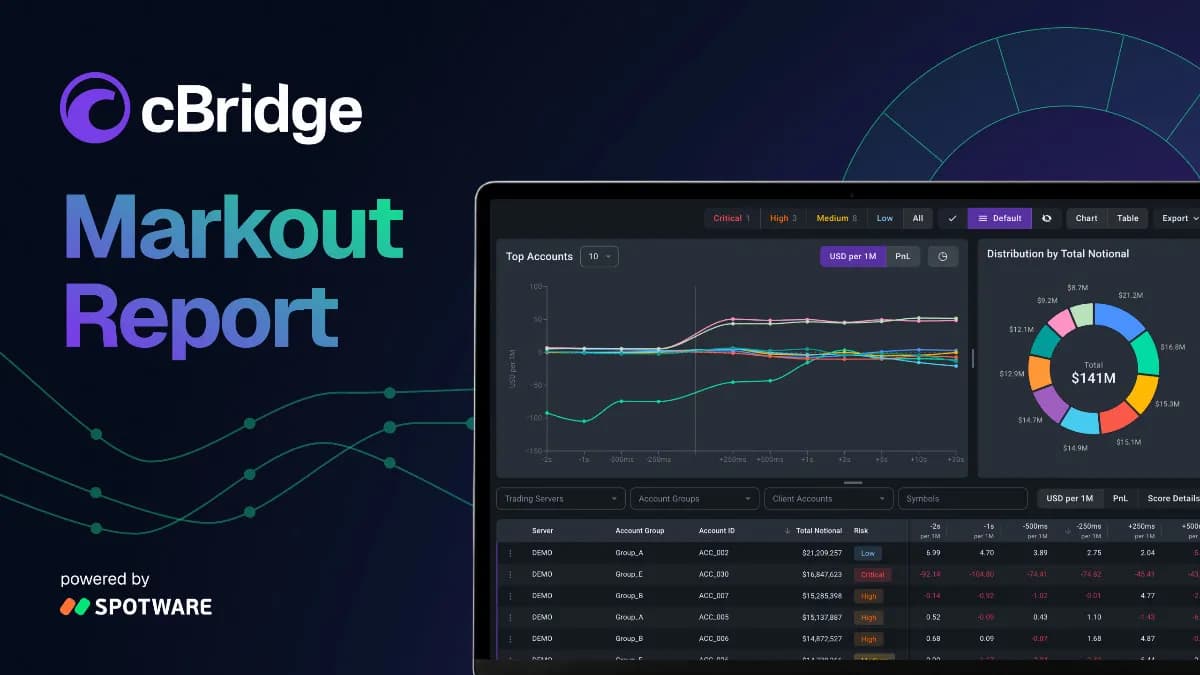
Liquidity bridge provider cBridge, by Spotware, has introduced Markout Report, a new risk intelligence module that helps brokers detect potentially toxic flow, measure its financial impact and respond before repeated losses accumulate.
The problem it targets is a familiar one for dealing desks: catching harmful trading patterns early enough to turn them into consistent routing decisions.
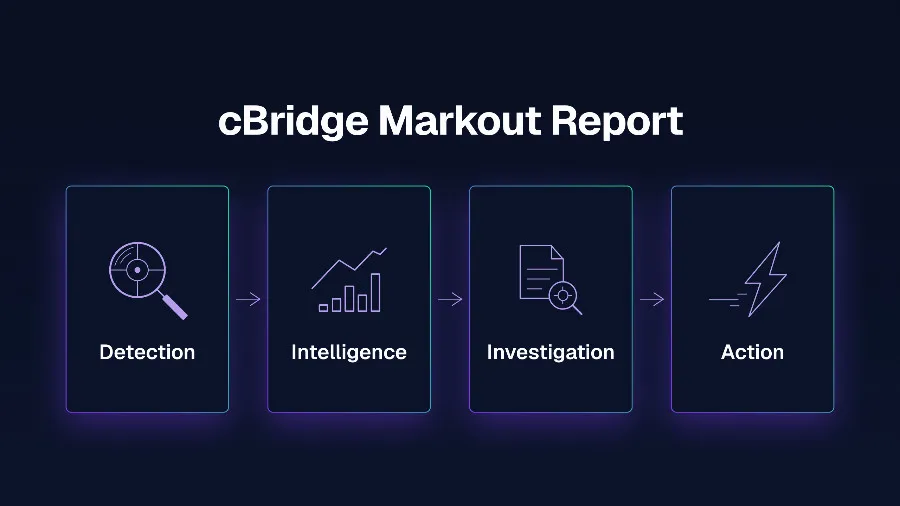
Markout Report brings execution records and raw tick data together into continuous, account-level risk intelligence that updates throughout the trading day, allowing brokers to identify adverse patterns earlier in the session and act before the damage grows. The system flags the accounts that need attention and shows straight away why they were flagged, so the trading department can investigate the instruments and behaviour involved, export data if needed and apply the right routing treatment, all within the same cBridge workflow.
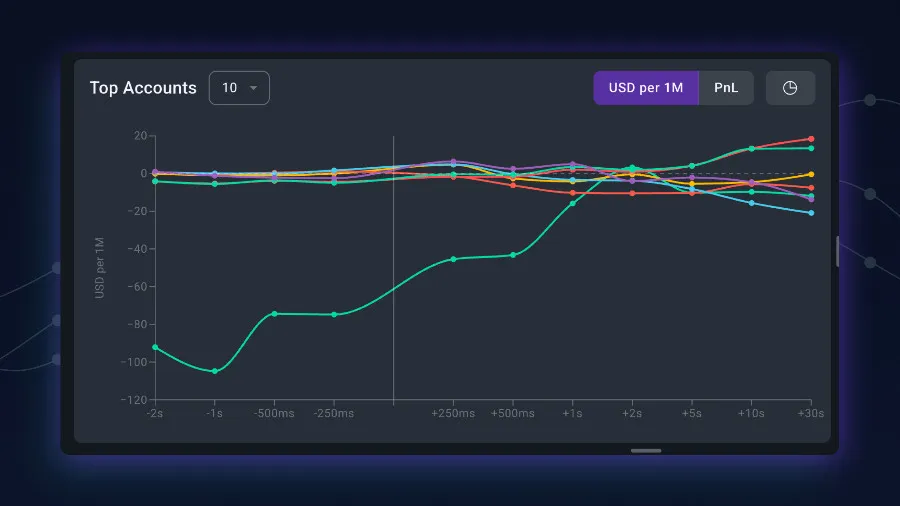
Most teams review execution quality only after the session has closed, once the P&L has already settled. By that point the loss is fixed and the only option left is to record it and adjust routing going forward.
Markout Report instead measures markout and pre-trade drift continuously while the session is still running. Risk teams can watch how accounts behave in real time, including during volatile periods, with interactive charts visualising account-level markout metrics across configurable time intervals. That earlier visibility gives trading departments more time to respond before repeated losses accumulate.
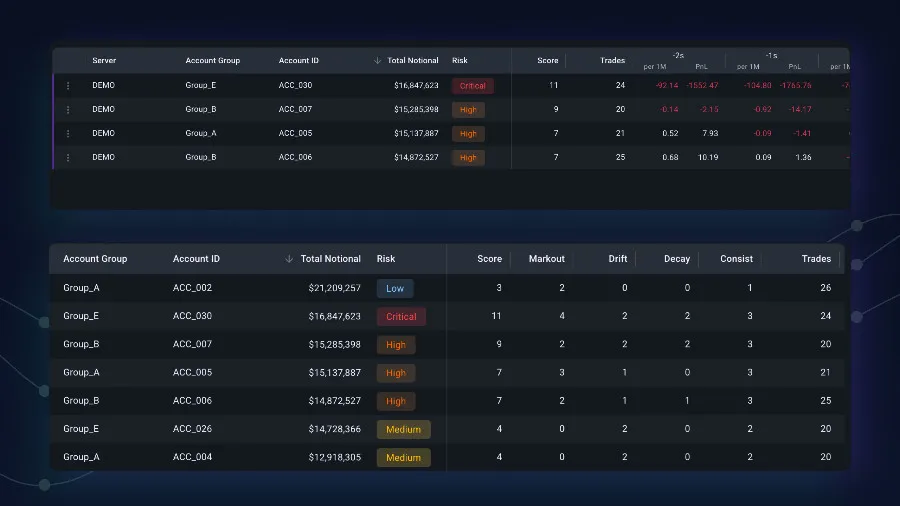
Some unusual accounts cause only minor losses, while others create significant leakage. Markout Report ranks accounts by both risk and notional volume so desks know where to focus. A "Top accounts" view highlights which accounts have the biggest impact, while the notional distribution shows how trading volume is concentrated across the account base, directing attention to the accounts where timely action can meaningfully protect the broker's P&L.
Account behaviour is classified at low, medium, high and critical risk levels, based on four transparent signals: markout, pre-trade drift, decay and consistency. Because every account is judged against the same framework rather than individual interpretation, decisions stay consistent across shifts and each routing action can be traced back to the specific signals that drove it.
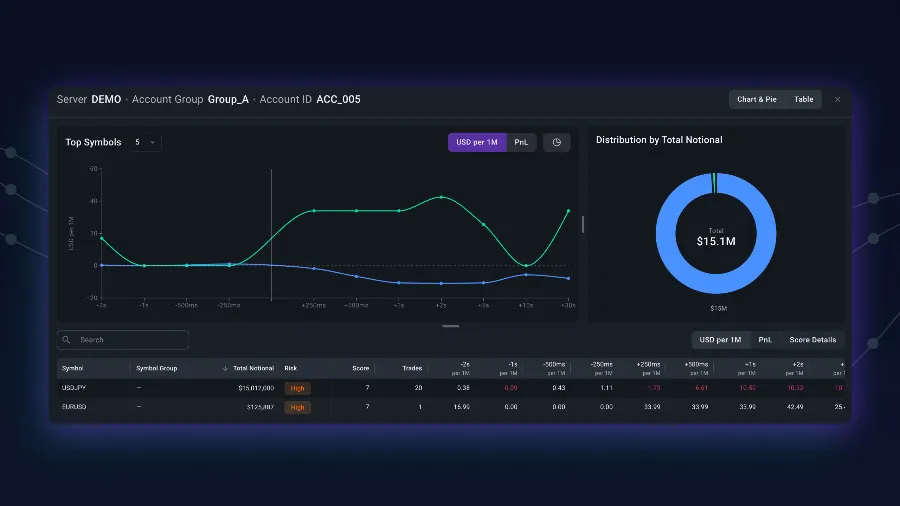
Once a potentially harmful account is identified, finding what is actually driving the result is usually the most time-consuming part of the job. Markout Report keeps that process in a single interface. Teams can scope the analysis to the relevant part of the account base, apply filters to isolate specific conditions and drill down to see whether the behaviour is concentrated in one instrument or repeated across several. Accounts can be categorised to keep the investigation structured and pinned to stay visible throughout the review.
With charts, account tables, risk summaries and investigation tools in the same place, the trading team can reach a clear conclusion on a specific account without switching between systems. Once intervention is confirmed, the relevant routing action can be initiated within the cBridge environment. Keeping the full workflow together reduces response time and lowers the operational risk created by copying data between platforms and relying on informal handovers.

Alexis Droussiotis, co-General Manager, cBridge
"Markout Report reflects the broader direction of cBridge. We want risk management to be a core part of the liquidity bridge, not something brokers have to handle separately, so execution, monitoring, investigation and control all happen in one place. As brokers grow, the operational side gets harder to manage, and that's exactly the problem we're trying to solve: giving them room to scale without losing control over their risk," - Alexis Droussiotis, co-General Manager, cBridge
Markout Report arrives as markout analysis, once mostly an institutional practice, becomes a routine part of retail broker risk management. cBridge itself recently added risk analytics from Tapaas alongside STARPRIME liquidity.
Found this interesting? Become a member of LiquidityFinder, join the community and join the discussion - join here.
We're the largest marketplace to connect with brokers, Fintech companies & digital asset firms. Want to partner? Let's get in touch.

Select the categories and companies you wish to follow directly to your person rss feed.
Create Custom RSS FeedSign up and join over 5,000 professional members who receive personalized news alerts, curated professional connections, and more for free!
Why did gold keep falling after reaching $3,880? See how a failed 4-hour retest confirmed weakness in XAUUSD and why $3,400 is the next weekly support to watch.
Reality television personality Aaron Chalmers and finfluencer Jason Agbodza have been fined after pleading guilty to illegally promoting an unauthorised foreign exchange trading scheme on social media.
UK retail sales rose a stronger-than-expected 0.7% in October, giving sterling some support, while a deepening tech sell-off pushed the dollar lower overnight against all major currencies. Thanim Islam, Head of FX Analysis at Equals, says the dollar remains in charge as the week ends, with the Fed expected to raise rates more than both the Bank of England and the ECB.
Nvidia beats expectations, reporting $115.8bn in revenue and raising its long-term growth outlook, but the stock still struggled to sustain its gains. AI remains fundamentally strong, but investor expectations are becoming more demanding, particularly around capex and profitability. Wall Street suffered a major sell-off, with the S&P 500 entering a six-session losing streak as rate concerns intensified.
iSAM Securities reviews the ris of weekend gold trading
Webull Corporation reported record third quarter 2026 revenue of $218.7 million, up 39% year-on-year, with customer assets reaching $32.4 billion and options contracts volume up 79%. Net income attributable to the company was $31.2 million, while margin debit balances passed $1 billion for the first time.
Anthropic, the company behind the Claude family of AI models, begins trading on the Nasdaq today under the ticker ANT. It priced its shares at $83 last night, above its marketed range of $70 to $78, and raised about $81.3 billion. That makes it the largest initial public offering on record, ahead of the roughly $75 billion SpaceX raised in June. This note covers what investors need to know: the terms, the business, how the company is governed, and what to watch.
Nvidia's first results without Jensen Huang answered the question that has hung over the AI trade since October. Revenue of $115.8 billion beat consensus by about $7 billion, fourth-quarter guidance of $130 billion came in roughly $5 billion above expectations, and the company raised its outlook for next fiscal year to around 75% growth. All of this assumes no data-centre sales to China.
Marex has entered the football financing market through a partnership with specialist sports investment and advisory firm Pinto Capital, targeting clubs in the Premier League and EFL Championship.
Around 110,000 UK retail investors have secured $300 million worth of Anthropic shares in its record-breaking $81 billion IPO. The heavily oversubscribed offer, coordinated by RetailBook, saw smaller investors prioritised, with 63% of applicants receiving their full allocation.