just now

Liquidity Finder Ltd is incorporated in England and Wales, company number 10610740, registered address 167-169 Great Portland Street, Fifth Floor, London W1W 5PF, United Kingdom.
Published: just now
New positioning data shared with LiquidityFinder by trading analytics and risk management platform Tapaas (@Tapaas) reveals how retail and professional traders across ten countries responded to last week's renewed hostilities between Israel and Iran, with gold emerging as the conflict hedge of choice and a surprising East-West divergence opening up in both gold and oil sentiment.
The data, from CFD and FX positioning across the brokers Tapaas works with, covers the last week (2 - 9 June 2026) and tracks two metrics: the percentage of trades placed long by count, and the percentage of volume positioned long by notional value. When the volume figure exceeds the trade count figure, long positions are on average larger than shorts, a useful proxy for where bigger money is leaning.
Gold was one of the most bullish instruments in the dataset all week, averaging 72 per cent long across trades and volume combined, against the roughly 50 per cent level where most instruments typically hover. Bullishness peaked at a sustained 80 per cent between 5 and 7 June, precisely as hostilities intensified in what became the worst escalation since the April ceasefire.

Gold sentiment: week line chart
The sequencing is the most striking feature of the data. In the first days of the week, volume-weighted sentiment ran consistently ahead of trade count sentiment, meaning larger positions were already leaning more bullish than the broader crowd. As the conflict escalated mid-week, both measures surged to their highs of the week simultaneously, a moment of genuine consensus. By late week the consensus fractured: smaller traders began retreating while larger positions held conviction, then reasserted their lead into the weekend.
That pattern, where bigger money leads, the crowd chases, and bigger money holds, is a sign of considered accumulation rather than panic buying. The size gap widened most sharply on 5 and 6 June, narrowed briefly on 8 June as ceasefire hopes surfaced, then re-established itself by the close of the period.

Size gap chart
There was a notable wobble mid-week, when sentiment briefly pulled back as traders reacted to early hints of diplomatic progress. The dip was short-lived and aggressively bought, with the recovery sharper and faster than the selloff. That asymmetry typically signals an intact underlying thesis. A second pullback on 8 June coincided with Iran suspending military operations and Israel halting its attacks, before sentiment recovered again on 9 June as traders weighed the durability of the pause.


Poland was the most consistently bullish market on gold of the ten countries tracked, averaging 83 per cent long and barely wavering all week, a reading that likely reflects Eastern Europe's acute sensitivity to regional conflict risk. Australia added to long positions most aggressively, up 9 percentage points over the week, with Thailand and the UK both up 6 points.
China and Hong Kong were the outliers. Both trimmed gold longs as the week progressed, even as Western and Southeast Asian traders were adding, leaving East Asia as the least bullish region at the close. The divergence may reflect a different reading of the conflict's implications: where Western markets see supply disruption risk pushing prices higher, East Asian traders may be weighing demand destruction or a stronger dollar scenario.
The same split appears even more dramatically in WTI crude positioning. Poland again led the bulls, adding 16.8 percentage points of long sentiment over the week, followed by Singapore, Italy and Germany. Hong Kong moved violently the other way, cutting bullish positioning by 27.9 percentage points, from 67.2 per cent long to just 39.3 per cent, the only market in the dataset to flip from net bullish to net bearish on crude during the conflict week.

Counterintuitively, gold sentiment correlated most closely with EUR/USD over the week, at +0.72, followed by the Nasdaq 100, silver and WTI. The correlation with USD/JPY, the other traditional safe haven, was weak at just +0.18. That suggests traders are treating the episode as a Middle East supply shock, inflationary and dollar-softening, rather than a global risk-off event that would typically lift the yen.

The negative correlation with Bitcoin, at -0.47, is one of the week's more interesting signals. Across the markets in the dataset, traders chose gold over digital assets as their conflict hedge, reversing a pattern seen in earlier geopolitical episodes where crypto attracted safe haven flows.
Sentiment tells you what traders believe. Tapaas also tracks toxic flow density, the proportion of flow that systematically profits at the expense of brokers, typically through latency arbitrage, trading around fast news, or other informed strategies that adversely select the price maker.
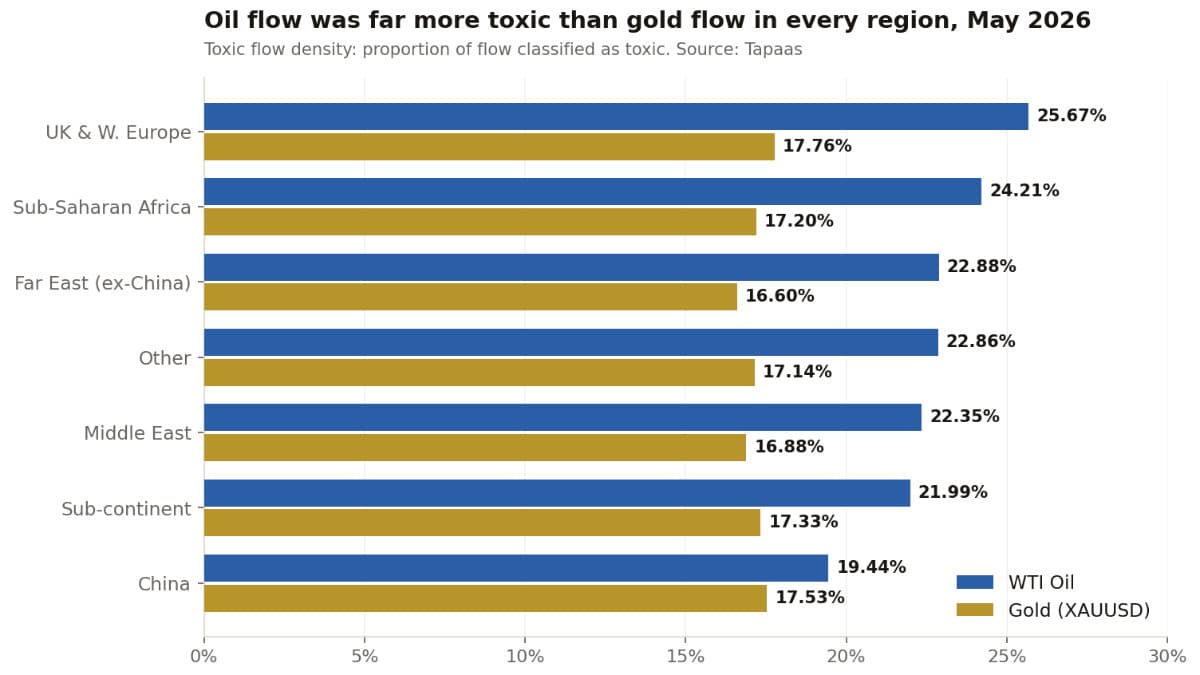
The May figures show the geopolitical risk premium landing squarely on brokers' oil books. WTI crude was the most toxic instrument in almost every region tracked, with toxic density ranging from 19.44 per cent of flow in China to 25.79 per cent in Central Europe and 25.67 per cent in the UK and Western Europe. In a fast, headline-driven oil market with the Strait of Hormuz in play, almost one in four WTI tickets in European books was flagged as toxic.

The single most toxic combination in the dataset was the DAX traded from the Middle East, at 26.40 per cent. Traders closest to the conflict appear to have been the sharpest at trading its equity market consequences.

Gold tells a different story. Despite carrying the heaviest one-way positioning in the dataset, gold toxicity sat in a remarkably tight band between 16.60 and 17.76 per cent across every region, comfortably below WTI everywhere. The crowd in gold was bullish but largely benign; the crowd in oil was smaller but far more predatory. For risk desks, the message is that conflict-driven volume is not all equal, and the instrument with the most dramatic sentiment is not necessarily the one doing the damage.
One caveat on timing: the toxicity figures cover May, the month before the ceasefire faltered, so they capture the conflict backdrop rather than last week's escalation specifically. The June figures, when available, will show whether the renewed hostilities pushed oil toxicity higher still.
The data describes considered, sequenced accumulation with larger positions leading and holding, rather than a fear-driven spike. Whether that conviction is rewarded depends on how durable the current pause in hostilities proves, and on whether the Strait of Hormuz, still the central pressure point for energy markets, moves towards normal operation.
Found this interesting? Become a member of LiquidityFinder and get daily industry news direct to your inbox — join here.
We're the largest marketplace to connect with brokers, Fintech companies & digital asset firms. Want to partner? Let's get in touch.

Select the categories and companies you wish to follow directly to your person rss feed.
Create Custom RSS FeedSign up and join over 5,000 professional members who receive personalized news alerts, curated professional connections, and more for free!
Multi-asset trading broker AvaTrade has agreed to acquire the majority of FXCM Group’s business and brand, in a transaction that would bring a longstanding retail FX franchise into the AvaTrade Group.
LSEG and CMC Markets have signed a multi-year strategic data agreement expanding CMC's access to LSEG's real-time and delayed pricing, reference and corporate actions data, news and analytics, plus AI-ready content, to support new products, entry into new markets and the growth of CMC's institutional and B2B partnerships.
The Tel Aviv Stock Exchange is considering a bid for the Cyprus Stock Exchange, with Israeli media citing its EU licence, trading platform and clearing house. Euronext’s Athens exchange and India’s National Stock Exchange are also seen as contenders, and Cyprus aims to sign a sale agreement by the end of this year.
CME Group will launch baseball futures on 12 October, pending regulatory review, tracking CME FutureSports Performance Indexes built on Official League Data. Standard and micro contracts will start with the 2026 Postseason and the four clubs in the League Championship Series, trading around the clock.
ESMA has published an opinion stating that MiCA-authorised crypto-asset service providers should cease services tied to non-MiCA-compliant stablecoins for EU clients across MiCA crypto-asset services. National authorities should require remediation of existing exposures within three months, by early January 2027.
Nasdaq Ventures has made a strategic investment in Amsterdam-based derivatives and crypto exchange One Trading, with both firms to explore 24/7 trading of equity futures. The undisclosed investment follows Nasdaq's US$100 million investment in Payward, the parent of Kraken, and CME Group's move to 24/7 trading.
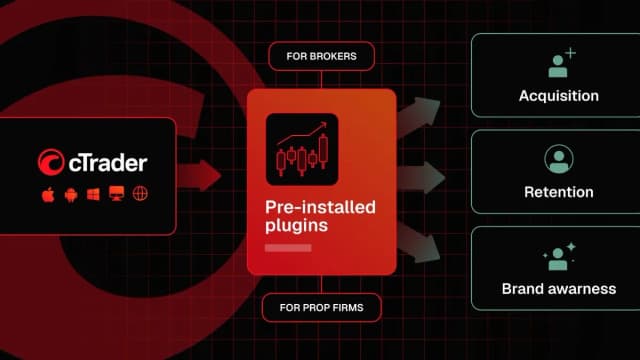
cTrader has opened multi-platform plugins to brokers and prop firms, which can pre-install their own tools for clients or list them in cTrader Store. The plugins run across Mobile, Web, Windows and Mac, and can be built and launched independently of core-platform releases, including trading journals and calculators.
Institutional brokerage and financial infrastructure provider Clear Street has joined TradingView’s broker network, allowing its clients to trade US stocks, exchange-traded funds and options directly through the charting and analysis platform.
Learn how to improve trading psychology, manage fear and greed, avoid revenge trading, and follow your trading strategy with discipline and a trading journal.
GTC Prime has announced a strategic partnership with Centroid Solutions to manage and distribute its liquidity through CS 360 Bridge, Centroid's multi-asset connectivity and execution engine, giving brokers and institutional clients access to tailor-made pricing, low-latency execution and real-time risk management.