just now

Liquidity Finder Ltd is incorporated in England and Wales, company number 10610740, registered address 167-169 Great Portland Street, Fifth Floor, London W1W 5PF, United Kingdom.
Published: just now

Every retail broker in the FX and CFD space is losing money to traders they cannot identify clearly. Broker money is being deliberately extracted by individuals who have turned broker abuse into a systematic business. This is happening at an industrial scale. They run multiple accounts under different names, in different countries, on different devices. They exploit negative balance protection to create asymmetric bets that always favour them. They game multiple funded accounts. They get caught at one broker or prop firm and simply move to the next, knowing that without a shared network, the new broker has no idea who they are or what they have done. The median time for a broker to identify and shut down a known abuser arriving from another firm is ten and a half months. In that time, the damage is done and the trader has moved on again.
I have spoken to a few different projects in the past that have had plans to address this problem with an industry initiative on data sharing. Something I have really endorsed. But it is difficult to come to the industry with a new initiative unless a significant part of the industry agrees to get on board. I have had conversations with brokers in the past about this sort of initiative as my way to support some nascent projects that were exploring the viability of this. Suspicion and complexity meant these have never really got off the ground. But I think this one will. In fact it is already doing it as it turns out.
When I had a tip-off that risk analytics platform When I had a tip-off that risk analytics platform Tapaas had quietly launched a new cross-broker tracking capability, one that could follow abusive traders from one brokerage to the next, I went straight to the source and got on a call with Jon Squires, the company's CEO. He confirmed it. We had a really long chat about this and what he shared changed the way I thought about the true scale of abuse running through the FX and CFD industry right now. It was Friday afternoon and we really got down to it over what turned out to be a really long call.
.png)
Jon Squires, CEO, Tapaas
Jon Squires is not a typical SaaS CEO. Before taking the helm at Tapaas, he served as CEO well-known retail brokers Capital.com then Skilling, giving him a first-hand understanding of exactly the problems his platform is now built to solve. He knows what it feels like to be on the losing side of these trades.
(In case you didn’t know, Tapaas stands for ‘Trade Analytics Platform As A Service’. This is what they do. Last year Elina Pedersen ( @elinap751d8 ) from Your Bourse and Roman Garanin ( @romangccf8f ) from Yourfintech, did a great YouTube video interview with TaPaas Founder Tom Vasak (PhD in Computer Science by the way) which explains the power of kdb+
For context, Tapaas provides real-time risk analytics to some of the largest brokers in the world, including IC Markets, CFI, MultiBank among others. The reason Tapaas can do this is because it utilises the kdb+ database (the fastest time-series database in the world – I know this as I used to work at First Derivatives - as it was then- selling the database based on this strapline). kdb+ is used by the largest hedge funds and tier-1 banks for example, for price making and risk analytics. One of the outstanding use-cases for KDB is trade surveillance.
Using kdb+, the Tapaas platform can process trade data within 5ms of execution, flagging clients across 88 configurable risk alert categories, from potential scalpers and front runners to news traders, high-leverage abusers, and what it labels ‘excessively profitable’ accounts. Brokers can configure every alert to their own thresholds, and notifications are pushed through Slack, email, or WhatsApp in real time.
Jon started quoting some fairly alarming statistics. For example, Tapaas has already identified 22,000 known front runners and scalpers currently jumping between brokers across its client network just in the last month.. And that’s only Tapaas’ current client network, a subset of the industry.
A further 29,000 accounts are placing what appear to be identical trades in opposite directions simultaneously and under exactly the same conditions across just two of its top broker clients on a daily basis. Jon told me that the methodology they use to match these trades shrinks the probability of that happening by chance to less than 0.1 per cent (I have to take his word for it - he’s obviously done the maths).
I asked Jon if this then means that this issue is endemic throughout the industry; he said “It’s absolutely endemic.” I don’t think this is news to anyone, but the scale of it, backed up by real numbers, may be.
Until recently, all of that analysis was contained within a single broker's own data. And Tapaas, working with multiple clients could see patterns across all their clients. What Tapaas has now built, and this is the game-changer, is a cross-network layer. Tapaas has centralised a reference database for the hundreds of thousands of abusive clients they have identified on individual brokers over the last decade, and each broker’s account now checks every account when it’s opened or active to see if it matches a record. This means that an abusive trader identified at one broker is immediately visible as a risk to every other broker in the system. And they’re adding it for free for even their smallest clients.
Jon laid out four (well known in the industry) distinct patterns of abusive behaviour that the platform is now either live with or actively developing. Tapaas uses its own internal labelling system for these categories, currently calling each type of behaviour a suspect, with the snappily named Suspect One to Suspect Three in their beta phase, with Suspect 4 coming soon. I am going to call them here “The 4 Horsemen of the Abuse Apocalypse”, because it sounds more dramatic and I needed a catchy title. (Not going to call them Conquest, War, Famine and Death - too much).
Horseman One: Latency Arbitrage (Front runners) and scalpers gaming the system across multiple brokers. To understand why this is so damaging, it helps to understand what these traders are actually doing.
Front runners exploit tiny windows of latency in a broker's price feed, placing trades in the fraction of a second between a price being quoted and the market moving. Scalpers operate similarly, targeting micro price movements that last milliseconds, extracting small but consistent profits from the broker's book on every trade. Both strategies work precisely because they carry a technological or informational advantage over the broker. Left unchecked, they are not trading so much as systematically extracting money.
The pattern Jon described is deliberate and calculated. A trader arrives at a broker, often opening multiple accounts under different names or from different jurisdictions to spread their activity. They run their strategy, beating the broker's risk controls five or six times, generating consistent profits. But they are careful. Between the winning trades, they deliberately place losing ones, muddying the algorithmic signal and making it harder for the broker's risk system to flag them as toxic. Eventually, the broker catches on and shuts them down.
At this point, a broker without cross-network intelligence considers the problem solved. It is not. The trader simply opens an account at the next broker and the cycle begins again. Jon's data shows that without Tapaas, the median time for the next broker to identify and close down that same individual is ten and a half months.
What Tapaas does is follow the fingerprints. Dozens of attributes, such as device IDs, IP addresses, account identifiers and behavioural patterns often travel with the trader even when their name, country and account details do not. When that individual opens an account at a new broker inside the Tapaas network, the flag arrives before they place their first trade.

Horseman Two: A single person, or coordinated team, running multiple accounts at the same broker under different names and often apparently from different countries. On paper, each account looks like a separate client. In practice, they are all controlled by the same individual, and the overall strategy only becomes visible when you look at all the accounts together.
Why do they bother? A few reasons.
The first is obscuring profitability. A trader who is consistently profitable on a single account will quickly attract attention from the broker's risk team. By spreading activity across multiple accounts, deliberately losing on some while winning on others, the trader keeps each individual account's win rate looking unremarkable. Jon showed an example during our conversation of a single client who had been operating this way for three years, losing on some accounts, winning on others, with a blended profile that would not immediately trigger a risk alert. The overall picture, only visible once all accounts were linked, told a very different story.
The second motivation is bonus harvesting. Brokers routinely offer deposit bonuses, welcome incentives, and promotional credits to new accounts. A trader running ten accounts under ten different names is, in effect, collecting ten sets of bonuses, using broker marketing budget as a direct subsidy for their trading activity.
The third is IB rebate generation. Where an account is connected to an introducing broker arrangement, every trade generates a volume-based rebate. Multiple accounts mean multiple streams of rebate income, often running simultaneously, inflating the apparent value of the IB relationship. The fourth, and most exploitative, is the negative balance protection play. As described below in ‘Horseman Three’, regulatory rules cap a client's losses at their deposited margin. A trader running opposing positions across multiple accounts at the same broker, or across brokers, on a volatile or illiquid symbol overnight, has a structurally positive expected value. One account gets stopped out, capped by regulation at the margin deposit. The other makes multiples. Jon walked through the arithmetic: deposit one hundred dollars, trade at one hundred to one, and you have a ten thousand dollar position. A 0.5% adverse move triggers the stop-out. But a 2% favourable move on the winning side, the average daily range for many instruments, generates returns that dwarf the capped loss.
What makes this category particularly difficult to detect without cross-network tools is that the fingerprint, while clear to Tapaas, is invisible to a broker's standard CRM. The device ID is most often the same across all accounts. The IP address, even when routed through different countries or VPNs, carries identifiable characteristics. The trading behaviour, the timing, the instruments, the sizing, follows recognisable patterns once you aggregate across accounts. Jon described a specific client whose overall P&L, once all accounts were consolidated, showed he had extracted half a million pounds from a single broker over three years, while maintaining a blended profile carefully managed to avoid triggering any individual alert.
Without Tapaas, the broker sees ten separate clients. With it, they see a very sophisticated operator who has been quietly running the same strategy for years.
Horseman Three: The third (currently in beta testing) targets a behaviour Jon described as genuinely staggering: 29,000 individuals placing identical but opposing positions, one long, one short, on the same instrument at the same time, across two different brokers simultaneously.
A trader opens a long position at Broker A and a short position at Broker B on a volatile instrument, say WTI crude oil, overnight. Regulatory rules require both brokers to apply negative balance protection, meaning the trader cannot lose more than their deposited margin. If the market moves sharply in one direction overnight, the losing position gets automatically stopped out at around 50% of margin, capping the loss. The winning position at the other broker, however, has no such cap. It can make two, three, four times the original deposit depending on how far the market moves. The point is - no individual broker, looking only at their own book, can see what is happening. If you want to know how Tapaas do this, Jon will explain it to you. I don’t want to give the game away to the practitioners of this behaviour.
Horseman Four: Funded account hedging abuse is the fourth pattern Tapaas is moving to address. The exploit follows the same logic as Horsemen Two and Three: a trader runs opposing positions across multiple funded accounts, at the same firm or across different firms, to create an asymmetric payoff. When one account blows through its drawdown limit, the prop firm absorbs the loss. The winning account pays out the profit split. The challenge fee becomes the cost of an options strategy the prop firm never knows it’s writing.
What makes this particularly difficult to police is the same problem that runs through all four horsemen: no individual firm can see what a trader is doing elsewhere. A trader systematically passing and failing challenges across ten prop firms simultaneously is invisible to each firm individually and only detectable across a shared network. Tapaas is applying the same cross-network approach it has built for the first three categories to the funded trading world - which Jon says is under development.
Jon has numbers about the financial impact of these abusers. ‘Horseman One’, the cross-network front-runner and scalper tracking system, is already identifying immediate savings for Tapaas clients around $1,000,000 a month in bonuses and P&L losses combined. Apparently, if the sensitivity parameters are widened, that figure can rise to well above $10,000,000. The identifier for ‘Horseman Three’, once fully deployed across the full Tapaas network, is expected to generate $10,000,000 in minimum monthly savings across all participating brokers, according to Jon.

Jon offered an exclusive insight from last month's cross-network data. The most abused trading instrument last month (April) was not gold, but WTI crude oil in Western Europe. The abuse, he said, is identifiable not just by instrument but by country and by time window, down to the hours of the day when abusive activity is most likely to occur. That level of granularity exists precisely because the network is large enough to surface patterns that no individual broker could see on their own.
Tapaas has built a sophisticated risk analytics tool but now is building on top of that a shared intelligence network. Like all networks, its value grows exponentially with participation. I think this could be it. This could be the industry game-changer for policing the abusive clients taking advantage of the industry. This is an automated client data sharing system, acting in real-time, and the alerts are broker-agnostic, i.e. Tapaas has determined the labels for the network database to create consistency.
Every broker that joins the network, adds to the Tapaas dataset. Every flagged abuser identified on one platform is a potential early warning for any other broker in the network. Data is shared only at the level of cross-network suspect flags, with individual client data remaining with each broker, but the aggregate signal is only available to those inside the network.
Brokers must choose to participate in the cross-network data sharing. Opting in is not compulsory. But the logic is hard to argue with: those who stay outside the network receive none of the cross-network intelligence, while those inside get an early warning system that takes the average broker ten and a half months to replicate on their own, if they ever do.
I asked Jon whether the system could look backwards, covering client activity before a broker joins. It cannot - new clients are onboarded from their go-live date only, with no back-history integration. But here is the important counterpoint: any trader already flagged elsewhere across the Tapaas network over the past ten years will be caught the moment they appear. The attribute “finger print” travels with the suspected trader, not with the broker. Which means the sooner a broker joins, the more of that accumulated intelligence they immediately benefit from. It may sound like a sales pitch. It is also simply true.
This brings me back to where I started. I have seen several well-intentioned industry initiatives around shared abuse data fail to gain momentum and get off the ground, hampered by suspicion, complexity, and the difficulty of convincing enough of the industry to move at once. What Tapaas has done differently is solve that cold-start problem by building the network from the inside out. The trust was already there, earned over years of handling some of the most sensitive data in the industry. But the data was siloed. The cross-network layer doesn’t require a new industry consensus - it’s incrementally adding one broker after another extending what already exists.
My final thought was where does this leave the new start-up broker who perhaps cannot afford a full Tapaas integration?
New start up brokers seem to be particularly vulnerable to abusers as these systematic abusers are aware that the new broker probably hasn’t got its risk management and dealing analytics embedded yet, and on the whole this is how things work out. One broker who had been through the mill on this told me he is aware that there are groups of traders who specifically prey on new brokers for the very reason that the new broker is green to the type of abuse that is out there and not ready to defend against it.
Jon had an answer for this. A smaller or micro startup broker working with an outsource dealing desk that is already a Tapaas client can access the full platform, including cross-network abuse tracking, VAR, and all the dashboards, at a significantly reduced cost, because the core integration is shared across all the brokers the dealing desk manages. The per-broker cost is prorated across the outsource desk's entire client base. In practice, Jon suggested, a micro broker operating this way could access the full Tapaas capability for roughly the same monthly cost as a basic standalone risk tool. The Tapaas network is not just for the big players. It’s also available to those who perhaps need it most.
Tapaas is not a silver bullet, and Jon is pragmatic about what the platform can and cannot do. But for the first time, the industry has something that could act like a shared defence system. The industry has spent years playing whack-a-mole with abusive traders and Tapaas seems to have a credible solution that will get stronger with every broker that joins.
To learn more about what Tapaas is offering, you can message Jon Squires directly here.
By the way, if you have not yet seen it, we launched a whole new version of LiquidityFinder (LF) last week. Take a look, sign up, post your news. Become a member of LiquidityFinder and get daily industry news direct to your inbox — join here.
Have a good week ahead, and don't take any abuse. Sam
We're the largest marketplace to connect with brokers, Fintech companies & digital asset firms. Want to partner? Let's get in touch.

Select the categories and companies you wish to follow directly to your person rss feed.
Create Custom RSS FeedSign up and join over 5,000 professional members who receive personalized news alerts, curated professional connections, and more for free!
Multi-asset trading broker AvaTrade has agreed to acquire the majority of FXCM Group’s business and brand, in a transaction that would bring a longstanding retail FX franchise into the AvaTrade Group.
LSEG and CMC Markets have signed a multi-year strategic data agreement expanding CMC's access to LSEG's real-time and delayed pricing, reference and corporate actions data, news and analytics, plus AI-ready content, to support new products, entry into new markets and the growth of CMC's institutional and B2B partnerships.
The Tel Aviv Stock Exchange is considering a bid for the Cyprus Stock Exchange, with Israeli media citing its EU licence, trading platform and clearing house. Euronext’s Athens exchange and India’s National Stock Exchange are also seen as contenders, and Cyprus aims to sign a sale agreement by the end of this year.
CME Group will launch baseball futures on 12 October, pending regulatory review, tracking CME FutureSports Performance Indexes built on Official League Data. Standard and micro contracts will start with the 2026 Postseason and the four clubs in the League Championship Series, trading around the clock.
ESMA has published an opinion stating that MiCA-authorised crypto-asset service providers should cease services tied to non-MiCA-compliant stablecoins for EU clients across MiCA crypto-asset services. National authorities should require remediation of existing exposures within three months, by early January 2027.
Nasdaq Ventures has made a strategic investment in Amsterdam-based derivatives and crypto exchange One Trading, with both firms to explore 24/7 trading of equity futures. The undisclosed investment follows Nasdaq's US$100 million investment in Payward, the parent of Kraken, and CME Group's move to 24/7 trading.
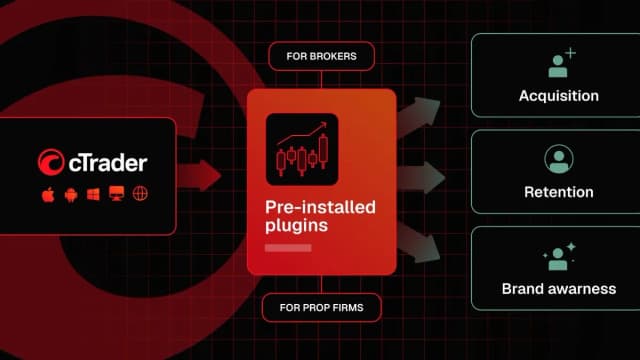
cTrader has opened multi-platform plugins to brokers and prop firms, which can pre-install their own tools for clients or list them in cTrader Store. The plugins run across Mobile, Web, Windows and Mac, and can be built and launched independently of core-platform releases, including trading journals and calculators.
Institutional brokerage and financial infrastructure provider Clear Street has joined TradingView’s broker network, allowing its clients to trade US stocks, exchange-traded funds and options directly through the charting and analysis platform.
Learn how to improve trading psychology, manage fear and greed, avoid revenge trading, and follow your trading strategy with discipline and a trading journal.
GTC Prime has announced a strategic partnership with Centroid Solutions to manage and distribute its liquidity through CS 360 Bridge, Centroid's multi-asset connectivity and execution engine, giving brokers and institutional clients access to tailor-made pricing, low-latency execution and real-time risk management.