just now


Liquidity Finder Ltd is incorporated in England and Wales, company number 10610740, registered address 167-169 Great Portland Street, Fifth Floor, London W1W 5PF, United Kingdom.
Published: just now


European Central Bank: How It Impacts Trading
The central bank manages the money supply for Eurozone countries.
Their main goal is maintaining a strict 2% inflation target.
They control the economy using three distinct interest rates.
Bond-buying programs heavily influence stock and real estate prices.
The European Central Bank is the main bank for the eurozone. This group includes all the European Union countries that use the Euro as their official cash. Their main job is to keep prices stable. They try to do this by keeping the eurozone inflation target right at 2%. Because they manage the money supply, their choices send shockwaves through global finance. You will see huge market swings when they act and shifts everything.
How does the European Central Bank affect trading?
When looking at the ECB trading impact, focus on their three main interest rates. These specific benchmark rates decide exactly how much credit costs for regular banks. That cost then trickles down to the rest of the everyday economy.
Deposit Facility Rate The interest earned on overnight deposits left with the ECB
Main Refinancing Rate The price banks pay to borrow money for one full week.
Marginal Lending Rate The total cost to borrow overnight credit from the bank.
Why do Press Conferences matter?
Markets often react more to what bank leaders say than what they actually do. After every Governing Council meeting, the president hosts a major press conference.
In order to predict the future course of interest rates, traders search for forward guidance signals. People are alerted to impending rate increases by a hawkish tone. A dovish tone suggests probability of cuts or a brief pause. Markets react fast.
Example below of 60-minute chart reaction of the pair EURUSD from the ECB Interest Rate Decision
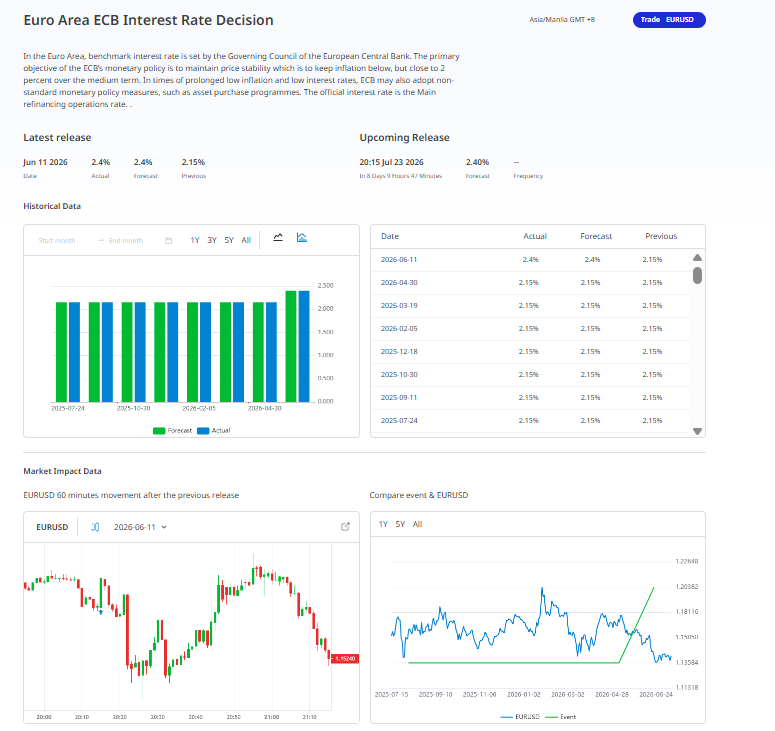
Source: Finlogix
What are unconventional tools used by the central bank?
Sometimes, traditional interest rate changes are just not enough to stimulate the broader economy. When this scenario happens, the massive bank pulls out unconventional tools to help fix things. The Asset Purchase Programme or APP is another great example. It adds liquidity.
They might also use the Pandemic Emergency Purchase Programme or PEPP to purchase bonds. Buying government or corporate bonds puts a lot more money into the global financial system. This action directly lowers long-term interest rates for everyone. Cash becomes lower value.
Market participants should track these large purchases since they can easily inflate asset prices. Purchasing bonds increases the total money supply. And because of this, stocks and real estate values can shoot up while the currency weakens. Watch the trends.
Trade ECB Events: Top Central Bank Strategies
Use volatility trading to catch wild price swings.
Follow new market trends when the central bank stance changes.
Watch for breakout strategies around key chart levels.
Watching the charts, major central bank updates always shake things up. Traders naturally expect huge jumps. If you want to trade ECB events successfully, you need a solid plan before the news hits.
Instead, you must rely on proven tactical approaches that easily handle rapid market shifts. During ECB announcement days, the overall reaction is often wild and completely unpredictable. Smart traders map out their moves long before the actual meeting starts. It pays to prepare.
By understanding the central bank's goals, you can spot amazing opportunities. A sudden policy surprise changes everything in a flash. The best traders use specific strategies to capture these fast moves.
How Do You Trade ECB Events With Volatility Strategies?
When the central bank speaks, the market often moves wildly and man experts rely on volatility trading because these announcements cause significant price swings. They employ a well-liked options strategy known as a Straddle. This limits directional risk.
In a straddle, you buy both a call and a put. This setup lets you to profit from immediate price movements regardless of the actual market direction. You do not have to guess if the asset will go up or down. The swing brings profits.
Why Is Trend Following Effective on ECB Announcement Days?
Sometimes, the meeting reveals a totally new central bank stance. Once the policy direction is clarified, traders can jump into positions that perfectly align with this new outlook. This approach is widely known as trend following. It captures ongoing momentum.
For example, the bank might intensify the market with a much more aggressive stance than anyone expected. When this happens, you might start EUR pairs for bullish to ride the upcoming wave. Following the new trend removes the guesswork from your daily chart analysis. Ride the big waves.
Wait-and-See Breakout Strategy: How to Trade the ECB
Avoid the early chaos of an ECB announcement by staying out of the market.
Chart the exact 15-minute high and low to build a reaction range.
Long the upside breakout or short the downside breakout to follow the trend.
Pair this with a Bollinger Band squeeze to ensure the move has real momentum behind it.
A hawkish approach is defined by higher rates and strict commentary from policymakers. Dovish talk brings rate cuts and softer language. Trying to predict these complex outcomes before they happen is incredibly hard. That is why I rely on the Wait-and-See Breakout strategy instead.
Rather than predicting the future, this simple approach lets the market reveal its direction first. You just wait as it completely removes the painful guesswork from trading central bank events. We let the massive institutional players show their hands before risking our own capital.
What is the Wait-and-See Breakout strategy for the ECB?
ECB announcement causes complete market chaos. Prices whip wildly back and forth. High-frequency trading algorithms always cause these unpredictable, crazy spikes on your charts. Stay safely out.
Step one is simply staying completely flat. You must not hold any open positions on the EUR/USD or other Euro pairs when the news actually hits. Note that the first ten minutes are just pure algorithmic noise.
How do you mark the reaction range?
After the initial volatility settles down, you can start charting. Look closely at your one-minute or five-minute timeframe (lower timeframes). You need to locate the specific High and Low prices that were established in the opening twenty minutes. Find those key boundaries that’s where you can draw your range price levels.
The High: Draw a line at the very peak of the initial upward spike.
The Low: Draw a line at the exact bottom of the initial downward drop.
When should you trade the breakout?
Once your marked range is set, the actual execution becomes crystal clear. You simply follow the immediate price movement to see where the market truly wants to go. This creates an objective map for your money. Use this basic formula.
Breakout Direction
If the price breaks above the High: This suggests the market interprets the news as bullish (positive Euro).
If the price breaks below the Low: This suggests the market interprets the news as bearish (negative Euro).
Follow the institutional momentum.
How do you manage risk when trading central bank events?
You have clear boundary levels. This brilliant setup makes risk management incredibly simple to handle. Place your stop-loss order safely on the exact opposite side of your marked range. If you placed at the High, your Stop always belongs below the Low. Protect your money first.
Setting your target is just as straightforward. A common rule is aiming for a profit target at least 1.5 times the size of your range. This keeps winning trades larger than losing ones.
The Wait-and-See Breakout strategy bypasses these scary early fake-outs. You absolutely do not need to be an expert to interpret complex central bank statements just watch the flow or direction movement instead. Let them move first!
What is the best tactic for extra confirmation?
Trading with Bollinger Bands is also a great ideas as these indicators pair wonderfully with this exact strategy setup. In the hour before the news, watch for the bands to pinch tightly on your chart. This severe contraction strongly signals a giant move. Squeezes build real energy.
Example below of 15-minute chart during ECB meeting held in June 11, 2026.
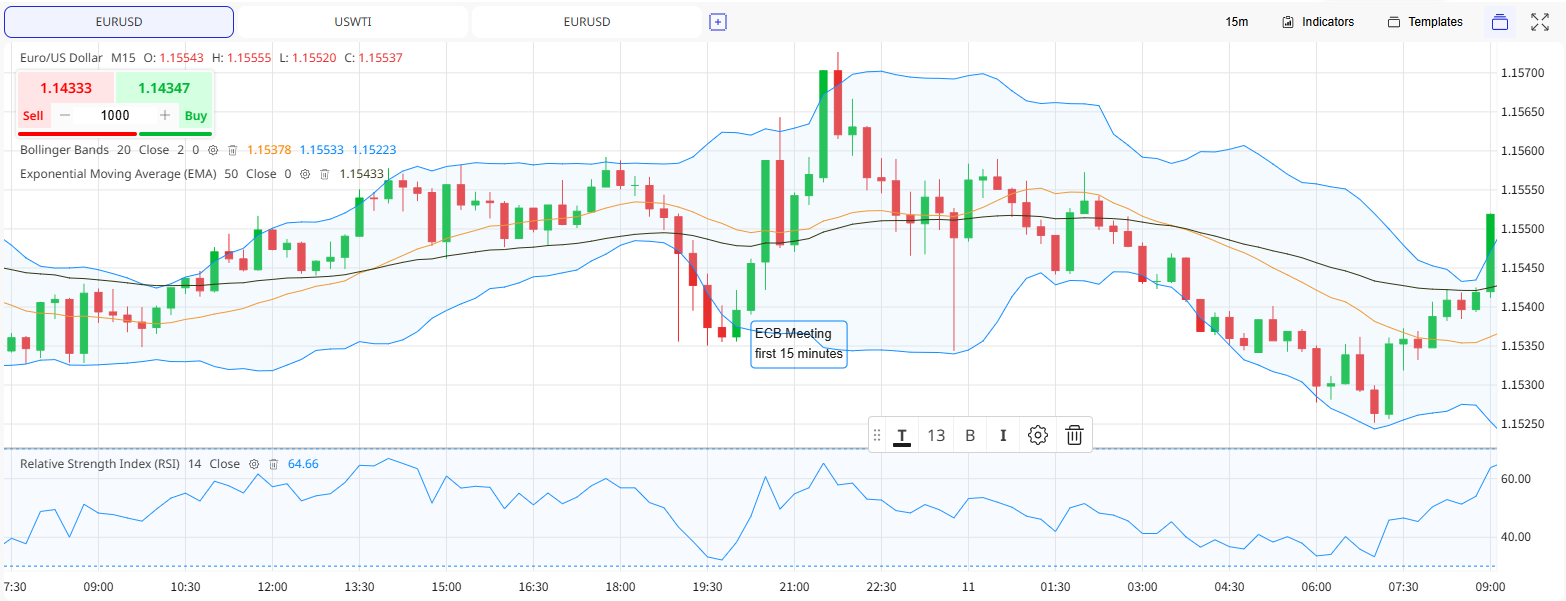
Source: ACY
Pairing these strategies creates a massive edge, using the squeeze to gauge if a breakout has the necessary fuel for a lasting trend. This trick prevents bad trades. Wait for the spark.
What Are the Best Breakout Strategies for Major Policy Surprises?
Before the meeting even begins, traders often identify key support and resistance levels on their favorite charts. These lines show where the price historically struggles to pass. A major policy surprise often triggers a massive breakout right through these exact zones. Watch those levels closely.
During a breakout, the price powerfully surges past the identified support or resistance levels. This sudden burst of speed is a major signal that a brand new trend is officially starting. This exciting method helps you catch a fast market move. Do not miss out.
Top-Down Confirmation Strategy: Trading Volatility
Use a 1-hour chart to identify the overall trend and major support/resistance zones before the news drops.
Wait out the initial 10-minute whipsaw on a 5-minute chart during the actual release.
Enter on a range breakout confirmed by RSI or Relative Strength Index (14) momentum in the direction of the higher time frame.
Place your Stop-Loss on the opposite side of the 10-minute range to strictly define your risk.
When you watch lower time frames like 1-minute or 5-minute charts during an ECB announcement, the price movements gets incredibly wild.
This method perfectly balances the need for fast decision-making with the safety of higher-level market trends. You definitely do not want to trade the noisy price spikes that fire off in the first few seconds of a release. Instead, use higher charts to set boundaries before sniping your entry.
What is a Top-Down Confirmation Strategy?
This setup requires you to look at a higher time frame before the actual event begins. You must identify if the EUR/USD is generally trending up or down to grasp the context.
You must find the closest major support and resistance levels to act as boundaries. If the price is miles away from these areas, you have plenty of room to trade the upcoming volatility safely. Be cautious near the lines.
How do you execute trades during ECB announcements?
When the news breaks, you drop down to your 5-minute chart. Let the market spike wildly in both directions for the first 5 to 10 minutes. You must wait out the initial whipsaw effect. Do not trade yet.
After the dust settles, identify the true direction. Watch for a clear breakout from the high and low established during those first 10 minutes. Confirm this momentum by checking the RSI (14) indicator and ensure it has a room.
Look for the price to break out in the same direction as the RSI. To ensure the move has momentum, avoid entering if the RSI is already at extremes (above 70 or below 30). It prevents bad entries.
What are the exact rules of engagement?
You need strict rules to survive. Following a rigid plan is the only way to conquer these volatile moments. You should enter only when the price closes outside the initial 10-minute range.
Follow these exact steps.
For Entry, enter exactly when the candle closes outside the 10-minute range in the direction of the 1-hour trend.
For Stop-Loss, position your stop-loss beyond the opposite boundary of the opening 10-minute range.
For Target Align with your exit strategy with the primary support or resistance zones mapped out on your 1-hour chart.
Why is this method best for trading high-volatility events?
This specific framework works beautifully because it reduces market noise. By forcing yourself to ignore the first 10 minutes, you avoid the most erratic price action entirely. High-frequency trading algorithms usually cause these massive early swings. It keeps you safe.
The Top-Down Confirmation Strategy is also deeply context-aware. By checking the 1-hour chart first, you ensure you never try to buy a dip in a strongly bearish market. Using the 10-minute range gives you an objective, mathematical place to put your stop-loss. This defines your risk.
Quick checklist for ECB days
Use an Economic Calendar to have facts when the Decision as the rates and the Press Conference as the rhetoric occur, as they are usually separated by 30 to 45 minutes.
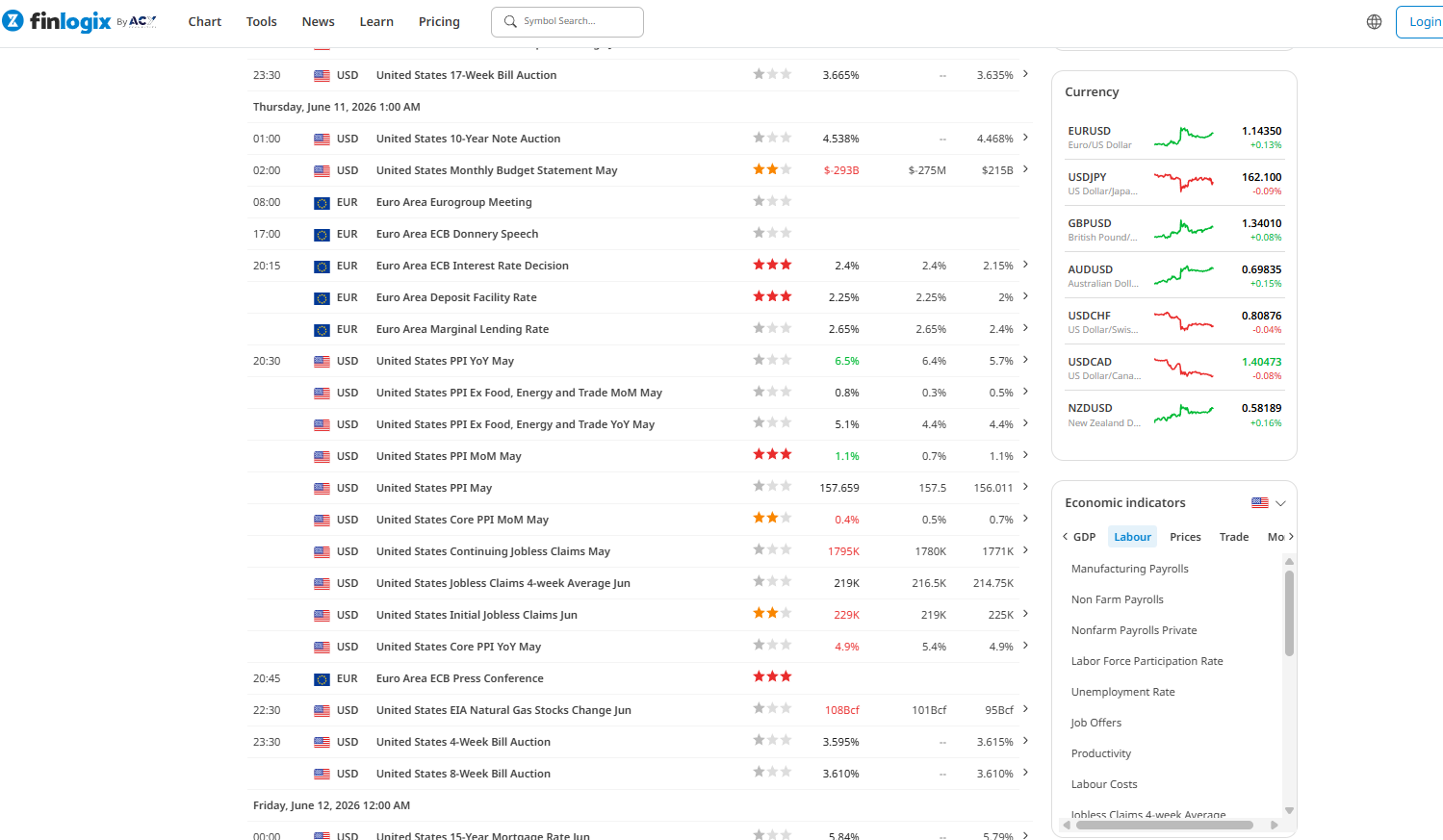
Source: Finlogix
The first few minutes of a major announcement, stop-losses might not be filled at the exact price requested because market liquidity evaporates.
Check the 1-hour trend before the news hits.
Abstain from the market for the first 10 minutes following a news release.
Trigger your trade only upon a breach of the 10-minute range, provided the 14-period RSI confirms the move has not reached an overbought or oversold extreme.
Set your stop-loss immediately upon entry.
Disclaimer: This content may have been written by a third party. ACY makes no representation or warranty and assumes no liability as to the accuracy or completeness of the information provided, nor any loss arising from any investment based on a recommendation, forecast or other information supplies by any third-party. This content is information only, and does not constitute financial, investment or other advice on which you can rely.
ACY Securities is one of Australia's fastest growing multi-asset online trading providers, offering ultra-low-cost trading, rock-solid execution, technologically superior account management and premium market analysis.

Select the categories and companies you wish to follow directly to your person rss feed.
Create Custom RSS FeedSign up and join over 5,000 professional members who receive personalized news alerts, curated professional connections, and more for free!
Bybit has launched Perp Options, described as the first options contracts built on TradFi perpetuals, giving traders round-the-clock access to US equity options. SpaceX and Nvidia are the first underlying assets, with USDT settlement and integration into Bybit's Unified Trading Account.
Use this trading preparation checklist to plan your session, define entry rules, manage risk, and build a disciplined trading routine in seven steps.
Your Bourse expands its crypto liquidity ecosystem with Caladan, giving brokers access to broader market coverage, institutional execution capacity and streamlined settlement.
Scope Markets, the retail brokerage part of Rostro Group, has appointed Ibrahim Hossny as Head of Research and Marketing for the Middle East and North Africa.
Hantec Prime, the institutional division of Hantec Markets, has reported trading volume up more than 300% year-to-date, alongside the addition of 42 new institutional clients since December, capping one of its strongest years of growth to date.
Learn how to refine XAUUSD support and resistance on the daily chart using candle bodies, market structure and weekly gold levels for swing trading. A slug alone cannot guarantee a top Google ranking. Keep it focused rather than adding every supporting keyword.
The week in Dubai will be focused on connecting directly with the industry and discussing how technology can help modern brokerages simplify operations, automate workflows, strengthen operational control, and scale efficiently.
Devexperts has launched a turnkey solution giving brokers in South Korea access to US equity markets, combining its DXtrade trading platform, dxFeed market data, and execution services. The offering targets South Korea's growing retail demand for US stocks, worth several billion USD monthly.
Assess why WTI crude oil surged past $105 per barrel amid Saudi pipeline disruptions, record tanker charter rates, and escalating geopolitical tensions.
Bitcoin price forecast: BTC/USD retests $78,460–$80,215 resistance. Watch bearish confirmation toward $72,480 or a bullish breakout toward $86,150.