just now

Liquidity Finder Ltd is incorporated in England and Wales, company number 10610740, registered address 167-169 Great Portland Street, Fifth Floor, London W1W 5PF, United Kingdom.
Published: just now
Most broker risk conversations start with the same cast of villains: latency arbitrageurs, scalpers, coordinated hedging rings, HFT strategies exploiting execution windows. The taxonomy is well-established. The detection logic is increasingly automated. The industry has spent years learning to identify flow it does not want.
The harder conversation is about flow brokers actively pursue.
Every broker wants profitable traders. They improve retention metrics, generate referrals, build the kind of track record that makes a brand credible. A client base with a visible percentage of winning accounts signals fair execution, good conditions, a trustworthy platform. Marketing wants them. Business development wants them. Sales wants them.
Risk management often does not have a view until it is too late.
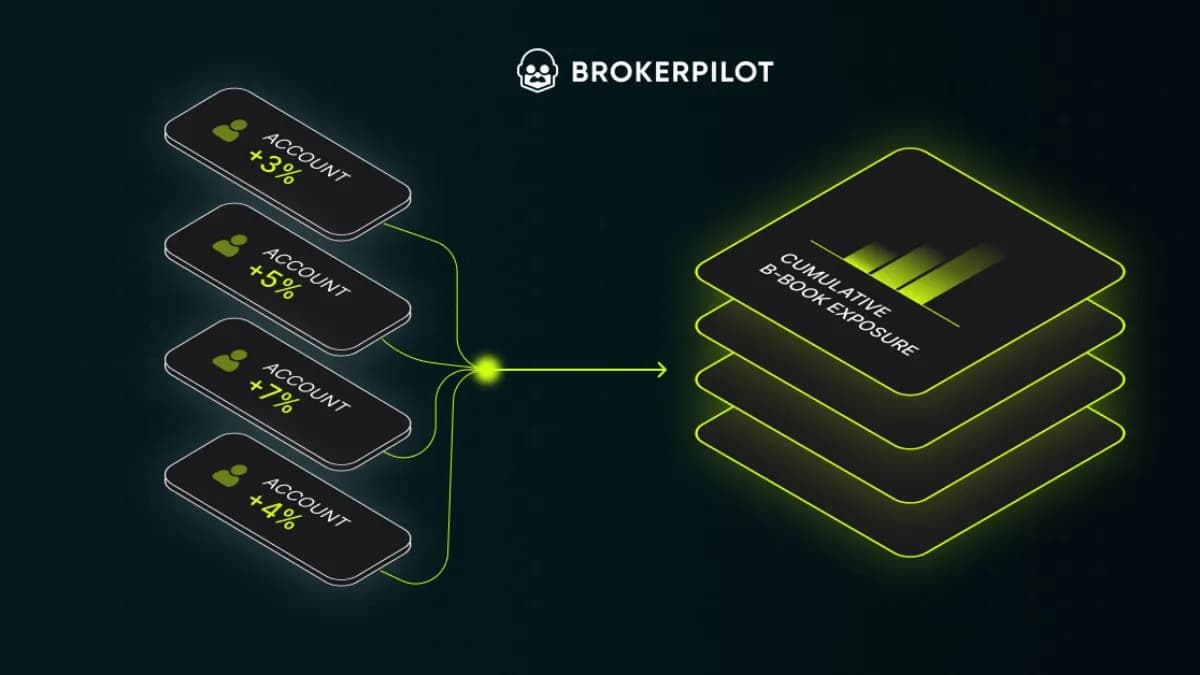
A B-book operates on a statistical principle: across a large enough population of retail traders, the majority will lose over time. The broker's margin comes from that spread of outcomes — not from any single account, but from the aggregate. The B-book is not a bet against any individual client. It is a position on a distribution.
Profitable traders break that distribution.
Not dramatically, not visibly, not in ways that trigger standard alert thresholds. They break it slowly, account by account, across quarters. A trader who generates consistent returns over six months on a B-book is not an anomaly to celebrate — from a risk architecture perspective, they are a structural drain that compounds without a natural ceiling.
The problem is not profitability itself. The problem is the combination of profitability, holding time, and instrument concentration that characterises informed or edge-driven flow. A retail trader who wins by luck will revert. A retail trader who wins by skill, timing, or access will not.
Most brokers cannot tell the difference in real time. They find out in the quarterly review.
This account trades frequently, holds positions for minutes to hours, and closes the majority with a gain. Drawdowns are shallow and short. Equity curves are smooth rather than volatile. On any standard CRM view, this is a model client — high activity, good retention, no complaints.
On a B-book, this account is extracting value systematically. The smoothness of the equity curve is the signal. Retail flow produces volatile equity curves. Informed or edge-based flow produces smooth ones. The distinction is visible in the data; it is rarely reviewed with the right question in mind.
This account is largely inactive between events, then enters positions in the minutes around scheduled data releases or central bank decisions. Win rate on these trades is high. Average holding time is short. The account looks dormant most of the time and profitable in concentrated bursts.
This pattern is not random. It reflects either a timing edge (fast data, co-location), a directional edge (macro positioning), or coordination with other accounts. All three create the same outcome for the broker: B-book exposure that moves against the house at exactly the moments when market conditions are already stressful.
This account holds positions for days or weeks, trades infrequently, and maintains a consistent win rate over months. From a dealing desk perspective, the exposure on any given day is modest. The positions are not large. There is no obvious manipulation. The account simply tends to be right.
The risk accumulates over time rather than in events. A broker running dozens of these accounts simultaneously — none individually alarming — is carrying a structural B-book imbalance that only becomes visible when the positions are marked to market collectively.
Risk monitoring is largely built to catch acute problems: sudden position concentration, rapid drawdown, correlated accounts entering simultaneously, execution anomalies that spike in real time. These systems are designed for events.
Profitable trader risk is chronic, not acute. It does not spike. It does not trigger thresholds. It accumulates in accounts that are operating within normal parameters by every standard metric — position size, leverage, frequency, instrument — while generating sustained directional pressure on the B-book that compounds silently.
The monitoring gap is not a failure of technology. It is a failure of the question being asked. Standard risk systems ask: is this account doing something unusual right now? The profitable trader question is: has this account's pattern of outcomes over the past 60 days indicated something about the quality of their flow?
These are different queries. The second requires account-level profitability analysis connected to routing decisions, not just exposure monitoring.
The obvious answer is reclassification: identify accounts with sustained profitability profiles and route them to A-book. This is correct in principle and operationally complex in practice.
A-book routing generates LP costs on every trade. For a high-frequency account, that cost is manageable per trade and material in aggregate. For an infrequent position trader, each trade carries a larger cost relative to volume. The reclassification calculus is not uniform across account types, and applying a blanket threshold — "all accounts profitable for 90 days move to A-book" — generates hedging costs on accounts that would have reverted naturally.
The precision required is not available through manual review. A dealing desk managing multiple server environments, monitoring open exposure, and responding to market events cannot simultaneously run profitability analysis at account level, weight it against routing cost projections, and make reclassification decisions on a rolling basis. It is not a capacity problem. It is a speed and data integration problem.
Brokers who manage this well share one operational characteristic: their risk system surfaces account-level profitability signals alongside exposure data, with routing recommendations that account for LP cost. The reclassification decision remains with the risk manager. The analysis that supports it does not arrive the following Monday.
The profitable trader problem is present in all market conditions. It becomes acute during volatility.
In Q1–Q2 2026 — EUR/USD moving 400 pips in a week, gold through $3,000, dollar weakness concentrated across a compressed timeframe — informed and edge-based traders perform disproportionately well. This is the environment their edges are designed for. They have been positioned for directional moves that materialise. Their accounts, already profitable, generate concentrated gains at exactly the moment the B-book is under stress from broader market exposure.
The compounding effect is not hypothetical. Brokers who entered April 2026 without account-level profitability monitoring were not just managing market volatility. They were managing it while carrying unquantified structural B-book exposure from the accounts they most wanted to keep.
The profitable trader is not the enemy. Many will eventually revert. Some will refer other clients. Some generate goodwill that has real commercial value. The goal is not to eliminate profitable accounts — it is to understand them clearly enough to route them correctly.
A trader generating consistent edge-based returns on a B-book is a loss-making relationship for the broker at the current routing. The same trader routed to A-book, at the right LP cost, becomes a sustainable one. The revenue model changes; the client relationship does not have to.
Brokers who have built this capability describe the shift in straightforward terms: the question changes from "how do we get rid of profitable traders" to "how do we know which profitable traders to keep on the book." The answer requires data that most brokers already collect, connected in ways most brokers have not yet built.
The risk management industry has developed strong frameworks for detecting and responding to overtly toxic flow. The profitable trader problem is different: it is structural, chronic, and built into the accounts a broker's own commercial strategy has worked to attract.
Solving it does not require a new category of risk tool. It requires connecting account-level profitability analysis to routing decisions, at the speed the book actually moves — not in the weekly review, not in the quarterly postmortem, but while the positions are open and the decision is still useful.
The brokers who have built this are not more sophisticated than their peers in most ways. They simply ask a different question about their best clients.
Brokerpilot provides real-time risk management and dealing desk automation for FX and CFD brokers on MT4, MT5, and cTrader — including consolidated account-level profitability monitoring across multi-server environments. Book a Presentation
Brokerpilot is a SaaS risk management platform for multi-asset brokers. It helps monitor trade servers, detect fraud, and automate reporting to enhance dealing transparency and operational control.

Select the categories and companies you wish to follow directly to your person rss feed.
Create Custom RSS FeedSign up and join over 5,000 professional members who receive personalized news alerts, curated professional connections, and more for free!
AUDJPY price forecast: Watch resistance at 110.045–110.403 for bearish rejection toward 109.283 or a bullish breakout targeting 111.550.
GER40 price forecast: DAX 40 tests 25,285–25,390 resistance. Explore bearish rejection, the neckline retest and bullish breakout confirmation.
NAS100 price forecast: Nasdaq 100 breaks above 30,750 after bullish weekly support rejection. Explore key levels, retest confirmation and downside risks.
XTB Institutional is heading to iFX EXPO Asia 2026 in Hong Kong. Meet the team at Booth #95 to discuss institutional liquidity, 24/7 market access and the latest trading conditions.
Profitable traders improve retention and brand credibility. They also break B-book distributions silently, over quarters. Most brokers find out too late.
Ondo Finance, a blockchain technology company focused on tokenising real-world assets, has announced Ondo Private Markets, a product offering tokenised exposure to privately held companies, beginning with an unnamed pre-IPO artificial intelligence company.
STARTRADER has launched 20 new Stock and ETF CFDs on MT5, tradable Monday to Sunday, with half listed in Seoul or Hong Kong. The additions focus on AI's physical infrastructure, covering HBM and DRAM supply chain names such as SK hynix and Hanmi Semiconductor, plus data-centre exposure through Cloudflare and Vistra.
IG Group has cut its 2026 revenue growth outlook after weaker revenue retention in its over-the-counter derivatives business outweighed growth in customer activity, putting the economics of its revised market-making approach in focus.
CME Group has withdrawn its filing to launch a 10-Barrel WTI Crude Oil futures contract that would have traded 24 hours a day, seven days a week. The exchange said industry participants were concerned that 24/7 energy trading could create unintended consequences without further due diligence.
Multibank FX aggregation service FXSpotStream reported a record average daily volume (ADV) of USD 179.118 billion for September 2026, replacing the previous high of USD 173.6 billion set in March this year.