just now


Liquidity Finder Ltd is incorporated in England and Wales, company number 10610740, registered address 167-169 Great Portland Street, Fifth Floor, London W1W 5PF, United Kingdom.
Published: just now


The U.S. dollar finds itself in the middle of a growing debate among global investors as President-elect Donald Trump’s economic and trade policies take centre stage. The key question is both simple and complex: Does Trump want a stronger or weaker dollar? His policy goals, rhetoric, and fiscal strategy paint a picture of conflicting objectives, leaving markets with more questions than answers.
Trump’s protectionist trade policies aim to reduce the U.S. trade deficit by discouraging global trade, a stance that could weaken the dollar in several ways. Historically, the dollar’s role as the world’s reserve currency has been bolstered by its central position in global trade. A protectionist tilt could dampen international demand for dollars, as fewer transactions flow through U.S. markets.
A weaker dollar could also support Trump’s efforts to boost American manufacturing and exports. A depreciated currency makes U.S. goods more competitive abroad, aligning with Trump’s narrative of rebuilding domestic industries and creating jobs in the manufacturing sector.
Yet, this approach comes with significant risks. A declining dollar would increase the cost of imports, fuelling inflationary pressures. With the U.S. already burdened by substantial fiscal deficits, a weaker dollar could exacerbate borrowing costs and complicate the financing of debt. Investors might demand higher returns to offset perceived risks, potentially creating headwinds for both private and public sectors.

On the other side of the coin, a stronger dollar could align with the U.S.’s heavy reliance on foreign capital. The country’s fiscal deficit, particularly under Trump’s anticipated spending policies, would require robust capital inflows. A stable or appreciating dollar would attract foreign investors seeking safe, high-return assets, ensuring the financing of U.S. obligations.
Moreover, a strong dollar could help contain inflation by keeping import prices in check. This would be particularly important if Trump’s fiscal policies stimulate economic activity to the point of overheating. A firm dollar would serve as a counterbalance, maintaining purchasing power and stabilizing consumer markets. You can check more about the USD HERE.
This inherent contradiction between Trump’s trade protectionism and his potential fiscal expansion leaves markets in a state of flux. On one hand, his policies suggest a structural depreciation of the dollar over time. Reduced global trade activity, coupled with potential capital repatriation trends in other regions, such as Europe, could weaken the currency's position.
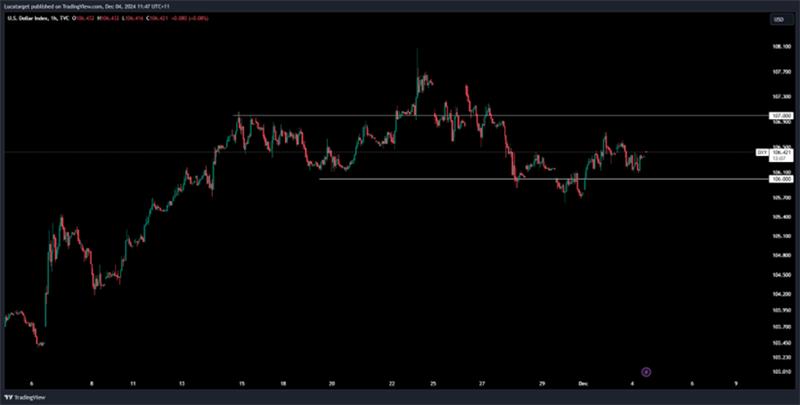
On the other hand, short-term capital inflows, driven by higher U.S. interest rates or growth premiums, could lend temporary support to the dollar. For now, the market seems to perceive the dollar as overvalued against major currencies, a position that could amplify its sensitivity to economic data surprises.
Investors will closely monitor the release of U.S. labour market data, including JOLTS job openings, and key speeches by Federal Reserve officials. While these events could shift short-term sentiment, the larger narrative will likely hinge on broader developments, including Trump’s fiscal strategy, international trade negotiations, and Federal Reserve policy.
Additionally, markets are already looking ahead to 2025, when portfolio and foreign direct investment flows might play a bigger role in shaping the dollar’s trajectory. For now, the interplay between Trump’s policy goals and macroeconomic fundamentals continues to fuel uncertainty.

The dollar’s direction in the coming months will depend on how Trump’s trade and fiscal policies reconcile—or fail to reconcile—their conflicting goals. A weaker dollar could provide a temporary boost to American exports and industrial output, but at the cost of inflation and higher debt-servicing costs. Conversely, a stronger dollar could stabilize inflation and attract foreign capital but may undercut Trump’s broader trade ambitions.
Ultimately, this policy tension underscores the challenges of balancing domestic and international economic priorities. As the world’s most traded currency, the dollar remains a barometer for global economic sentiment, and its path forward will likely have far-reaching implications beyond U.S. borders.
This content may have been written by a third party. ACY makes no representation or warranty and assumes no liability as to the accuracy or completeness of the information provided, nor any loss arising from any investment based on a recommendation, forecast or other information supplies by any third-party. This content is information only, and does not constitute financial, investment or other advice on which you can rely.
Why Is Forex Trading So Difficult?
How To Master MT4 & MT5 - Tips And Tricks For Traders
The Importance Of Fundamental Analysis In Forex Trading
Forex Leverage Explained: Mastering Forex Leverage In Trading & Controlling Margin
The Importance Of Liquidity In Forex: A Beginner's Guide
Close All Metatrader Script: Maximise Your Trading Efficiency And Reduce Stress
Best Currency Pairs To Trade In 2024
Forex Trading Hours: Finding The Best Times To Trade FX
MetaTrader Expert Advisor - The Benefits Of Algorithmic Trading And Forex EAs
ACY Securities is one of Australia's fastest growing multi-asset online trading providers, offering ultra-low-cost trading, rock-solid execution, technologically superior account management and premium market analysis.

Select the categories and companies you wish to follow directly to your person rss feed.
Create Custom RSS FeedSign up and join over 5,000 professional members who receive personalized news alerts, curated professional connections, and more for free!
CMC Markets has retired the CMC Connect name and will now present its institutional business as CMC Markets Institutional.
The SEC has approved Cboe's binary options tied to key performance indicators reported by 23 companies, covering more than 100 metrics such as iPhone revenue. The cash-settled contracts pay a fixed $1, Robinhood plans to be the first retail broker to offer them, and trading awaits clearing registration.
Gold is trading around $4,150, recovering sharply after falling to a recent low of $4,073.

Global semiconductor and technology stocks sold off sharply on Thursday, with South Korea’s SK Hynix plunging over 10% and Samsung Electronics falling more than 8%.
Learn gold market structure to identify bullish, bearish and ranging XAUUSD trends using higher highs, higher lows, lower highs and lower lows, support and resistance.
Axi has launched an MCP integration connecting eligible MT5 accounts to Claude, allowing clients to access live market data, track positions, execute trades and update risk parameters through the AI assistant developed by Anthropic. Available to eligible Axi clients with an active MT5 account. Setup runs via Claude.ai.
Movantis has selected Integral to extend its FX liquidity offering for institutional clients including banks, payment networks and digital asset operators, adding an institutional trading platform, direct-to-client API trading and API connectivity into a third-party multi-dealer venue, supporting regional expansion.
Running a venue around the clock is the easy part. Pricing risk when the market underneath it is shut is not. Lars Holst, CEO of GCEX explains how to manage risk in 24/7 markets.
ATFX has released its Q4 2026 Trader Magazine, offering a closer look at the macroeconomic and market forces that could shape trading conditions in the final quarter of the year.
LSEG has announced a collaboration with NVIDIA that lets financial institutions analyse years of LSEG Tick History data in seconds using NVIDIA cuDF on GPUs, without creating another full copy of the dataset. Tick History holds 110 trillion rows across 100 million instruments and more than 580 venues and contributors.