just now


Liquidity Finder Ltd is incorporated in England and Wales, company number 10610740, registered address 167-169 Great Portland Street, Fifth Floor, London W1W 5PF, United Kingdom.
Published: just now


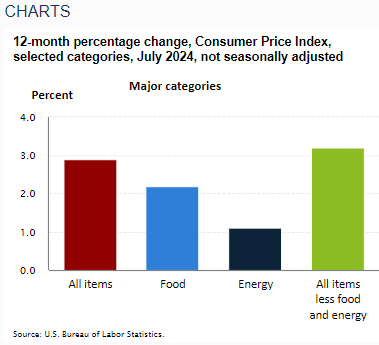
Yesterday (Wednesday 14/08/2024) at 10:30pm on Australia time, the U.S. Consumer Price Index (CPI) continued to exhibit signs of disinflation, aligning closely with market expectations. The headline CPI, which measures the overall change in consumer prices across various goods and services, recorded a modest month-over-month increase of 0.165%. This marked a recovery from the slight decline of -0.1% observed in the previous month. Meanwhile, the core CPI—which excludes the more volatile food and energy sectors—rose by 0.205% month-over-month, indicating a steady, albeit slow, increase in underlying inflationary pressures.
USA CPI

A detailed analysis of the CPI components reveals diverging trends within the core goods and services sectors. Core goods prices continued their downward trajectory, largely influenced by ongoing declines in used car auction prices. This trend reflects the easing of supply chain disruptions and a normalization of demand following the pandemic-era surge in car prices.
In contrast, core services prices saw a more pronounced increase of 0.3% month-over-month. This uptick was primarily driven by higher costs in shelter and recreational services, both of which play significant roles in the overall inflation picture. The rise in shelter costs, which includes rent and owners' equivalent rent, is particularly noteworthy, as it remains a significant contributor to the core CPI. However, this increase in services was somewhat tempered by a notable decrease in medical care costs, which provided a partial offset.
Overview of CPI Sectors
Looking Ahead:
Looking ahead, the disinflationary trend is expected to persist, especially in the rents and services sectors. Softer labour market conditions and a cooling housing market are likely to support this trend, as wage growth moderates and housing demand slows. However, the pace of decline in goods prices may begin to decelerate, especially as supply chains stabilize and pent-up demand is absorbed.
The latest CPI report has significant implications for monetary policy, particularly concerning the Federal Reserve's stance on interest rates. The sustained disinflationary environment bolsters the case for a potential interest rate cut by the Federal Reserve, possibly as early as September 2024. However, recent shifts in market sentiment suggest that expectations for a more aggressive 50 basis point cut have diminished. Instead, a more measured approach may be favoured, as policymakers weigh the risks of curbing inflation against the need to sustain economic growth.
Market Focus and Global Economic Indicators
As the market's focus broadens beyond inflation to include economic growth, upcoming labour market data will become increasingly critical. The strength of job creation, wage growth, and unemployment rates will play key roles in shaping the Federal Reserve's decisions in the coming months.
Furthermore, attention is also shifting to global economic conditions, particularly in China, where economic indicators for July 2024, such as retail sales and industrial production, are under scrutiny. These metrics are crucial for assessing the momentum of global economic growth, especially as China remains a major driver of global demand. Recent reports of soft credit growth in China have raised concerns about the need for further stimulus to support the country's economic recovery. Should China’s economy continue to falter, it could have ripple effects across global markets, potentially influencing the Federal Reserve’s approach to interest rates as well.
In summary, the July 2024 CPI report highlights the ongoing trend of disinflation in the U.S. economy, driven by complex dynamics within the core goods and services sectors. As the Federal Reserve navigates these trends, its policy decisions will be closely watched by markets, particularly in light of evolving labor market conditions and global economic developments. The coming months will be critical in determining whether the U.S. economy can achieve a balance between controlling inflation and sustaining growth.
This content may have been written by a third party. ACY makes no representation or warranty and assumes no liability as to the accuracy or completeness of the information provided, nor any loss arising from any investment based on a recommendation, forecast or other information supplies by any third-party. This content is information only, and does not constitute financial, investment or other advice on which you can rely.
Why Is Forex Trading So Difficult?
How To Master MT4 & MT5 - Tips And Tricks For Traders
The Importance Of Fundamental Analysis In Forex Trading
Forex Leverage Explained: Mastering Forex Leverage In Trading & Controlling Margin
The Importance Of Liquidity In Forex: A Beginner's Guide
Close All Metatrader Script: Maximise Your Trading Efficiency And Reduce Stress
Best Currency Pairs To Trade In 2024
Forex Trading Hours: Finding The Best Times To Trade FX
MetaTrader Expert Advisor - The Benefits Of Algorithmic Trading And Forex EAs
ACY Securities is one of Australia's fastest growing multi-asset online trading providers, offering ultra-low-cost trading, rock-solid execution, technologically superior account management and premium market analysis.

Select the categories and companies you wish to follow directly to your person rss feed.
Create Custom RSS FeedSign up and join over 5,000 professional members who receive personalized news alerts, curated professional connections, and more for free!
Bybit has launched Perp Options, described as the first options contracts built on TradFi perpetuals, giving traders round-the-clock access to US equity options. SpaceX and Nvidia are the first underlying assets, with USDT settlement and integration into Bybit's Unified Trading Account.
Use this trading preparation checklist to plan your session, define entry rules, manage risk, and build a disciplined trading routine in seven steps.
Your Bourse expands its crypto liquidity ecosystem with Caladan, giving brokers access to broader market coverage, institutional execution capacity and streamlined settlement.
Scope Markets, the retail brokerage part of Rostro Group, has appointed Ibrahim Hossny as Head of Research and Marketing for the Middle East and North Africa.
Hantec Prime, the institutional division of Hantec Markets, has reported trading volume up more than 300% year-to-date, alongside the addition of 42 new institutional clients since December, capping one of its strongest years of growth to date.
Learn how to refine XAUUSD support and resistance on the daily chart using candle bodies, market structure and weekly gold levels for swing trading. A slug alone cannot guarantee a top Google ranking. Keep it focused rather than adding every supporting keyword.
The week in Dubai will be focused on connecting directly with the industry and discussing how technology can help modern brokerages simplify operations, automate workflows, strengthen operational control, and scale efficiently.
Devexperts has launched a turnkey solution giving brokers in South Korea access to US equity markets, combining its DXtrade trading platform, dxFeed market data, and execution services. The offering targets South Korea's growing retail demand for US stocks, worth several billion USD monthly.
Assess why WTI crude oil surged past $105 per barrel amid Saudi pipeline disruptions, record tanker charter rates, and escalating geopolitical tensions.
Bitcoin price forecast: BTC/USD retests $78,460–$80,215 resistance. Watch bearish confirmation toward $72,480 or a bullish breakout toward $86,150.