just now


Liquidity Finder Ltd is incorporated in England and Wales, company number 10610740, registered address 167-169 Great Portland Street, Fifth Floor, London W1W 5PF, United Kingdom.
Published: just now

On July 16, 2025, the U.S. Bureau of Labor Statistics reported that the Producer Price Index (PPI) for final demand remained unchanged in June a notable surprise compared to the expected 0.2% rise.

This flat reading, following a revised 0.3% increase in May, reflects a complex interplay in the economy where elevated input costs due to import tariffs were offset by a weakness in services sector prices
The flat monthly change in PPI masks diverging trends: goods prices climbed by 0.3%, driven partly by tariff-related cost pressures, while services prices dipped 0.1%, reflecting weak demand in sectors such as travel, lodging, and automobile services.
The modest lift in goods prices was evident in categories like household furnishings, appliances, toys, and electronics segments directly affected by the import levies implemented earlier this year.
Conversely, service cost declines included a 2.7% drop in airline passenger prices and a 5.4% fall in automobile retail prices, as falling volumes pressured vendors to absorb cost increases.
On an annualised basis, PPI rose 2.3% year-over-year, down from May’s 2.7% pace, marking a nine-month low in wholesale inflation.
Core PPI excluding volatile food and energy also remained unchanged for the month, slowing to 2.6% y/y from 2.8%
This mixed reading highlights that while tariffs continue to exert upward pressure on goods prices, broader inflation dynamics remain subdued due to softer service demand.
Economists have noted that this "muted tariff effect" thus far suggests limited upside inflation risk but most caution that as tariff waves expand, inflation pressure could intensify
Financial markets responded positively to the cooler-than-anticipated data. Investors recalibrated expectations for Federal Reserve policy, maintaining a bias toward a pause in rate hikes and even potential cuts later in the year.
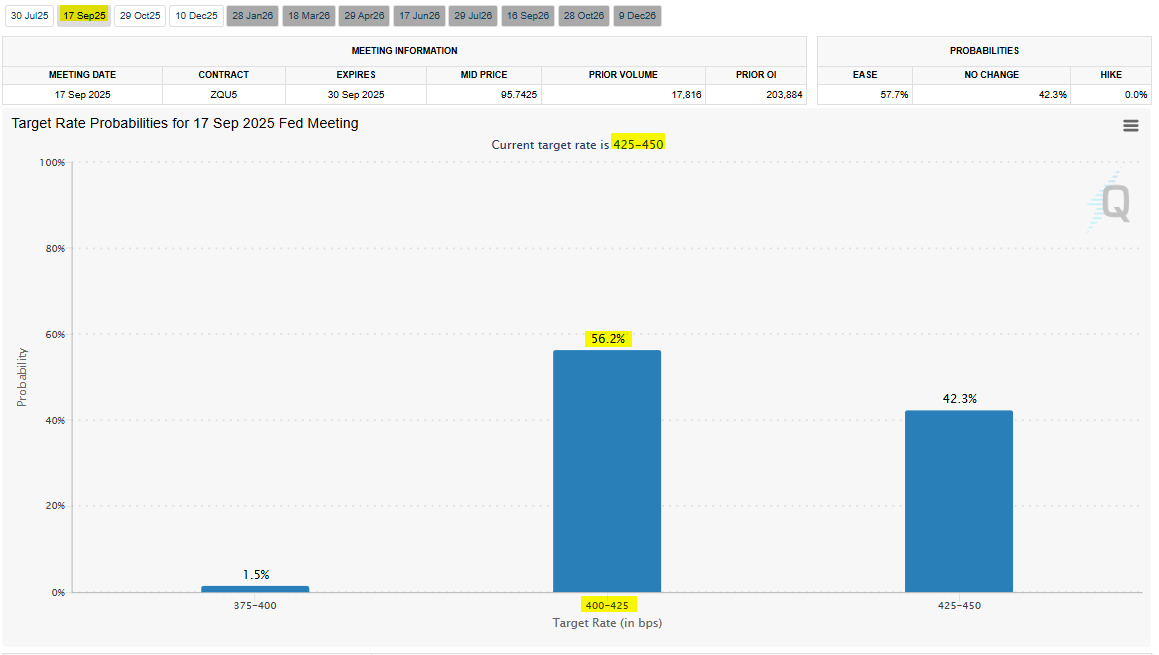
Indeed, futures markets are now pricing in a higher likelihood of Fed rate reductions beginning in September, contingent on continued inflation moderation and weakening labor data.
The Federal Reserve Beige Book, released alongside the PPI, painted a similar picture of rising economic activity tempered by growing input cost concerns and labor shortages tied to tariffs and policy changes.
Firms reported passing some costs onto customers but also expressed caution around future pricing capacity, especially as pre-tariff inventories are depleted.
The flat headline PPI reading in June, coupled with softening core inflation and continued weakness in services prices, provides the Federal Reserve with additional breathing room. Although the latest CPI report showed some firmness, the producer-side data tells a different story one of demand-side fragility that is beginning to outweigh supply-driven inflation, at least temporarily.
This dynamic is crucial because the Fed’s recent rhetoric has shifted to a more data-dependent, risk-balanced approach. With the PPI showing no monthly increase and core PPI decelerating to 2.6% on a year-over-year basis, policymakers are likely to interpret this as a sign that inflationary pressures particularly upstream are stabilizing.
The services sector, which accounts for a large portion of core PCE inflation (the Fed's preferred metric), is showing visible disinflation. Airline fares, retail margins, and hotel prices all components of service PPI declined in June, suggesting that price stickiness may be easing.
Market participants are increasingly pricing in a scenario where the Fed could initiate a rate cut as early as September (as shown on the image above), particularly if upcoming labor market data continues to soften and services inflation remains subdued.
Futures pricing currently reflects a roughly 65–70% probability of a cut before year-end, a sharp contrast to expectations earlier this year when persistent inflation risks dominated the outlook.
For the U.S. dollar, the implications are twofold. On the one hand, the stall in PPI reduces pressure on the Fed to maintain its hawkish stance, which in theory should weaken the greenback as interest rate differentials compress against peers like the ECB or BoE.
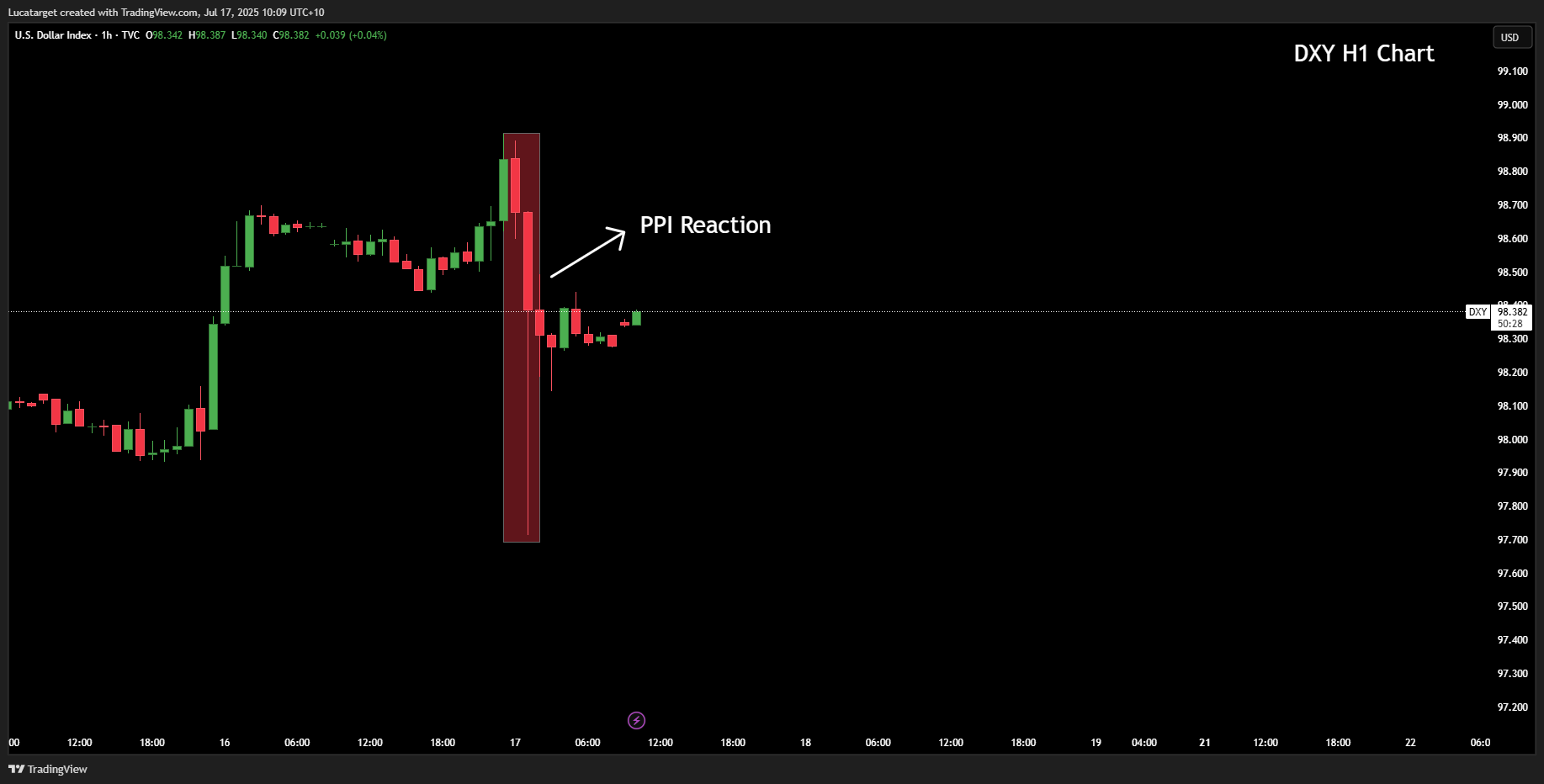
Indeed, the initial reaction in FX markets was mildly bearish for the USD, particularly against higher-yielding and inflation-sensitive currencies like the AUD and GBP.
However, this narrative is complicated by external factors such as sluggish European growth, political uncertainty in the UK, and ongoing yen weakness due to Japan’s yield curve control framework.
Ultimately, the dollar’s trajectory will hinge not just on the Fed’s next move but on relative economic strength and how other central banks respond to their own inflation challenges.
If the PPI trend persists and is confirmed by weaker CPI and labor market reports, the USD could enter a gradual softening phase, especially against EM and cyclical FX.
However, any resurgence in input costs due to tariff escalation or geopolitical tensions could reignite the inflation debate and delay the Fed’s easing path, providing renewed support to the dollar.
In short, the June PPI release does not singlehandedly dictate the Fed's next step, but it tilts the balance toward accommodation provided that downstream inflation and employment data align.
For dollar traders and rate strategists alike, this reinforces the importance of near-term data flow and global policy convergence in shaping market expectations.
Q1: What did the June 2025 U.S. PPI report reveal about inflation trends?
A: The June PPI showed no change on a month-over-month basis, coming in at 0.0% versus expectations of a 0.2% increase. On a year-over-year basis, headline PPI slowed to 2.3%, while core PPI (excluding food and energy) decelerated to 2.6%. This suggests that upstream inflation pressures are stabilizing, with goods prices rising modestly due to tariffs, while service sector prices declined, reflecting softer consumer demand.
Q2: How is the Federal Reserve likely to interpret the latest PPI data?
A: The flat PPI reading supports a more cautious and data-dependent approach from the Federal Reserve. With upstream price pressures appearing to moderate and services inflation showing early signs of softening, the Fed is less compelled to maintain a restrictive stance. This could open the door to a potential rate cut as early as September, especially if labor market and consumer price data continue to cool in the coming months.
Q3: Why did markets view the PPI data as dovish?
A: Markets interpreted the flat producer prices as a sign that inflation is not re-accelerating despite ongoing tariff pressures. This reinforced expectations that the Fed might have room to cut rates later this year. As a result, bond yields pulled back slightly and interest rate futures began pricing in a higher probability of easing, with traders now anticipating at least one 25bps cut before year-end.
Q4: What are the implications for the U.S. dollar?
A: A softer inflation backdrop reduces the urgency for the Fed to stay hawkish, which in turn lowers the interest rate premium supporting the dollar. The initial USD reaction was mildly bearish, particularly against higher-beta currencies. However, the broader FX impact remains conditional on how other central banks respond. If global peers remain dovish or face growth constraints, the dollar may hold up despite domestic easing.
Q5: Could tariffs still reignite inflation later this year?
A: Yes. While the current PPI suggests muted pass-through from tariffs, upcoming duties scheduled for August 1st on goods from Mexico, Japan, and the EU could eventually lead to higher input costs. If businesses begin to pass these costs on more aggressively especially once inventory buffers deplete both producer and consumer inflation could rebound, complicating the Fed’s path and reintroducing upside risks for the dollar.
This content may have been written by a third party. ACY makes no representation or warranty and assumes no liability as to the accuracy or completeness of the information provided, nor any loss arising from any investment based on a recommendation, forecast or other information supplies by any third-party. This content is information only, and does not constitute financial, investment or other advice on which you can rely.
ACY Securities is one of Australia's fastest growing multi-asset online trading providers, offering ultra-low-cost trading, rock-solid execution, technologically superior account management and premium market analysis.

Select the categories and companies you wish to follow directly to your person rss feed.
Create Custom RSS FeedSign up and join over 5,000 professional members who receive personalized news alerts, curated professional connections, and more for free!
Theorem has integrated Symbiotic’s Liquid Lane RFQ network, letting holders of tokenised real-world assets trade against on-chain pool liquidity and market-maker quotes. The integration is live on Ethereum, with Midas’s yield-bearing mHYPER fund as the first supported asset. Holders can trade for the USDC stablecoin.
US equities were volatile with technology selloff erasing much of the earlier rebound.
FM Summit London 2026 returns to Old Billingsgate on 24 November for its 15th edition, with LMAX Group, Plus500 and oneZero among confirmed exhibitors. The one-day event adds Business Connect meetings and roundtables, and opens with a networking evening at The Folly on 23 November.
Finance Magnates Summit London returns to Old Billingsgate on 24 November 2026 for its 15th edition. The one-day event brings together brokers, liquidity providers, institutional firms, trading technology vendors, payments businesses and digital asset firms.
iSAM Securities Apex has integrated with Match-Prime, giving brokers access to liquidity across more than 2,000 instruments, with tailored pricing and up to 10 levels of market depth.
propfunding.com's free-entry instant funding changes the order of prop funding. Start trading first. Its free-entry instant funding model offers two qualification attempts without an upfront activation fee.
US stocks closed higher on Wednesday, with the Nasdaq gaining 1%, the S&P 500 rising 0.6%, and the Dow advancing 0.7%, as renewed enthusiasm for AI-related stocks lifted market sentiment.
SpaceX went public in June as a rocket company. On October 20 it reported as something else entirely: an AI infrastructure business, financed by a satellite broadband network, with a launch division attached. Rockets generated 12% of third quarter revenue and lost money. The AI segment generated 52% of revenue and consumed 84% of capital expenditure. Starlink generated 85% of operating profit.
Standard Chartered has signed definitive agreements to acquire 100% of Zodia Custody UK Limited, folding its regulated digital asset custody business into Securities Services. Zodia Solutions will be set up under SC Ventures with bank investors including Northern Trust, NAB Ventures, Emirates NBD and Investcorp.
Bybit Fintech FZE has secured a Virtual Asset Service Provider licence from Dubai’s Virtual Assets Regulatory Authority for Exchange Services, covering spot trading. Bybit’s Peter Loo said the firm hopes to add derivatives, subject to regulatory approvals. Its international Dubai headquarters opened in 2022.