just now


Liquidity Finder Ltd is incorporated in England and Wales, company number 10610740, registered address 167-169 Great Portland Street, Fifth Floor, London W1W 5PF, United Kingdom.
Published: just now

I woke up today with the same question everyone in FX space is asking now: does yesterday’s "in-line" US CPI meaningfully change the dollar’s path, or did it simply clear the way for the market to refocus on policy and politics?
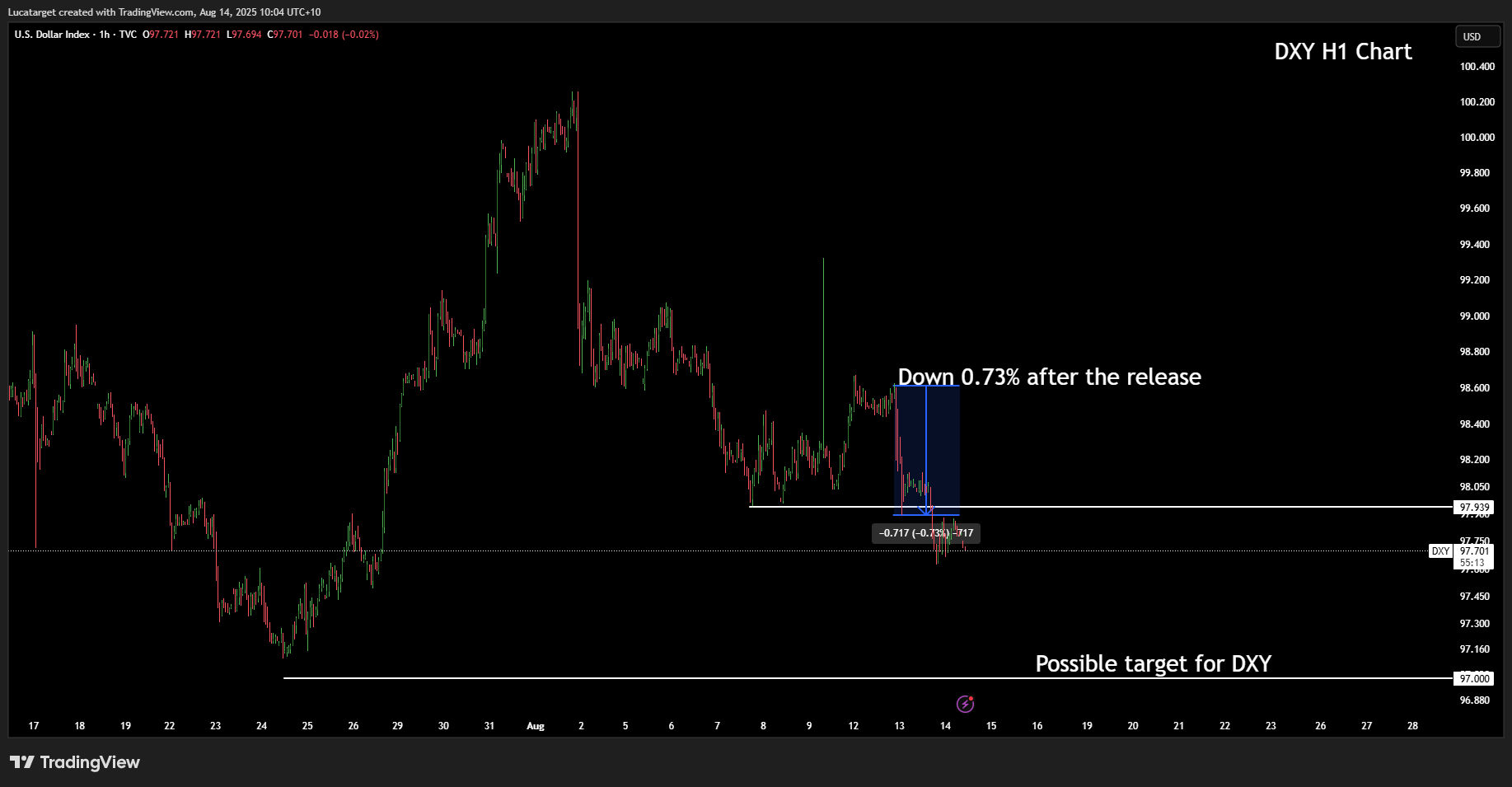
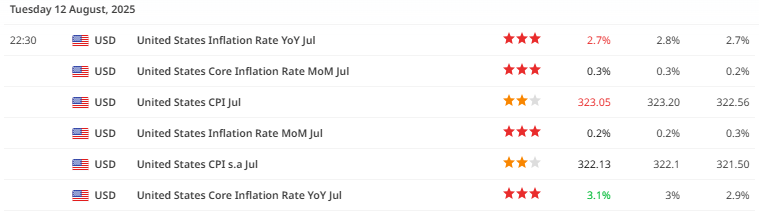
My base case is the latter. Headline CPI at +0.2% m/m and core at +0.3% m/m didn’t shock positioning; instead, it removed upside-inflation tail risk and put the spotlight back on the Fed’s reaction function and the political risk premium embedded in USD. That combination, policy glide path plus politics, will set the tone into the September FOMC.
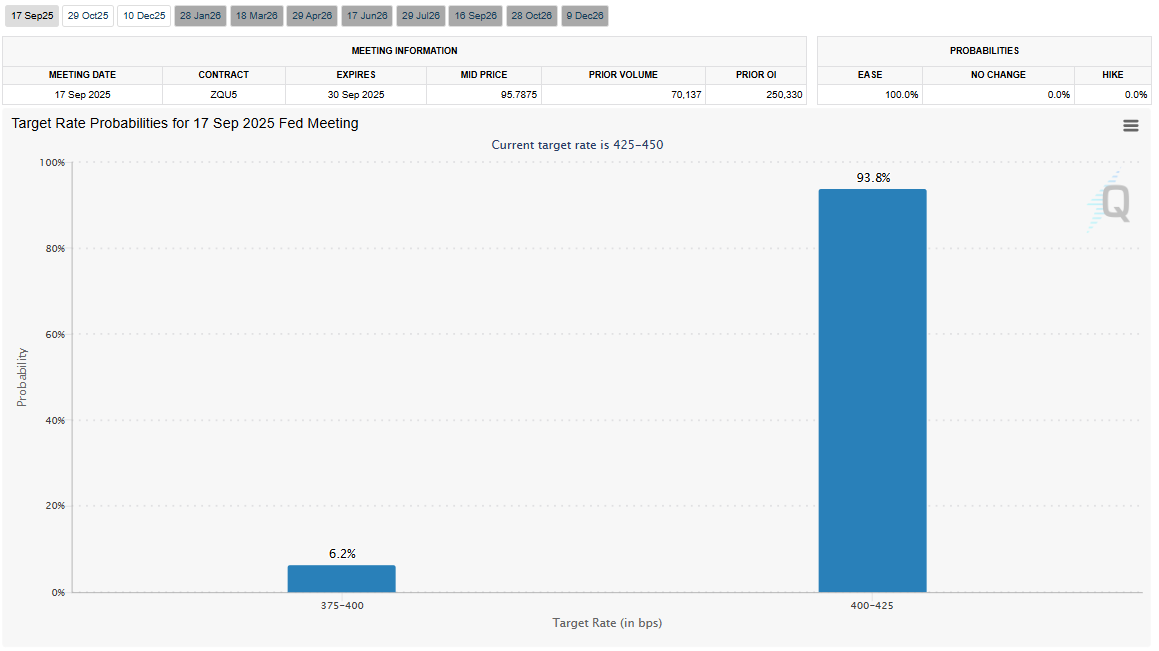
From a market-mechanics standpoint, the immediate effect has been straightforward: softer US front-end rates, firmer rate-cut pricing into September, and another test of support on broad USD indices. When CPI lands in line, the market hunts for the second-order drivers: the labor data trend, the composition of inflation under the surface, and the degree to which the Fed can ease without reigniting price pressures.
This is where the micro details matter. Core goods (ex-autos) cooled again, while core services showed a firmer monthly print, with airline fares rebounding and medical services firming, offset by further easing in shelter. That mix supports a “disinflation, not deflation” narrative: enough deceleration to validate gradual cuts, not enough softness to force emergency easing.
Policy communication risk is the second pillar. The market is now leaning toward at least a 25 bp cut by September, with scope for additional easing by year-end if labor slackening persists. What complicates the curve, and the dollar, are the political cross-currents around the Fed’s leadership and the data infrastructure (think: commentary about the BLS and the optics of personnel changes).
Regardless of one’s politics, the market reads these headlines through a single lens: institutional predictability. When predictability is questioned, the term premium on “policy noise” rises, and that can cheapen USD on a risk-adjusted basis even if macro prints are benign.
Where does that leave positioning? In my playbook, two things dominate the next two to four weeks:
First, the dollar as a funding currency. Implied volatility across G10 has drifted toward cycle lows, and carry is being rewarded again. That regime is fragile, it thrives on calm rates and narrow event risk windows, but while it persists, high-carry FX continues to attract flows at the dollar’s expense. I’m tactically respectful of that dynamic. I don’t need to love every carry expression; I just need to recognize that lower vol plus a clearer easing path is a tailwind for it.
Second, the composition of inflation. Shelter disinflation is doing work, but services ex-shelter is sticky. If September’s narrative is “growth cooling, inflation mixed, but trending lower,” the Fed has air cover to ease gradually. The risk to that story is a services-inflation surprise or a labor-market wobble sharp enough to re-price a larger cut in one meeting, which would shift the dollar’s reaction from “orderly drift” to “abrupt regime change.” I’m on watch for that asymmetry: benign data grinds USD lower; a downside labor shock cheapens the dollar faster; an upside services shock arrests the slide.
Tactically, here’s how I’m framing it for the days ahead:
I remain biased to sell USD strength into known supply zones rather than chase weakness. In practice, that means I prefer to fade relief rallies on US-centric headlines that don’t alter the rates path. The exception is if we get a credible upside surprise in services inflation proxies or a hawkish rhetorical pivot from key Fed speakers, particularly if it comes alongside a backup in front-end yields. In that scenario, I stand aside, because the market will quickly test whether the “carry + low vol” regime was over-owned.
Cross-sectionally, I’m selective. For higher-beta carry, I want confirmation from volatility: if front-end rate vol rises, I reduce exposure and favor quality carry (currencies with credible policy frameworks and cleaner external balances) over the highest nominal yields. Conversely, if vol stays muted, I’m comfortable letting winners run, but I rotate toward expressions with fundamental buffers, think pairs where disinflation is more advanced and current-account dynamics are not a headwind.
On the G3, I’m attentive to relative policy timelines. If the Fed leans into gradualism while other central banks are closer to terminal, or have already telegraphed a shallow easing path, the dollar’s cyclical premium can compress further without a dramatic macro shock. That doesn’t guarantee a one-way move, but it caps upside unless US growth materially re-accelerates. Put differently: without a growth surprise, the dollar needs inflation re-acceleration or policy hawkishness to sustain a durable rebound.
Risk management is the non-negotiable. This is a headline-sensitive tape, and the left-tail comes from politics as much as macro. I’m structuring exposure with optionality where possible, short-dated options financed by range trades in pairs I already like, so I can participate in the grind while being paid if the regime breaks. Into key speaker slots and data (Fed speakers, BoC deliberations, and the PCE deflator later this month), I scale, not swing. The goal is to be long convexity when the narrative changes, not after.
In-line CPI didn’t “save” the dollar; it removed a speed bump. The real drivers into September are (1) the credibility of a measured Fed easing path and (2) the market’s assessment of institutional predictability amid political noise. As long as volatility stays suppressed and the data allow the Fed to cut methodically, USD rallies are to be sold and carry remains supported. I’ll keep leaning into that regime, selectively, with tight risk, until the data or the policy signal tells me the story has changed.
Q1: How did the in-line US CPI print affect the USD?
A: The in-line CPI removed upside inflation tail risk and allowed markets to focus back on the Fed’s reaction function and political risk premium. This led to softer US front-end rates, firmer rate-cut pricing for September, and a test of support on broad USD indices.
Q2: Why is the Fed’s policy communication important now?
A: The market is leaning toward at least a 25 bp cut in September, but political noise and questions about institutional predictability can impact term premiums and risk-adjusted USD valuations, even without significant macro surprises.
Q3: What market dynamics are currently supporting USD weakness?
A: Low implied volatility and a clearer Fed easing path are encouraging carry trades, which are being funded partly by USD selling. This dynamic remains fragile and dependent on calm rates and narrow event-risk windows.
Q4: What are the main risks to the current USD drift lower?
A: A sharp services inflation surprise, a significant labor market downturn, or a hawkish Fed pivot could abruptly change the narrative, potentially ending the carry-friendly, low-volatility environment that is weighing on USD.
Q5: How is the current USD strategy framed?
A: The approach is to sell USD rallies into resistance zones while being selective in carry exposure. Positions are structured with optionality and scaled around key events to capture the grind lower while protecting against abrupt regime changes.
This content may have been written by a third party. ACY makes no representation or warranty and assumes no liability as to the accuracy or completeness of the information provided, nor any loss arising from any investment based on a recommendation, forecast or other information supplies by any third-party. This content is information only, and does not constitute financial, investment or other advice on which you can rely.
ACY Securities is one of Australia's fastest growing multi-asset online trading providers, offering ultra-low-cost trading, rock-solid execution, technologically superior account management and premium market analysis.

Select the categories and companies you wish to follow directly to your person rss feed.
Create Custom RSS FeedSign up and join over 5,000 professional members who receive personalized news alerts, curated professional connections, and more for free!
Multi-asset trading broker AvaTrade has agreed to acquire the majority of FXCM Group’s business and brand, in a transaction that would bring a longstanding retail FX franchise into the AvaTrade Group.
LSEG and CMC Markets have signed a multi-year strategic data agreement expanding CMC's access to LSEG's real-time and delayed pricing, reference and corporate actions data, news and analytics, plus AI-ready content, to support new products, entry into new markets and the growth of CMC's institutional and B2B partnerships.
The Tel Aviv Stock Exchange is considering a bid for the Cyprus Stock Exchange, with Israeli media citing its EU licence, trading platform and clearing house. Euronext’s Athens exchange and India’s National Stock Exchange are also seen as contenders, and Cyprus aims to sign a sale agreement by the end of this year.
CME Group will launch baseball futures on 12 October, pending regulatory review, tracking CME FutureSports Performance Indexes built on Official League Data. Standard and micro contracts will start with the 2026 Postseason and the four clubs in the League Championship Series, trading around the clock.
ESMA has published an opinion stating that MiCA-authorised crypto-asset service providers should cease services tied to non-MiCA-compliant stablecoins for EU clients across MiCA crypto-asset services. National authorities should require remediation of existing exposures within three months, by early January 2027.
Nasdaq Ventures has made a strategic investment in Amsterdam-based derivatives and crypto exchange One Trading, with both firms to explore 24/7 trading of equity futures. The undisclosed investment follows Nasdaq's US$100 million investment in Payward, the parent of Kraken, and CME Group's move to 24/7 trading.
cTrader has opened multi-platform plugins to brokers and prop firms, which can pre-install their own tools for clients or list them in cTrader Store. The plugins run across Mobile, Web, Windows and Mac, and can be built and launched independently of core-platform releases, including trading journals and calculators.
Institutional brokerage and financial infrastructure provider Clear Street has joined TradingView’s broker network, allowing its clients to trade US stocks, exchange-traded funds and options directly through the charting and analysis platform.
Learn how to improve trading psychology, manage fear and greed, avoid revenge trading, and follow your trading strategy with discipline and a trading journal.
GTC Prime has announced a strategic partnership with Centroid Solutions to manage and distribute its liquidity through CS 360 Bridge, Centroid's multi-asset connectivity and execution engine, giving brokers and institutional clients access to tailor-made pricing, low-latency execution and real-time risk management.