just now


Liquidity Finder Ltd is incorporated in England and Wales, company number 10610740, registered address 167-169 Great Portland Street, Fifth Floor, London W1W 5PF, United Kingdom.
Published: just now

(Guest Article written by Valentina Kirilova, Exness)
December 5, 2020 - When speaking about different nations, one must always have their culture in mind because it is one of the main characteristics that makes a nation unique. Ethnic make-up, social habits, language, religion, health, and education systems are just some of the differentiators that set one country’s culture apart from another. Each of these elements plays a particular part in the behaviour of the people within that culture, helping them make decisions about their food, career, fashion, as well as their investing approach.
An investor’s attitude to risk is usually associated with their wealth, job security, and inflation. Having this in mind, you might conclude that two people from entirely different cultures and countries will invest similarly if their economic situation is the same. And you would be right. The whole concept of investment starts within communities and individual households, built on the foundation of the societal norms that surround them and constitute the fabric of their culture.
A study by Mei Wang and Marc Oliver Rieger, professors in behavioural finance, shows that cultural background influences investment behaviour, even when inflation rates and wealth are taken into account.
According to Wang and Rieger, the more impatient the investors are, the higher the value premium in a country is. Russia and Romania, for example, are such countries. Anglo-Saxons are willing to pay more for equities. Traditionally some societies tend to be quite risk averse than others, which is reflected in the make-up of the overall economy. “Ego-traders” are usually situated in the United States. More patient ones live in Germany and the Nordics, where there are more value traders who prefer to wait for more significant returns.
People’s expectations and the idea of value or value creation have changed with time. Yet culturally, many societies still favour traditional investment tools as a way to preserve or create wealth.
The most historical of all emotional connections between cultures and specific asset classes is the one that exists with gold. The demand for gold trading has moved East over the last decade, and this is primarily due to the cultural affinity that exists between precious metal and countries such as India and China, where gold is considered one of the safest stores of value.
A lot of capital in India is stuck in hard assets because that’s the traditional and cultural mindset of the society there. The culturally defined beliefs in the country drive high demand for gold as an asset class, whether it is traded as physical gold or as a CFD (contract for difference) on the precious metal. This cultural affinity to gold is also similar in China. It is instrumental in the Lunar New Year, and 24-carat jewelry featuring the zodiac sign is frequently given as presents, both for its symbolism and centuries-old value.
Superstition is another emotional factor influencing the investment. In the Western world, stock market returns are always lower on Friday the 13th. A similar situation can be observed in East Asian cultures, primarily China, with the number four - investors avoid all sorts of trades on the fourth day of every month.
The coronavirus pandemic has already played out differently around the world according to individual cultures. The majority of investors globally have responded by increasing their trading activity significantly, not least because most people were quarantined at home for months, with more time on their hands to trade.
Multi asset broker Exness offers some products by region depending on geographic behaviour, popular asset classes, and even religion. Its swap-free trading accounts, for example, are explicitly created for traders of the Islamic faith. According to the Koran, they cannot take part in any trading activity that accumulates interest. These particular accounts, however, allow clients in some of Exness’s most essential regions to invest freely without compromising their faith.
According to Stanislav Bernukhov, market analyst at Exness:
“Though some specific behavioural patterns may be visible through different countries, the financial markets liberate people, allowing them to achieve success no matter what education or background one might have. Mr. Market doesn't care whether you hold a CFA license or graduated from the Ivy League - you just need to have the skills and knowledge which comes from persistent learning and usually has nothing to do with nationality.”
Investors don’t necessarily have something to learn from their counterparts in other countries, but understanding cultural differences in trading behaviour can certainly point them to opportunities they haven’t considered before.
We're the largest marketplace to connect with brokers, Fintech companies & digital asset firms. Want to partner? Let's get in touch.

Select the categories and companies you wish to follow directly to your person rss feed.
Create Custom RSS FeedSign up and join over 5,000 professional members who receive personalized news alerts, curated professional connections, and more for free!
Multi-asset trading broker AvaTrade has agreed to acquire the majority of FXCM Group’s business and brand, in a transaction that would bring a longstanding retail FX franchise into the AvaTrade Group.
LSEG and CMC Markets have signed a multi-year strategic data agreement expanding CMC's access to LSEG's real-time and delayed pricing, reference and corporate actions data, news and analytics, plus AI-ready content, to support new products, entry into new markets and the growth of CMC's institutional and B2B partnerships.
The Tel Aviv Stock Exchange is considering a bid for the Cyprus Stock Exchange, with Israeli media citing its EU licence, trading platform and clearing house. Euronext’s Athens exchange and India’s National Stock Exchange are also seen as contenders, and Cyprus aims to sign a sale agreement by the end of this year.
CME Group will launch baseball futures on 12 October, pending regulatory review, tracking CME FutureSports Performance Indexes built on Official League Data. Standard and micro contracts will start with the 2026 Postseason and the four clubs in the League Championship Series, trading around the clock.
ESMA has published an opinion stating that MiCA-authorised crypto-asset service providers should cease services tied to non-MiCA-compliant stablecoins for EU clients across MiCA crypto-asset services. National authorities should require remediation of existing exposures within three months, by early January 2027.
Nasdaq Ventures has made a strategic investment in Amsterdam-based derivatives and crypto exchange One Trading, with both firms to explore 24/7 trading of equity futures. The undisclosed investment follows Nasdaq's US$100 million investment in Payward, the parent of Kraken, and CME Group's move to 24/7 trading.
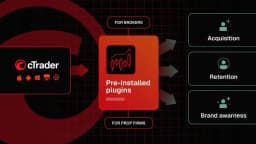
cTrader has opened multi-platform plugins to brokers and prop firms, which can pre-install their own tools for clients or list them in cTrader Store. The plugins run across Mobile, Web, Windows and Mac, and can be built and launched independently of core-platform releases, including trading journals and calculators.
Institutional brokerage and financial infrastructure provider Clear Street has joined TradingView’s broker network, allowing its clients to trade US stocks, exchange-traded funds and options directly through the charting and analysis platform.
Learn how to improve trading psychology, manage fear and greed, avoid revenge trading, and follow your trading strategy with discipline and a trading journal.
GTC Prime has announced a strategic partnership with Centroid Solutions to manage and distribute its liquidity through CS 360 Bridge, Centroid's multi-asset connectivity and execution engine, giving brokers and institutional clients access to tailor-made pricing, low-latency execution and real-time risk management.