
When traders request withdrawals, the speed and reliability of processing reveals more about your infrastructure than any marketing page ever could.
Introduction: I remember sitting with a broker who had just crossed 800 active clients. Everything looked healthy—solid liquidity feed, decent MT5 performance, growing IB network. Then the withdrawal requests started piling up on Fridays. What should have been a simple process turned into a weekend scramble of manual approvals, compliance checks, and frustrated support tickets.
That bottleneck wasn’t about client volume. It was about how the back office handled money movement. Automated payouts aren’t a luxury feature anymore. They’re the quiet infrastructure that either builds trust or quietly erodes it, especially as your brokerage or prop firm scales.
Operators who’ve run desks know this truth: clients forgive a few platform hiccups, but they rarely forgive slow access to their own funds.
The Real Pain of Manual Withdrawal Workflows
Picture this. It’s 4 PM on a busy trading day. Your compliance officer is reviewing documents for three separate withdrawal requests while the dealing desk handles a volatility spike. Each request needs verification against KYC records, balance confirmation in the broker CRM, risk exposure checks, and then manual initiation through different payment rails.
One delay leads to another. A high-value client waits four business days. Word spreads in trader communities. Suddenly your retention numbers dip even though your execution quality is strong.
For prop firms, the problem multiplies. Funded traders hit their profit targets and expect fast payouts as promised in the challenge rules. When those payouts drag, refund requests rise and your reputation as a reliable prop infrastructure provider takes a hit. Many founders underestimate how quickly operational friction in payouts can stall growth, especially after the initial hype phase.
Manual processes also create hidden costs—extra staff hours, error corrections, and the opportunity cost of time not spent on acquisition or product improvement.
What Automated Payouts Actually Mean in Practice
At its core, automated payouts connect your trading infrastructure, broker CRM, back office, and payment gateways so withdrawal requests move through defined rules with minimal human touchpoints.
This doesn’t mean zero oversight. Smart systems keep compliance, AML, and risk gates active. They automatically cross-check client profiles, trading history, and withdrawal patterns against your policies. Approved requests then route through integrated payment processors—bank transfers, e-wallets, or crypto rails—often within minutes or hours instead of days.
In an MT5 white label environment, this integration matters deeply. The platform already tracks real-time balances and positions. When your broker back office and liquidity bridge talk seamlessly to the payout layer, you avoid reconciliation nightmares. A request initiated from the client portal can pull verified data directly, apply your business rules, and execute without someone copying numbers between systems.
Prop firms benefit especially here. Automated profit-split calculations, drawdown validations, and scheduled payout cycles become reliable instead of manual spreadsheet exercises.
The Technology Layer That Makes It Scalable
Good automated payout systems sit at the intersection of several broker infrastructure pieces. They need clean APIs connecting to your MT5 white label, robust broker CRM for client data, and flexible liquidity bridge setups that don’t create settlement lags.
Scalability thinking starts early. Can the system handle 50 withdrawals a day or 500? Does it support multi-currency and multi-jurisdiction rules? How does it behave during high market volatility when both trading volumes and withdrawal requests spike together?
Reporting becomes critical too. You want dashboards that show payout velocity, approval rates, common rejection reasons, and average processing times. These insights help you refine rules and spot potential issues before they affect client experience.
Security and compliance workflows must be baked in—proper segregation of funds, audit trails, and configurable risk thresholds. The best setups allow operators to maintain control without becoming the bottleneck themselves.
How Automated Payouts Shape Business Outcomes Fast, reliable withdrawals directly influence client lifetime value. Traders who can access profits quickly trade more confidently and stay longer. For prop firms, smooth payouts reinforce the credibility of your funded account programs.
On the operational side, automation frees your team from repetitive tasks. Compliance staff shift from processing routine requests to handling exceptions and deeper reviews. This improves both efficiency and risk management.
Launch speed also improves. When your infrastructure provider delivers connected modules—trading platform, CRM, payments, and back office—new brokers reach revenue faster without stitching fragile custom integrations.
Long-term, it affects your regulatory posture. Clean, documented, automated workflows make audits smoother and demonstrate operational maturity to partners and regulators.
What Experienced Operators Look For
When evaluating payout capabilities, focus on a few practical areas:
- Native integration depth with your core platforms (MT5, CRM, risk tools)
- Configurable rule engine for different client segments and business models
- Multi-rail payment support with transparent settlement times
- Real-time monitoring and exception handling workflows
- Detailed audit logs and compliance reporting
- Ability to test payout scenarios during onboarding
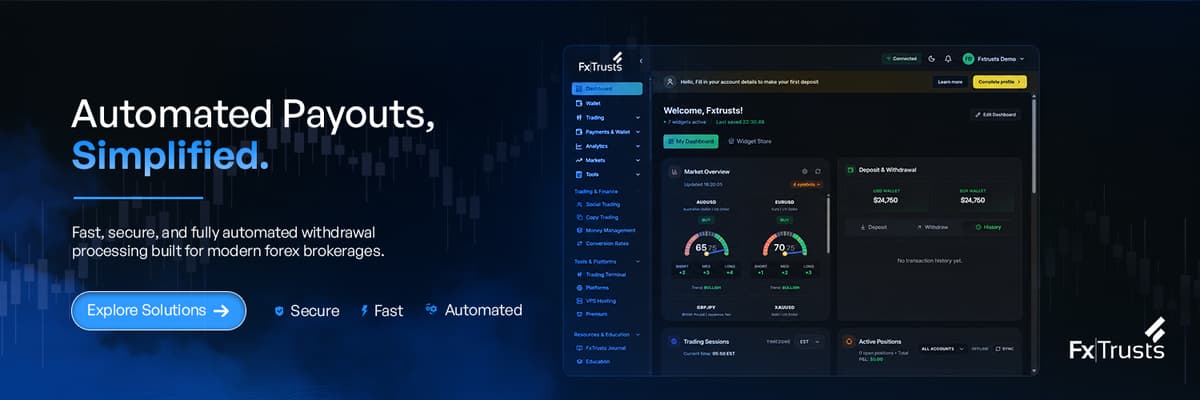
Infrastructure providers such as FXTrusts are usually evaluated not only for the platform layer, but also for how CRM, liquidity bridge, and back-office workflows fit together.
Conclusion: Automated payouts may not be the flashiest part of building a brokerage or prop firm, but they often determine how sustainable your growth becomes. In an industry where trust is measured in execution quality and fund accessibility, hidden friction in withdrawals creates unnecessary risk.
The operators who treat payouts as core infrastructure rather than an afterthought tend to build more resilient businesses. They move faster, retain clients better, and spend less time firefighting operational issues.
The real question isn’t whether you can add automated payouts later. It’s whether your current setup is quietly costing you clients and momentum you can’t afford to lose.