just now

Liquidity Finder Ltd is incorporated in England and Wales, company number 10610740, registered address 167-169 Great Portland Street, Fifth Floor, London W1W 5PF, United Kingdom.
Published: just now
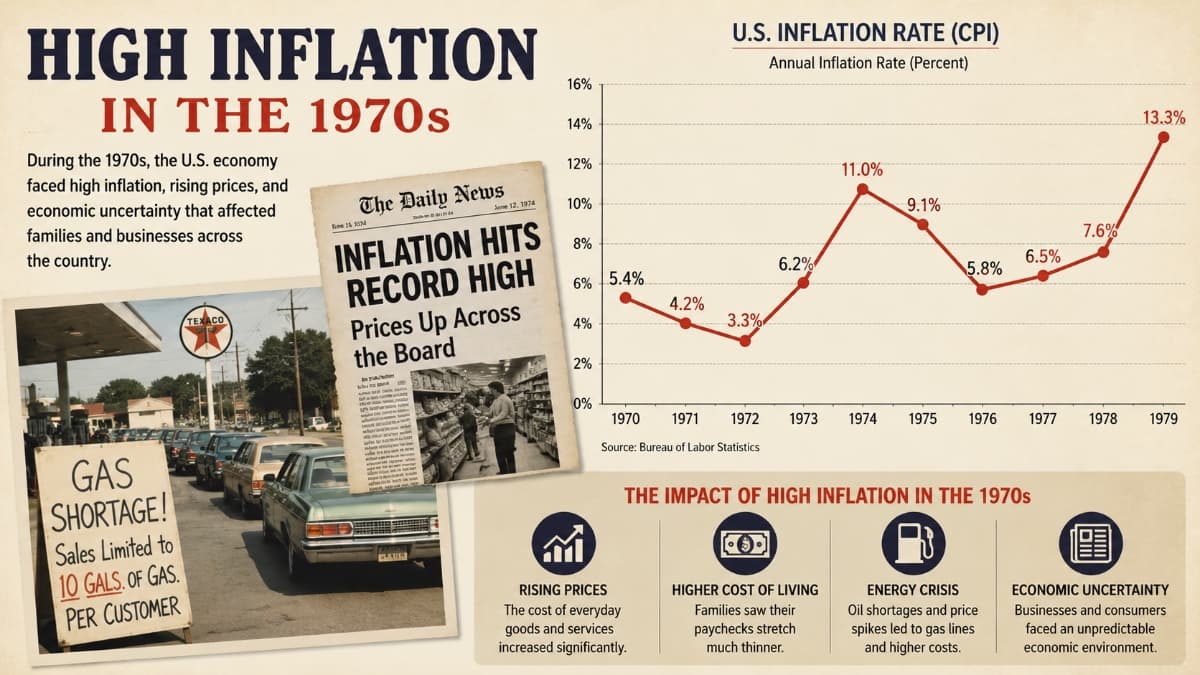
The bond market has pulled off one of the sharpest narrative reversals in recent memory. A market that began the year confidently pricing rate cuts is now openly flirting with the prospect of rate hikes — and Treasury yields have moved accordingly. The 10-year is pressing the upper end of its 2026 range around 4.55–4.62%, the 30-year has punched above 5%, and the 2-year has reclaimed the 4% handle.
The catalyst is inflation that simply refuses to behave. April CPI came in at 3.8% — the hottest reading in nearly three years — with energy alone accounting for roughly 40% of the increase, alongside firmer shelter and food prices. The energy shock stemming from the conflict in the Middle East and the disruption around the Strait of Hormuz is now feeding directly into consumer prices, and that is exactly the kind of supply-driven inflation a central bank struggles to contain. With a hawkish-leaning Fed under new leadership and a deeply divided FOMC, the market has shifted from asking when the next cut comes to pricing a meaningful probability of tightening before year-end.
That backdrop sets the tone for the week ahead — and the data on the docket has the potential to pour fuel on the fire.
In a holiday-shortened week, with US markets closed Monday for Memorial Day and liquidity thin into the open, the main macro story will be tied to the April personal income and spending report. Headline spending will be lifted by higher gasoline prices, but otherwise we are likely to see some weakness in an environment where consumer sentiment is so depressed. We already know that auto sales fell and retail sales in general were mixed. The softness in service sector surveys also hints at subdued spending.
The report also includes the Fed's favoured measure of inflation, the core PCE deflator. It is expected to show prices rising 0.3% MoM versus the 0.4% MoM increase seen in core CPI. That is because some of the components, such as airline fares and medical care costs, are more closely aligned with the PPI metrics for those components, while weaker stock markets will depress the portfolio fees component. This will do little to ease inflation concerns in an environment where freight costs are rising appreciably in response to higher motor fuel costs. There are several Fed speakers scheduled too, and they are likely to sound quite hawkish, which will keep the market leaning in the direction of possible rate hikes over the coming 18 months.
Monday 25 May — Memorial Day. US markets closed. Expect thin, headline-driven trade across the globe.
Tuesday 26 May — Conference Board Consumer Confidence (the week's first read on whether depressed sentiment is stabilising), Durable Goods Orders, FHFA House Price Index, and the Dallas Fed Manufacturing Index.
Wednesday 27 May — MBA Mortgage Applications and the FOMC Minutes, which will be scoured for how seriously policymakers are entertaining a shift in the direction of the next move.
Thursday 28 May — Q1 GDP (second estimate), weekly Initial Jobless Claims, and Pending Home Sales.
Friday 29 May — The main event: April Personal Income & Spending and the core PCE deflator, alongside the Chicago PMI and the final University of Michigan Consumer Sentiment print.
The risk is asymmetric. A firm core PCE lands in an already nervous market and hands the hawks fresh ammunition; only a clear downside surprise would meaningfully challenge the rate-hike narrative now embedded in the curve.
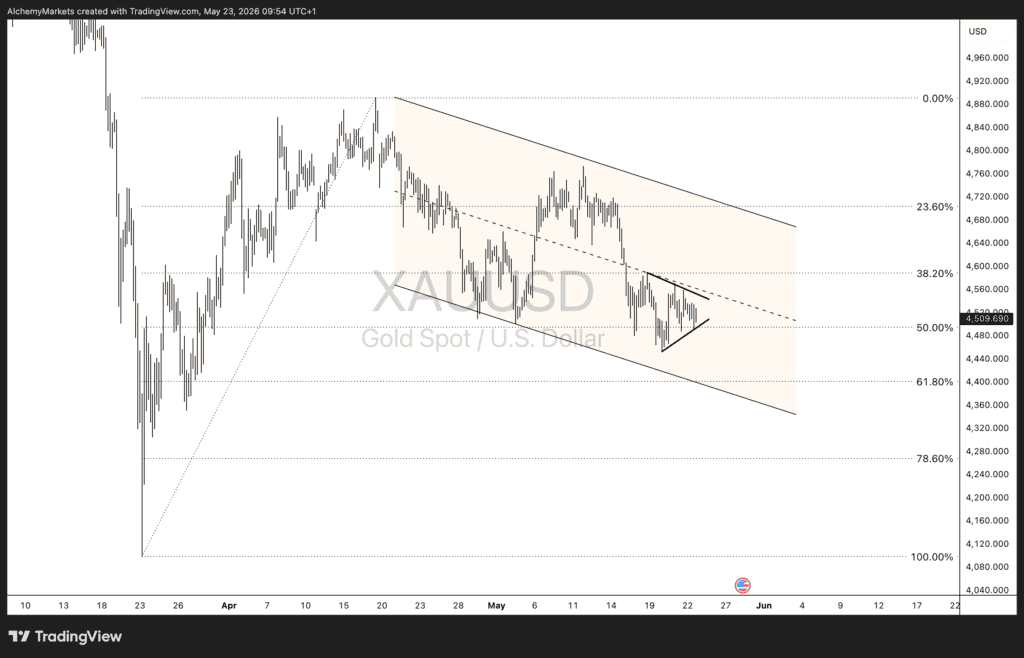
Gold has spent the past month grinding lower after topping out near $4,890, and the technical structure now mirrors the macro pressure. Price has retraced the prior advance back into the 50% Fibonacci zone around $4,495, with spot sitting just above it at roughly $4,510. The decline has been orderly, contained within a well-defined descending channel, and the latest price action has coiled into a small triangle as the market consolidates ahead of the data.
The setup is poised. A downside break of that triangle would open the door toward the 61.8% retracement near $4,400, a level that lines up neatly with the lower boundary of the descending channel — a confluence that makes it the natural magnet on a break lower. That technical picture sits hand-in-glove with the fundamentals: a hawkish Fed, higher real yields, and a firm dollar are a textbook headwind for a non-yielding asset, and a hot core PCE on Friday would be the obvious trigger.
To the upside, the 38.2% retracement around $4,590 caps the immediate recovery, with the channel top and the 23.6% level near $4,705 the bigger hurdle. A decisive break back above the channel would neutralise the bearish structure — but for now, the path of least resistance, on both the chart and the macro, points lower.
Alchemy Markets is a multi-asset brokerage providing retail traders with the same elite trading conditions, tools, and transparency typically reserved for institutions.

Select the categories and companies you wish to follow directly to your person rss feed.
Create Custom RSS FeedSign up and join over 5,000 professional members who receive personalized news alerts, curated professional connections, and more for free!
Multi-asset trading broker AvaTrade has agreed to acquire the majority of FXCM Group’s business and brand, in a transaction that would bring a longstanding retail FX franchise into the AvaTrade Group.
LSEG and CMC Markets have signed a multi-year strategic data agreement expanding CMC's access to LSEG's real-time and delayed pricing, reference and corporate actions data, news and analytics, plus AI-ready content, to support new products, entry into new markets and the growth of CMC's institutional and B2B partnerships.
The Tel Aviv Stock Exchange is considering a bid for the Cyprus Stock Exchange, with Israeli media citing its EU licence, trading platform and clearing house. Euronext’s Athens exchange and India’s National Stock Exchange are also seen as contenders, and Cyprus aims to sign a sale agreement by the end of this year.
CME Group will launch baseball futures on 12 October, pending regulatory review, tracking CME FutureSports Performance Indexes built on Official League Data. Standard and micro contracts will start with the 2026 Postseason and the four clubs in the League Championship Series, trading around the clock.
ESMA has published an opinion stating that MiCA-authorised crypto-asset service providers should cease services tied to non-MiCA-compliant stablecoins for EU clients across MiCA crypto-asset services. National authorities should require remediation of existing exposures within three months, by early January 2027.
Nasdaq Ventures has made a strategic investment in Amsterdam-based derivatives and crypto exchange One Trading, with both firms to explore 24/7 trading of equity futures. The undisclosed investment follows Nasdaq's US$100 million investment in Payward, the parent of Kraken, and CME Group's move to 24/7 trading.
cTrader has opened multi-platform plugins to brokers and prop firms, which can pre-install their own tools for clients or list them in cTrader Store. The plugins run across Mobile, Web, Windows and Mac, and can be built and launched independently of core-platform releases, including trading journals and calculators.
Institutional brokerage and financial infrastructure provider Clear Street has joined TradingView’s broker network, allowing its clients to trade US stocks, exchange-traded funds and options directly through the charting and analysis platform.
Learn how to improve trading psychology, manage fear and greed, avoid revenge trading, and follow your trading strategy with discipline and a trading journal.
GTC Prime has announced a strategic partnership with Centroid Solutions to manage and distribute its liquidity through CS 360 Bridge, Centroid's multi-asset connectivity and execution engine, giving brokers and institutional clients access to tailor-made pricing, low-latency execution and real-time risk management.