
Since publishing our latest prediction markets report, we've had some great conversations about the challenges of operating across different jurisdictions. One question came up repeatedly: What happens when a market is global, but local access becomes a regulatory problem?
Brazil offers an interesting case study.
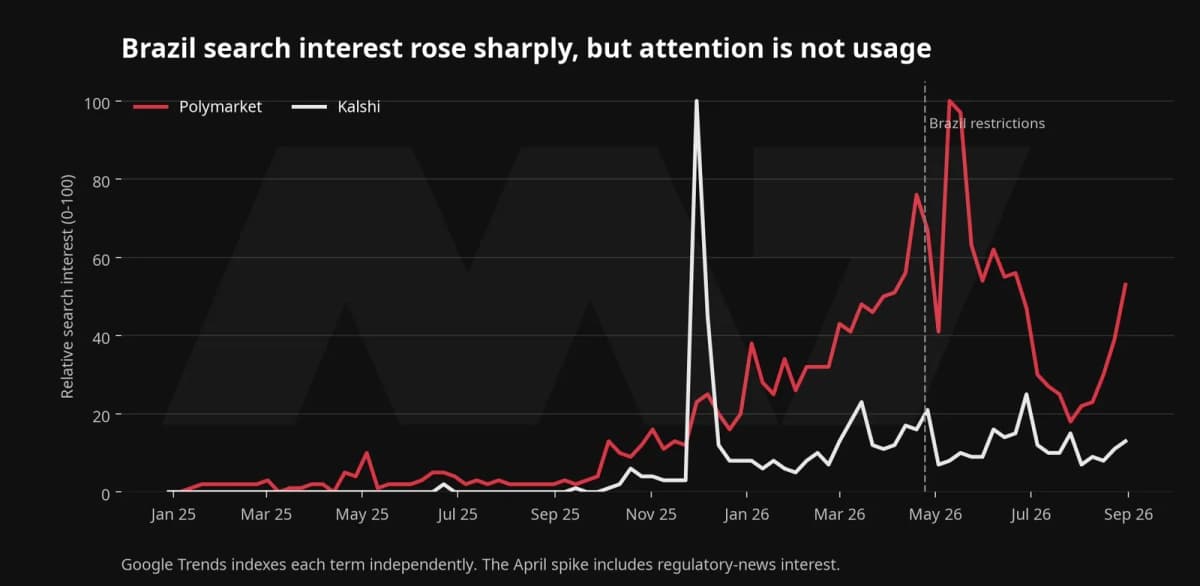
The chart below shows relative search interest for Kalshi and Polymarket in Brazil. It offers a snapshot of how attention can persist even when local distribution becomes a regulatory challenge.
In April 2026, Brazil’s Secretariat of Prizes and Bets (SPA) analyzed prediction-market platforms offering contracts on real sporting events and other non-economic-financial events. It suggested blocking Brazilian access to platforms within that scope.
The important distinction is that this was not a universal ruling on every prediction-market contract design. It was a proposed restriction on local access to platforms within that scope. This makes the situation more complex than a simple “banned or not banned” story.
The remaining questions are:
- What contracts can be listed?
- How can users be onboarded, funded, and supported?
- What can be marketed, and to whom?
- How does the customer journey change across jurisdictions?
For prediction markets, regulation can shape the inventory, access, and customer journey from the start. And this is where the broader opportunity becomes interesting.
Prediction markets are a new form of event-based futures trading. The event contract headline only tells part of the story.
The complexity lies in the infrastructure behind the contract, which includes market access, liquidity, clearing, distribution, compliance, and customer acquisition. It's important to note that global attention does not automatically translate into global trading access.
Thanks to everyone who read our latest report and sent thoughtful questions.
Read the full report: merchantseven.com/research