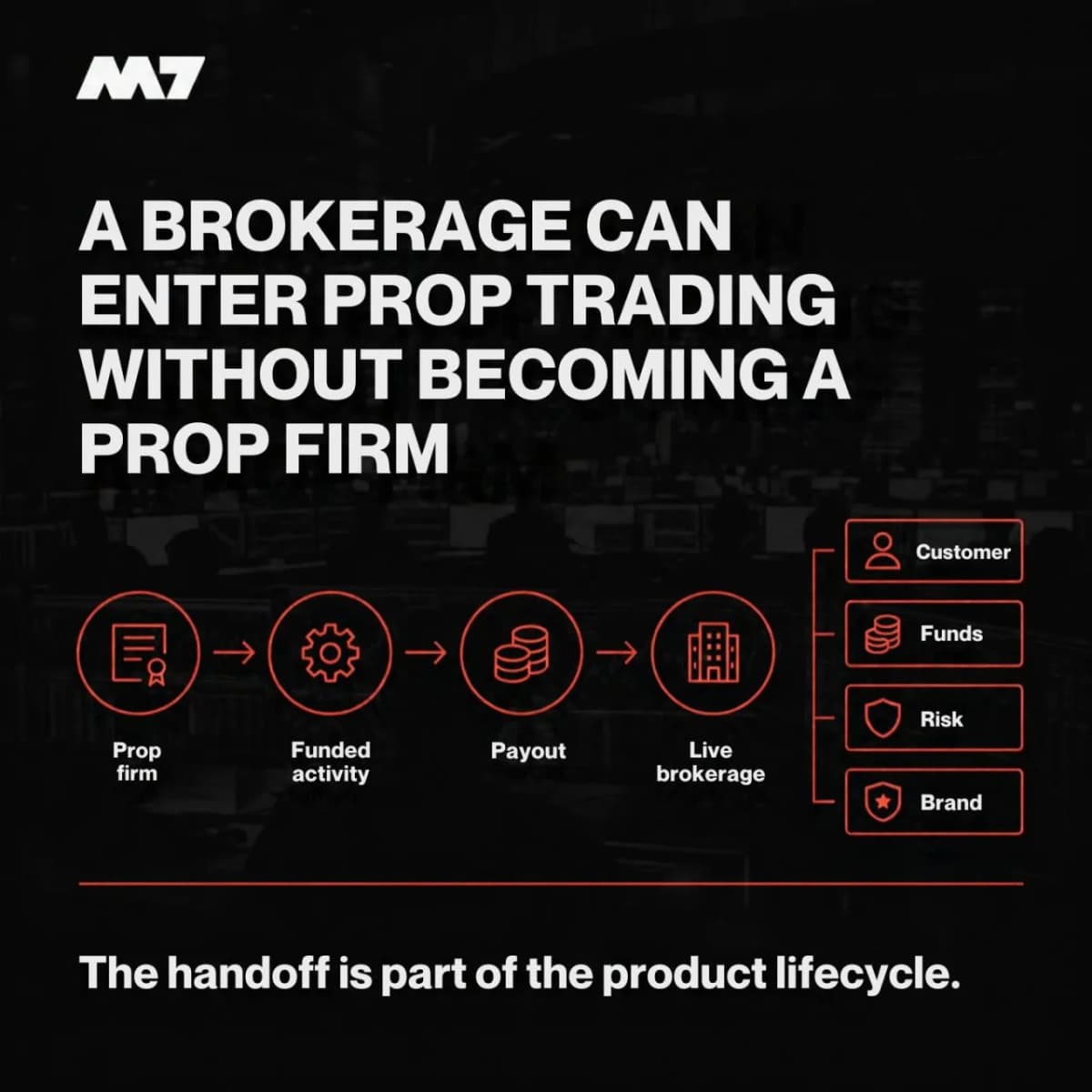

The traditional path has been fairly fragmented. A trader discovers a prop firm, completes an evaluation, trades a funded account, earns a payout and then often starts the process all over again somewhere else if they want to trade their own capital.
There may be a bigger opportunity sitting between prop firms and brokerages.
The natural progression is fairly simple:
Evaluation → Funded Trading → Payout → Live Brokerage
Prop firms have become an important entry point for traders who want access to markets without putting significant amounts of personal capital at risk. Brokerages, meanwhile, are built for the next stage of the journey: traders deploying their own capital.
That creates an interesting question. Why should those experiences remain completely separate?
A brokerage doesn't necessarily need to build a prop firm from scratch. A prop firm doesn't necessarily need to become a full scale brokerage. There is potentially a middle ground where the two businesses connect their ecosystems and give traders a clearer path from one stage to the next.
There are already signs of this happening. Tradeify launched Slay Markets in 2026 around its existing trader community and partnered with NinjaTrader for clearing and technology. Tradeify also promotes the ability for traders to move payouts into Slay Markets and transition toward trading their own capital.
That example points to something bigger than a new brokerage launch.
It suggests that the prop firm could become an acquisition and development channel for the brokerage, while the brokerage becomes the natural next step for traders who have progressed beyond funded trading.
The interesting part is what happens between those stages.
Who owns the relationship? How does a payout become live account funding? What happens to the trader's identity, history and experience during the transition? Which risk rules belong to the funded program and which belong to the brokerage? And how can two separate businesses make the experience feel like one continuous journey?
Those questions become even more important in U.S. futures, where introducing brokers and FCMs have different regulatory roles. A seamless customer experience still has to preserve those boundaries.
The opportunity isn't necessarily for brokerages to become prop firms or for prop firms to become brokerages. It may be to connect two businesses that already serve different points in the same trader lifecycle.
Because if a trader goes from evaluation, to funded account, to payout, and eventually to trading their own capital, the biggest opportunity may not be owning every step. It may be owning the transition between them.