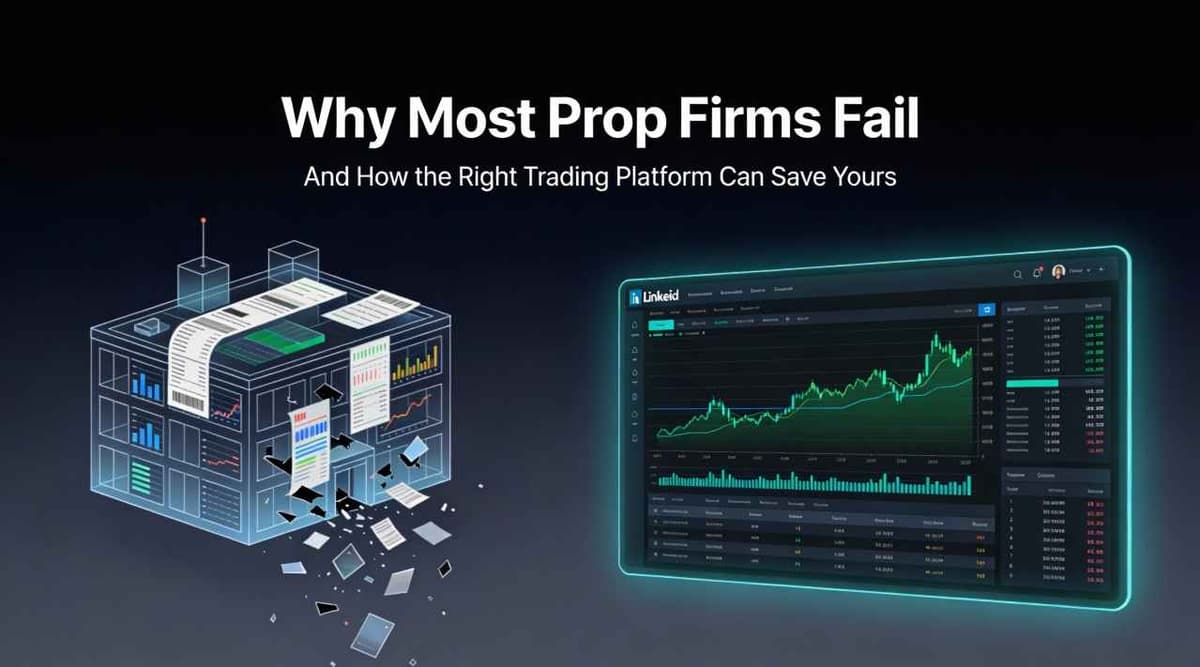
Many prop firms do not collapse because of a lack of trader interest, but because their entire structure, business model, risk framework, and technology stack, is too fragile for a more regulated and demanding 2026 environment. When markets turn, regulators tighten their grip, or a platform vendor changes course, weaknesses that were invisible in the boom years suddenly become fatal.
1. A business model built on sand
A large portion of retail oriented prop firms still rely overwhelmingly on evaluation and reset fees, not on the long term performance of funded traders. That creates a hidden problem: the firm thrives only while marketing is strong and new traders keep paying for challenges, making the company more akin to a gamified subscription product than a genuine capital allocation business.
This model also pushes some firms to design challenges that are statistically almost unwinnable, tight daily drawdowns, asymmetric rules around news, and instant breaches on tiny deviations, just to protect fee revenue. Over time, traders notice the pattern, word spreads in communities and on social media, and the firm’s reputation erodes faster than it can replace disappointed clients with new ones.
2. Weak governance, rules and risk management
Beyond revenue structure, many failed prop firms share the same internal flaws: ad‑hoc rules, poor documentation, and a lack of serious risk management. Terms and conditions are updated on the fly, risk limits are enforced inconsistently, and funded accounts are sometimes monitored manually in spreadsheets rather than through robust systems.
This becomes especially dangerous when traders finally succeed. A cluster of high performing traders, possibly using similar strategies or signals, can produce correlated large wins at the same time. If the firm hedges poorly, or mirrors positions inefficiently with liquidity providers, a payout wave can turn into a liquidity crisis. The result is familiar: delayed withdrawals, sudden rule changes, accusations of “scam” and, in many cases, closure or rebranding under a new name.
3. Technology debt and platform dependence
On the tech side, many prop firms effectively try to run a serious funding operation on infrastructure that was originally designed for simple retail demo trading. Servers are overloaded, risk dashboards are rudimentary, and the “simulation” environment bears little resemblance to an institutional market, slippage is ignored, depth is unrealistic, and news events are handled with crude blanket restrictions.
On top of that, single vendor dependence is a structural risk. When a dominant platform provider changes its policies, licensing, or stance on prop firms, entire business lines can be disrupted overnight. The industry has already seen cases where firms had to suspend operations, migrate in a rush, or radically change their model because their only platform stopped supporting their use case. This is not just a technical inconvenience; it is an existential threat if there is no alternative stack ready.
4. Erosion of trader trust
Prop firms live and die on trust. Traders are not just customers; they are the talent the firm is supposed to fund, support, and showcase. Yet many failed brands treated them as short term fee payers, with opaque metrics, limited communication, and slow or combative customer support when issues arose.
After a series of high profile collapses and payout disputes across the industry, traders have become far more skeptical and better informed. They now benchmark firms on execution quality, payout track record, credibility of the tech stack, and whether rulebooks feel fair and stable, not just on eye catching “$200k in funding” banners. A firm that cannot convincingly answer these questions sees its funnel dry up over time, even if the marketing remains aggressive.
5. Why the right trading platform is critical
Against this backdrop, the choice of trading platform is not cosmetic; it is a core strategic decision. A robust, modern platform like cTrader addresses several of the failure points above simultaneously and supports a shift from fee centric “game” to sustainable trading business.
cTrader offers transparent and professional grade execution, with clear depth of market, Level II pricing, and realistic order handling that make both evaluation phases and funded accounts feel closer to live institutional conditions. This reduces disputes over fills, makes rule enforcement more objective, and provides better data for the firm’s own risk models.
The platform’s APIs and modular architecture also help firms reduce vendor lock in and build a more resilient stack. Risk dashboards, monitoring tools, custom challenge logic, and integrations with CRM, payment systems, and back office reporting can all be built around cTrader’s ecosystem, instead of relying on fragile plugins on top of a closed environment. This makes it far easier to adapt to regulatory changes, new products, or different liquidity arrangements without breaking the core experience for traders.
6. How cTrader helps prop firms endure
For prop firms that want to avoid the common path to failure, adopting a platform like cTrader supports three key goals:
- Professional perception and trader acquisition: Offering a respected, broker grade platform signals that the firm is serious about trading, not just selling challenges. This attracts more experienced traders, who tend to generate better P&L and healthier long term relationships.
- Operational robustness and compliance readiness: Detailed logs, consistent execution, and high quality data from cTrader make it easier to document policies, respond to disputes, and demonstrate seriousness to potential regulators or partners. That is crucial as authorities look more closely at how simulated environments and prop funding models actually work.
- Ecosystem leverage and visibility: Being part of the cTrader environment, including initiatives such as listings and exposure within that ecosystem, gives prop firms extra visibility and an additional layer of credibility beyond their own marketing. In a crowded market, this can be the difference between being seen as “another challenge firm” and being recognized as a robust, tech driven funding house.
Prop firms fail when they rely on marketing instead of structure, and shortcuts instead of systems. They endure when they combine a sustainable revenue model, disciplined risk management, and a solid technological backbone, built on platforms like cTrader that support realistic trading, transparent execution, and scalable operations.