
Search Companies, News, Members & more
Terms of ServicePrivacy PolicySecurity PolicyLegal InformationCommunity GuidelinesSitemapsCookie Settings
2026 Copyright © Liquidity Finder Ltd. All rights reserved.
Liquidity Finder Ltd is incorporated in England and Wales, company number 10610740, registered address 167-169 Great Portland Street, Fifth Floor, London W1W 5PF, United Kingdom.
Neobanks Have Grown Up: From Digital Banking to Financial Platforms

Published on Sep 8, 2026
Updated on Sep 8, 2026
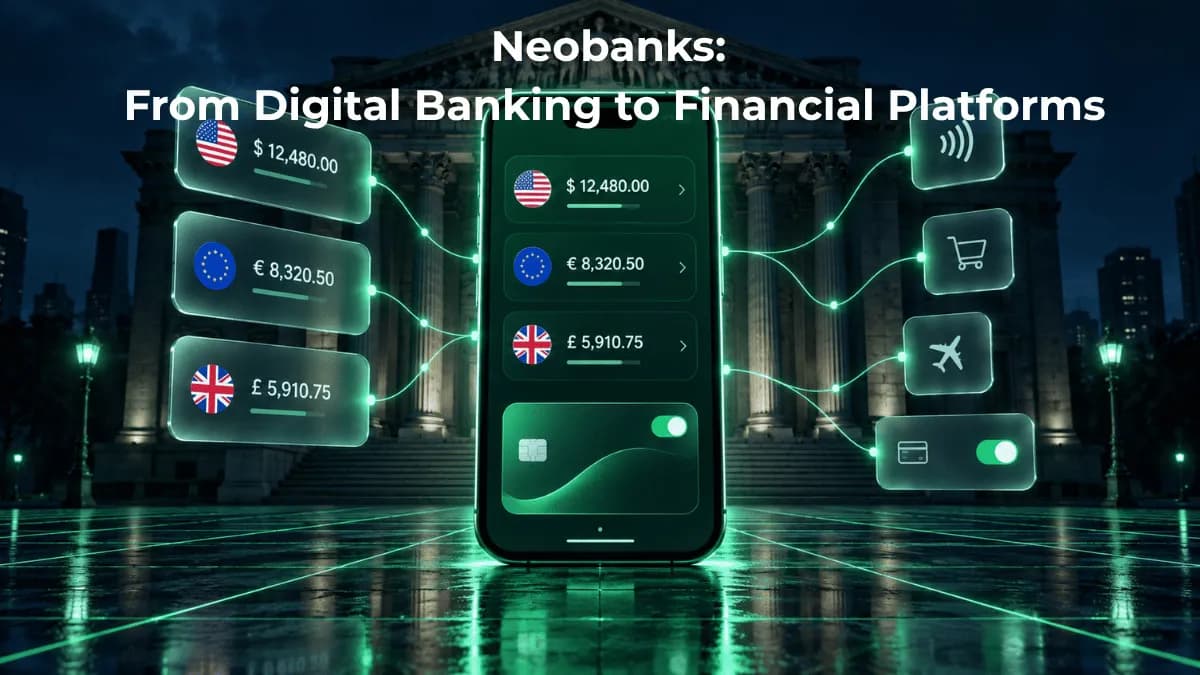
I love Revolut. My wife and I travel a lot, and we are convinced that Revolut offers us a better user experience and product than we can get from a combo of the offerings of our traditional banks and credit card firms. Judging from interactions with folks in my network, many of our friends seem to think the same.
So, this is a good time to be a bit more analytical and layout what neobanks are doing to gain traction, as well as to understand more about the successes and failure.
What Is A Neobank?
A useful place to start is with a definition:
A neobank is a digital-first financial institution that delivers banking services primarily through software rather than branches. Some hold their own banking licence, while others operate through licensed banking partners using Banking-as-a-Service infrastructure.
That said, not every neobank is actually a bank. There are really three models.
That said, not every neobank is actually a bank. There are really three models:
| Model | Example |
| Licensed digital bank | Monzo, Starling, Varo |
| Fintech using partner bank | Chime, Current |
| Financial platform with banking services | Revolut (historically), Wise, Mercury |
Underneath the hood there is a bank with some form of banking license. The service offering typically covers payments, debit cards, maybe credit cards.
Revolut is a good illustration of how quickly a firm can move between those boxes. It applied for a UK banking licence in 2021, received authorisation with restrictions in July 2024, and in March 2026 the Prudential Regulation Authority lifted those restrictions, allowing Revolut Bank UK Ltd to launch as a fully licensed bank with FSCS-protected deposits for its 13 million UK customers.
Why Mobile First Changed The Product
For me, two ingredients stand out. First, the mobile first bias. Millennials and Gen Z seem to have a bias for having their lives revolve around their phones. Rather than just trying to digitise their existing processes, successful neobanks seem to have been able to re-think banking, starting from the question: what should a good user experience for somebody on a mobile look like?
My own experience might help illustrate the challenges the legacy providers have. I live in Switzerland, yet I am often in the UK, Italy and Germany, as well as spending longer periods in South Africa.
A few years back I was in the UK pretty much every week. I spent a lot of pounds. I had an Amex card from Cornercard in Switzerland. Good deal for the BA air miles, horrid deal on the FX rate on all those GBP charges. At some point I ended up in a meeting with the CEO of Cornercard. I asked if under the same Amex I could have a second card, in GBP, and the same deal for air miles. The answer was an emphatic “No, CHF billing only”.
If I want to open an account in another currency with my bank. UBS, there are forms to be filled in, in wet ink and physically mailed back and forth.
Then along came Revolut. I have an account and a base currency, Swiss Francs. I can add accounts in other currencies from my phone. I have a physical card; I can order another one if I want it and I can have virtual cards. Last week, I was in Milan, spending Euros. I was able to swap CHF for EUR on my phone, on the fly, at better rates than either UBS would offer me or the credit card folks at Cornerbank would charge me. As long as I had a Euro account with enough Euros in it, Revolut used my available Euro balance. No expensive FX charges. Everything immediately visible in the app.
The Small Features That Legacy Providers Still Can't Match
My favourite difference between things new and old is a security feature. In South Africa, I need to be careful on matters security. I have a local phone with only virtual cards in the wallet. My Revolut card allows me to set a spending limit dynamically. If my phone is stolen, and the thieves manage to open it, my downside is limited. I also have a virtual Cornercard. Nothing dynamic there at all. You can only set a limit when you create the virtual card. I have asked for “the same as Revolut has” a number of times. So far, deaf ears.
The UK Neobank Market: Scale Versus The Incumbents
The UK remains arguably the world's most successful neobank ecosystem. It has created an entire ecosystem of successful firms which have achieved scale, profitability or international expansion: Monzo, Starling Bank, Revolut, Atom Bank, OakNorth, Monese, Wise
| Institution | Approximate retail customers |
| Barclays UK | 20+ million |
| Revolut (global) | 75+ million |
| Monzo | 15+ million |
| Starling | 6+ million accounts |
| Lloyds Banking Group (UK retail brands combined) | ~30 million+ |
| NatWest Group | ~19 million retail customers |
Although Monzo and Revolut have grown extraordinarily quickly, they are still smaller than the UK's largest incumbent banks in terms of domestic retail customer numbers. However, Monzo has reached meaningful scale at around 75% of Barclays UK's customer base in just over a decade, which is remarkable considering Barclays has been serving UK customers for more than 330 years.
The UK’s broad-based success has a few ingredients: a regulatory environment, talent pool and competitive market that allowed multiple firms to achieve scale, profitability and international influence.
Latin America: Nubank And The Banco Inter Exception
South America is another success story and perhaps the most interesting market:
Nubank in Brazil, Banco Inter, C6 Bank, Ualá in Argentina, Mercado Pago, PicPay
Nubank is arguably the world's greatest neobank success story. Across just three markets, Brazil, Mexico and Colombia, it serves well over 100 million customers, comfortably more than Revolut's global base. Its focus has been to deliver a country-specific banking experience, compared with Revolut's single global platform approach.
What is interesting in the neobank space generally is that legacy institutions have not proven able to really compete. Brazil’s Banco Inter is the exception to that rule. Formerly Banco Intermedium, it was a specialist mortgage and payroll lender. Around 2015 it transformed into a fully digital bank and today is widely regarded as one of Latin America's leading digital banks. This is similar to how DBS transformed itself in Singapore, using an existing banking licence and balance sheet while completely reinventing the customer experience.
The UK’s NatWest tried the same play, with Bo, but closed the venture in its infancy.
The Marketplace Model And Diversified Revenue
Another ingredient in the successful rapid scaling has been the marketplace model. Legacy institutions typically make every product themselves. A neobank might provide the current account itself but offer a marketplace for insurance, pensions even investing. The customer experiences a single app, even though many different providers are delivering the underlying services.
Revolut have borrowed a play from the Goldman Sachs playbook; they are long-term greedy. They are focussing on owning the client relationship through their app.
This helps drive a diversified stream of revenues: subscriptions, FX, investing, interchange, business banking, merchant services, wealth products and premium services.
Why Legacy Banks Struggle: The Old Iron Problem
My take is that there are two major obstacles which cause friction between the old and the new. One is the ability to envisage what good needs to look like. The other is the willingness and ability to develop on a new platform. IMHO, fiddling with the old iron is not going to do the trick.
In wholesale banking, I see that there is a similarity when I look at the success of JP Morgan’s Kinexys platform for 7/24/365 digital payments. Ten years back, JP like all its peers, had an “old iron” processing system for DDA, demand deposit, accounts. It could do USD things at scale. Non-USD was like brain surgery. I am not exaggerating; I was in the room at a major planning meeting around FX Payments. What has been food & drink for Swiss banks for decades, to make a payment not in the currency of the account, was a mountain to climb for the JP folks. A couple of years later, when they saw crypto coming, they made a conscious decision to build an entirely new set of rails, or a parallel universe if you will, and not to try to make the old dog of an old iron system do new tricks.
At NatWest, the grand vision for Bo, as I understood it from talking to insiders, was that it would be the new platform and one day, the bank could shut-down its legacy systems. Sound idea, which needed patience from the executive suite which turned out to be short supply.
With all things bleeding edge in financial services, there are a number of risks when I write: There is every risk that I haven’t understood properly, or just missed a few salient points, or just come to an implausible conclusion. If any of these things are true, please call me out on them.
In any case, please do share a comment or two.
Please feel free to get in contact via LiquidityFinder here.
Frequently Asked Questions
What is a neobank?
A neobank is a digital-first financial institution that delivers banking services primarily through software rather than branches. Some hold their own banking licence, while others operate through licensed banking partners using Banking-as-a-Service infrastructure.
Is a neobank a real bank?
It depends on the model. Licensed digital banks such as Monzo and Starling hold their own banking licence. Fintechs such as Chime and Current operate through a partner bank. Financial platforms such as Wise and Mercury deliver banking services without being the licensed entity themselves.
Which is the largest neobank in the world?
Nubank, which serves well over 100 million customers across Brazil, Mexico and Colombia.
Why have traditional banks struggled to compete with neobanks?
Two obstacles stand out: the ability to envisage what a genuinely good digital product looks like, and the willingness to build on a new platform rather than modify legacy systems. NatWest's Bo is an example of the second obstacle. JP Morgan's Kinexys, built as an entirely new set of rails, is an example of getting it right.
What is the neobank marketplace model?
Rather than manufacturing every product in-house, a neobank provides the current account and offers third-party products such as insurance, pensions and investments through its app. The customer sees a single interface while multiple providers deliver the underlying services.
Share this article

Comments
Most Recent
Find The Right Partners for
Your Trading Business
Sign up and join over 5,000 professional members who receive personalized news alerts, curated professional connections, and more for free!

Anya Aratovskaya's notes from her visit to Sibos Miami, 2026. Artificial intelligence led the agenda but many of the conversations came back to the work banks still need to do on data, controls and the client experience.

Why has onboarding become so difficult for CFD brokers? With candid input from a Head of Operations at a regulated retail broker, I look at what is really happening behind the scenes with PSPs, banks, acquirers and compliance teams — and why the biggest bottleneck may now be processing the evidence rather than finding a provider willing to take the business.

Independent review of the Equals BaaS solution: multi-currency accounts, payments and cards for FX brokers and digital asset firms facing debanking risk.

As tokenisation and digital assets move from niche curiosity to mainstream expectation, banks and financial institutions face an uncomfortable truth: their legacy core banking systems were never built for this. From order execution and pre-funding to custody, portfolio management and gas fees, Olaf Ransome explores the key infrastructure challenges FIs must navigate and asks whether to re-use, buy or build their way to a solution that actually scales.
Create Your FREE Account
Get access to latest news, updates, real-time data, brokerage and trading firm insights and customized information feeds.


OANDA Japan has restricted trading on accounts that may have been affected by unauthorised access after login details stored on GMO's Onamae.com Desktop Cloud VPS leaked. The broker says its core systems were not breached and is directing affected clients to GMO's compensation process while urging password changes and 2FA.

Alpaca has received in-principle approval from ADGM's FSRA for Alpaca Clearing & Custody ME Ltd. Subject to a Financial Services Permission, the entity plans to offer brokerage services and virtual asset custody, bringing Alpaca's API-driven brokerage infrastructure closer to partners in the Middle East region.


US stock futures edged higher in early trading today as investors prepared for a week of major central bank decisions. S&P 500 futures rose 0.2%, Dow futures gained 0.3%, and Nasdaq-100 futures advanced 0.3%, following Friday’s selloff.

Brent crude is trading at $115.57 after retreating from its recent high of $118.23. The moving averages indicate a mixed short term picture.


iSAM Securities Apex is working with LMAX Group to bring perpetual futures pricing to FX and CFD brokers through the Apex platform.

ICM MENA has promoted Ahmed Kamal to Chief Executive Officer. Kamal joined the firm in March 2019 as Business Development Manager and most recently served as Regional Manager. He brings more than a decade of experience in financial markets, with expertise in foreign exchange, business development and team leadership.

Theorem has integrated Symbiotic’s Liquid Lane RFQ network, letting holders of tokenised real-world assets trade against on-chain pool liquidity and market-maker quotes. The integration is live on Ethereum, with Midas’s yield-bearing mHYPER fund as the first supported asset. Holders can trade for the USDC stablecoin.

US equities were volatile with technology selloff erasing much of the earlier rebound.

FM Summit London 2026 returns to Old Billingsgate on 24 November for its 15th edition, with LMAX Group, Plus500 and oneZero among confirmed exhibitors. The one-day event adds Business Connect meetings and roundtables, and opens with a networking evening at The Folly on 23 November.

Finance Magnates Summit London returns to Old Billingsgate on 24 November 2026 for its 15th edition. The one-day event brings together brokers, liquidity providers, institutional firms, trading technology vendors, payments businesses and digital asset firms.
Feed