
just now


Liquidity Finder Ltd is incorporated in England and Wales, company number 10610740, registered address 167-169 Great Portland Street, Fifth Floor, London W1W 5PF, United Kingdom.
Published: just now


The recent weakness in the U.S. dollar, as observed ahead of the Federal Reserve's anticipated rate cut, aligns with historical precedents. This trend often signals the market's expectation of forthcoming monetary easing, a phenomenon that has been consistently documented over time. The Dollar Index (DXY), a key gauge of the dollar's value against a basket of major currencies, typically exhibits a decline prior to the Fed's initial rate cut. However, what is particularly noteworthy is the dollar's tendency to rebound strongly in the aftermath, especially during periods of economic recession. This pattern can be attributed to market behaviour, where the anticipation of looser monetary policy initially exerts downward pressure on the currency, but as liquidity improves and economic conditions stabilize, the dollar strengthens once again.
FED CUTS
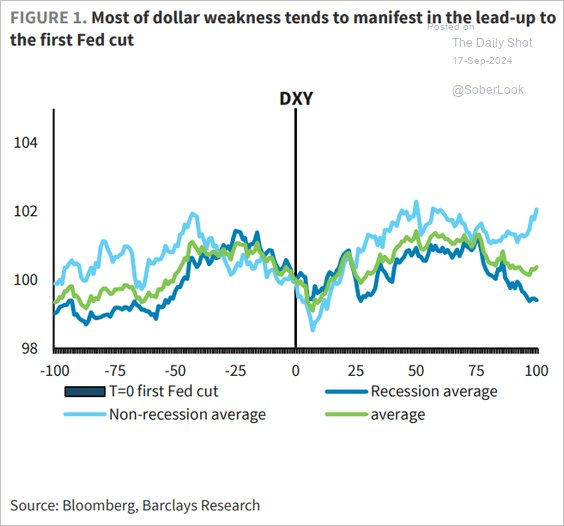
This cyclical movement in the dollar is reflective of broader financial conditions. In the initial phase of monetary easing, markets anticipate lower interest rates, which tend to reduce the appeal of holding dollar-denominated assets due to the prospect of lower returns. However, as the rate cuts take effect and liquidity increases, the economy often finds its footing, particularly during a recession, leading to renewed strength in the dollar as risk appetite improves and economic growth stabilizes.
Looking beyond the dollar’s trajectory, historical data on the performance of the S&P 500 (SPX) following the Federal Reserve's first rate cut offers additional insight into how financial markets react to shifts in monetary policy. A close examination of the S&P 500 returns three, six-, and twelve-months post-cut reveals varied outcomes that are heavily influenced by whether the broader economy is experiencing a recession or not.
During non-recessionary periods, such as the rate cuts observed in 1984, 1987, 1989, and 1995, equity markets generally reacted positively to the easing of monetary policy. For instance, after the 1995 rate cut, the S&P 500 posted impressive gains, advancing 13% over the following six months and 22% over the next year. This robust performance underscores how rate cuts in a stable or growing economic environment tend to bolster investor sentiment, leading to substantial stock market gains
FED Rate Cut Cheat Sheet
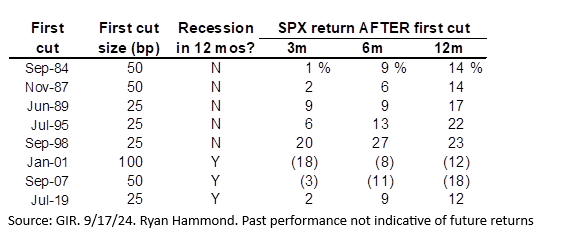
In contrast, during recessionary periods, such as in 2001 and 2007, the market's reaction to rate cuts was far more negative. The 2007 rate cut, which came amid the unfolding financial crisis, saw the S&P 500 fall by 3% after three months, 11% after six months, and 18% by the end of the year. This sharp decline reflected investor scepticism about the effectiveness of monetary easing in the face of deteriorating economic conditions. Despite the Federal Reserve's efforts to stabilize the economy through lower rates, the underlying recessionary pressures outweighed the potential benefits of increased liquidity, resulting in significant losses in the equity markets.
This content may have been written by a third party. ACY makes no representation or warranty and assumes no liability as to the accuracy or completeness of the information provided, nor any loss arising from any investment based on a recommendation, forecast or other information supplies by any third-party. This content is information only, and does not constitute financial, investment or other advice on which you can rely.
Why Is Forex Trading So Difficult?
How To Master MT4 & MT5 - Tips And Tricks For Traders
The Importance Of Fundamental Analysis In Forex Trading
Forex Leverage Explained: Mastering Forex Leverage In Trading & Controlling Margin
The Importance Of Liquidity In Forex: A Beginner's Guide
Close All Metatrader Script: Maximise Your Trading Efficiency And Reduce Stress
Best Currency Pairs To Trade In 2024
Forex Trading Hours: Finding The Best Times To Trade FX
MetaTrader Expert Advisor - The Benefits Of Algorithmic Trading And Forex EAs
ACY Securities is one of Australia's fastest growing multi-asset online trading providers, offering ultra-low-cost trading, rock-solid execution, technologically superior account management and premium market analysis.

Select the categories and companies you wish to follow directly to your person rss feed.
Create Custom RSS FeedSign up and join over 5,000 professional members who receive personalized news alerts, curated professional connections, and more for free!

Clear Street has been admitted as a General Clearing Member of the London Stock Exchange, completing its UK and European equities build. The firm now clears its own equity business directly across execution, prime brokerage and financing, with UK, European and US positions held on a single ledger.
Tickmill has appointed Ranim Turfa as Head of Research & Market Analysis - MENA. A Certified Financial Technician and CISI member, Turfa brings forex and equity markets experience to the role, where she will lead technical commentary and market insights across Tickmill's platforms for its global trading community.
STARPRIME has expanded its gold offering with AM/PM Fixing and XAU24/7, adding new ways for clients to manage gold exposure. The products build on its existing Spot XAUUSD and XAU Futures suite and will debut at MENA Forex Expo 2026 in Dubai, where STARPRIME is a Platinum Sponsor exhibiting at Booth 152.
Barcelona-based trading education provider the International Trading Institute (ITI) has broadened its course offering beyond its flagship Master's in Trading, adding a wider range of professional development routes for traders at different levels of experience.
Mauritius-regulated multi-asset CFD and forex broker Spec Markets has integrated liquidity and technology provider iSAM Securities' Radar risk analytics platform and Apex bridge into its trading operations.
cTrader’s Market Replay lets traders practise against historical market conditions, test manual strategies and review decisions without risking real capital.
Gold-i has integrated Crypto Finance Group, part of Deutsche Börse Group, into its MatrixNET liquidity bridge, giving brokers, proprietary trading firms and fund managers access to regulated institutional digital asset trading and liquidity services across MT4, MT5, DXtrade and CLEO without additional development work.
Specialist liquidity partner Hantec Prime has appointed Veronica Dager as Senior Institutional Sales. Hantec Prime is the institutional division of multi-asset broker Hantec Markets.
Integral's weekly roundup looks at how the trading industry is being reshaped: API-first platforms and MCP servers replacing rigid legacy systems, a new generation of traders demanding mobile-first experiences, crypto exchanges such as MEXC moving into stocks and ETFs, stablecoin settlement going mainstream, and prediction markets and prop trading changing how brokers win clients.
Interactive Brokers has integrated with X Cashtags, letting US investors move from stock and crypto conversations on X into trading on Interactive Brokers. New clients who open and fund a qualifying account via the feature receive $100, as IBKR extends its platform to investors already active in market discussions on X.